


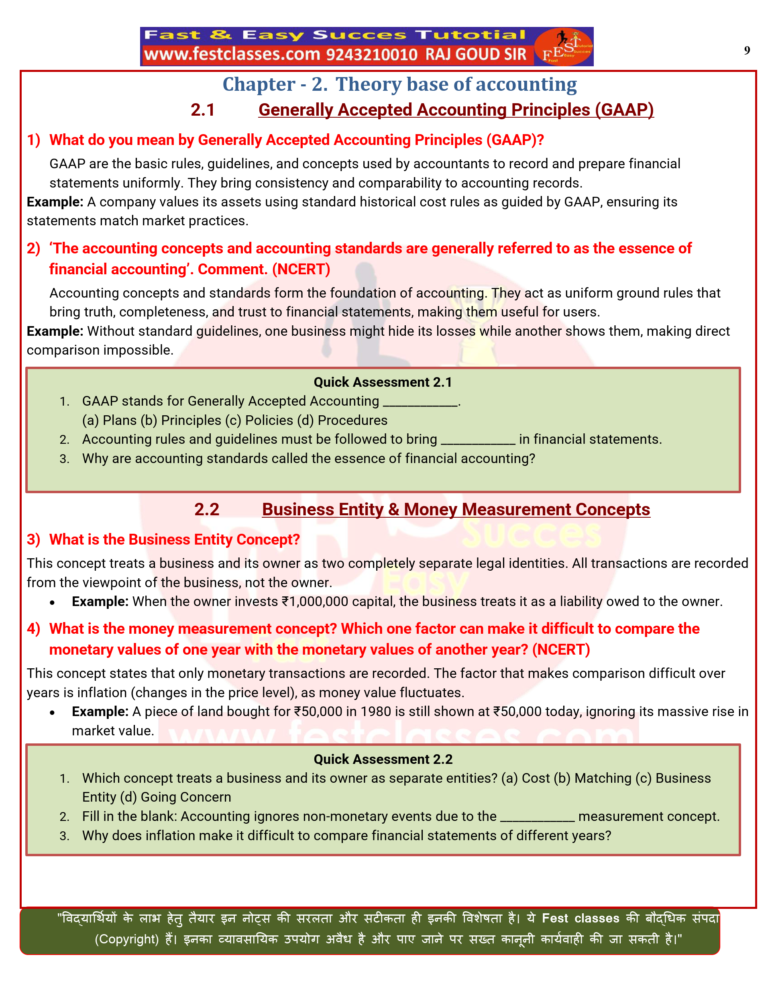
Chapter – 1.
Theory
base of accounting
1.1
Generally Accepted Accounting Principles (GAAP)
1)
What do you mean by Generally Accepted
Accounting Principles (GAAP)?
GAAP
are the basic rules, guidelines, and concepts used by accountants to record and
prepare financial statements uniformly. They bring consistency and
comparability to accounting records.
Example: A company values its assets using standard historical
cost rules as guided by GAAP, ensuring its statements match market practices.
2) ‘The
accounting concepts and accounting standards are generally referred to as the
essence of financial accounting’. Comment. (NCERT)
Accounting
concepts and standards form the foundation of accounting. They act as uniform
ground rules that bring truth, completeness, and trust to financial statements,
making them useful for users.
|
Quick Assessment 2.1
(a) Plans (b) Principles (c) Policies (d) Procedures
|
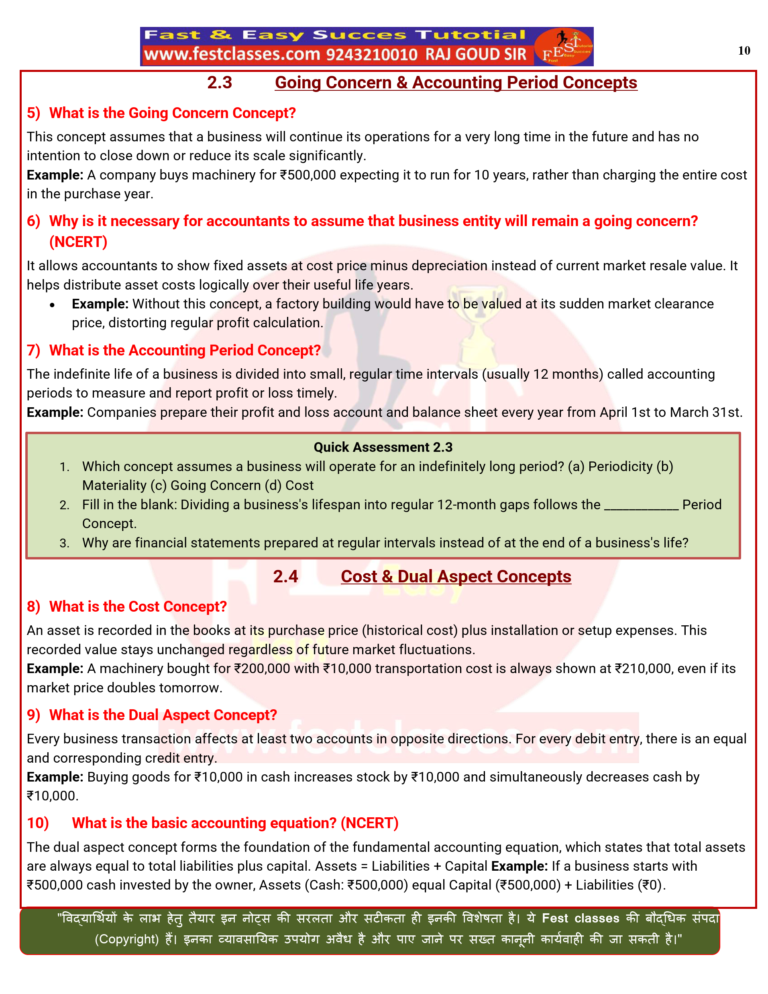
1.2
Business Entity & Money Measurement Concepts
3) What
is the Business Entity Concept?
This concept treats a business and its owner as two
completely separate legal identities. All transactions are recorded from the
viewpoint of the business, not the owner.
- Example: When the owner invests ₹1,000,000 capital, the business treats it
as a liability owed to the owner.
4) What
is the money measurement concept? Which one factor can make it difficult to
compare the monetary values of one year with the monetary values of another
year? (NCERT)
This concept states that only monetary transactions
are recorded. The factor that makes comparison difficult over years is
inflation (changes in the price level), as money value fluctuates.
Quick Assessment 2.2
- Which concept treats a business and its
owner as separate entities? (a) Cost (b) Matching (c) Business
Entity (d) Going Concern
- Fill in the blank: Accounting ignores
non-monetary events due to the ____________ measurement concept.
- Why does inflation make it difficult to
compare financial statements of different years?
- Which concept treats a business and its
owner as separate entities? (a) Cost (b) Matching (c) Business
Entity (d) Going Concern
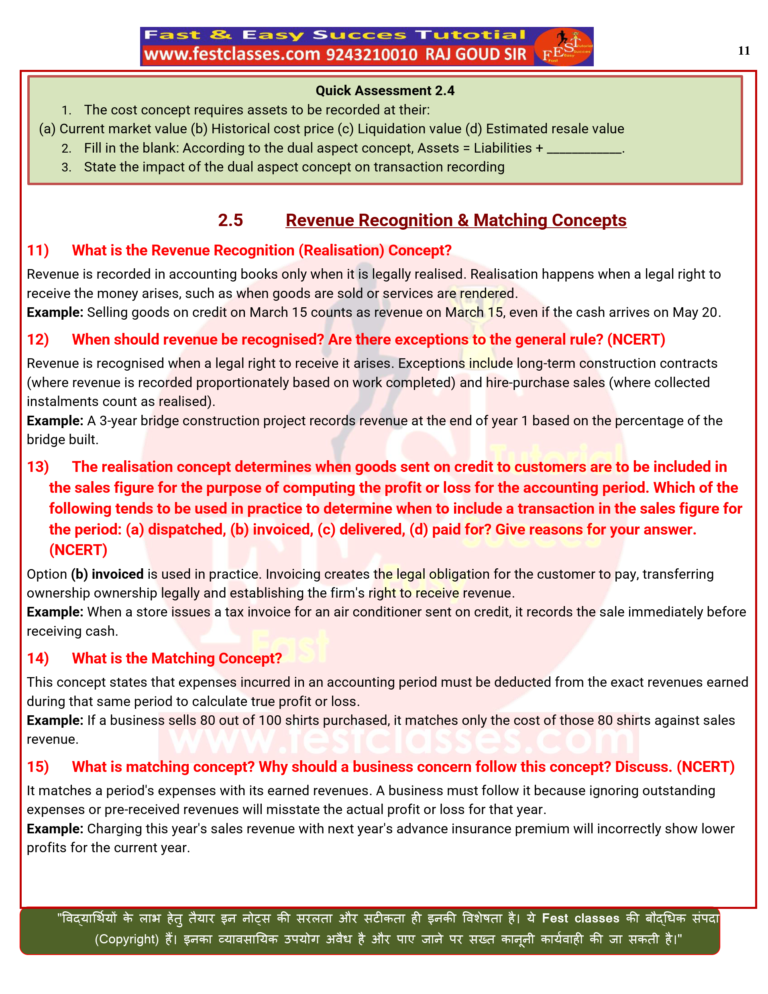
1.3
Going Concern & Accounting Period Concepts
5) What
is the Going Concern Concept?
This concept assumes that a business will continue its
operations for a very long time in the future and has no intention to close
down or reduce its scale significantly.
Example: A company buys machinery for ₹500,000 expecting it to
run for 10 years, rather than charging the entire cost in the purchase year.
6) Why
is it necessary for accountants to assume that business entity will remain a
going concern? (NCERT)
It allows accountants to show fixed assets at cost
price minus depreciation instead of current market resale value. It helps
distribute asset costs logically over their useful life years.
- Example: Without this concept, a factory building would have to be valued
at its sudden market clearance price, distorting regular profit
calculation.
7) What
is the Accounting Period Concept?
The indefinite life of a business is divided into
small, regular time intervals (usually 12 months) called accounting periods to
measure and report profit or loss timely.
|
Quick Assessment 2.3
4. |
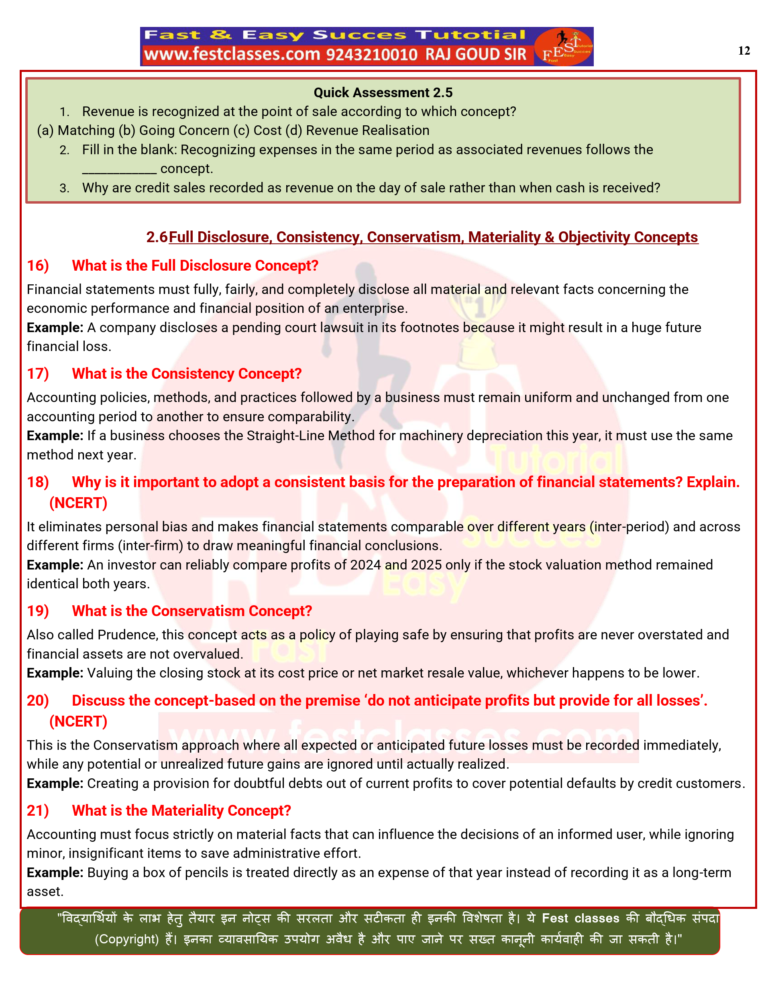
1.4
Cost & Dual Aspect Concepts
8) What
is the Cost Concept?
An asset is recorded in the books at its purchase
price (historical cost) plus installation or setup expenses. This recorded
value stays unchanged regardless of future market fluctuations.
Example: A machinery bought for ₹200,000 with ₹10,000
transportation cost is always shown at ₹210,000, even if its market price
doubles tomorrow.
9) What
is the Dual Aspect Concept?
Every business transaction affects at least two
accounts in opposite directions. For every debit entry, there is an equal and
corresponding credit entry.
Example: Buying goods for ₹10,000 in cash increases stock by
₹10,000 and simultaneously decreases cash by ₹10,000.
10)
What is the basic accounting equation? (NCERT)
The dual aspect concept forms the foundation of the
fundamental accounting equation, which states that total assets are always
equal to total liabilities plus capital. Assets = Liabilities + Capital Example:
If a business starts with ₹500,000 cash invested by the owner, Assets (Cash:
₹500,000) equal Capital (₹500,000) + Liabilities (₹0).
|
Quick Assessment 2.4
(a) Current market value (b) Historical cost price
(c) Liquidation value (d) Estimated resale value
|
1.5
Revenue Recognition & Matching Concepts
11)
What is the Revenue Recognition (Realisation)
Concept?
Revenue is recorded in accounting books only when it
is legally realised. Realisation happens when a legal right to receive the
money arises, such as when goods are sold or services are rendered.
Example: Selling goods on credit on March 15 counts as revenue
on March 15, even if the cash arrives on May 20.
12)
When should revenue be recognised? Are there
exceptions to the general rule? (NCERT)
Revenue is recognised when a legal right to receive it
arises. Exceptions include long-term construction contracts (where revenue is
recorded proportionately based on work completed) and hire-purchase sales
(where collected instalments count as realised).
Example: A 3-year bridge construction project records revenue
at the end of year 1 based on the percentage of the bridge built.
13)
The realisation concept determines when goods
sent on credit to customers are to be included in the sales figure for the
purpose of computing the profit or loss for the accounting period. Which of the
following tends to be used in practice to determine when to include a
transaction in the sales figure for the period: (a) dispatched, (b) invoiced, (c) delivered, (d)
paid for? Give reasons for your answer. (NCERT)
Option (b) invoiced is used in practice. Invoicing
creates the legal obligation for the customer to pay, transferring ownership
ownership legally and establishing the firm’s right to receive revenue.
Example: When a store issues a tax invoice for an air
conditioner sent on credit, it records the sale immediately before receiving
cash.
14)
What is the Matching Concept?
This concept states that expenses incurred in an
accounting period must be deducted from the exact revenues earned during that
same period to calculate true profit or loss.
Example: If a business sells 80 out of 100 shirts purchased,
it matches only the cost of those 80 shirts against sales revenue.
15)
What is matching concept? Why should a business
concern follow this concept? Discuss. (NCERT)
It matches a period’s expenses with its earned
revenues. A business must follow it because ignoring outstanding expenses or
pre-received revenues will misstate the actual profit or loss for that year.
Example: Charging this year’s sales revenue with next year’s
advance insurance premium will incorrectly show lower profits for the current
year.
|
Quick Assessment 2.5
(a) Matching (b) Going Concern (c) Cost (d)
Revenue Realisation
4. |
1.6 Full Disclosure, Consistency,
Conservatism, Materiality & Objectivity Concepts
16)
What is the Full Disclosure Concept?
Financial statements must fully, fairly, and
completely disclose all material and relevant facts concerning the economic
performance and financial position of an enterprise.
Example: A company discloses a pending court lawsuit in its
footnotes because it might result in a huge future financial loss.
17)
What is the Consistency Concept?
Accounting policies, methods, and practices followed
by a business must remain uniform and unchanged from one accounting period to
another to ensure comparability.
Example: If a business chooses the Straight-Line Method for
machinery depreciation this year, it must use the same method next year.
18)
Why is it important to adopt a consistent basis
for the preparation of financial statements? Explain. (NCERT)
It eliminates personal bias and makes financial
statements comparable over different years (inter-period) and across different
firms (inter-firm) to draw meaningful financial conclusions.
Example: An investor can reliably compare profits of 2024 and
2025 only if the stock valuation method remained identical both years.
19)
What is the Conservatism Concept?
Also called Prudence, this concept acts as a policy of
playing safe by ensuring that profits are never overstated and financial assets
are not overvalued.
Example: Valuing the closing stock at its cost price or net
market resale value, whichever happens to be lower.
20)
Discuss the concept-based on the premise ‘do not
anticipate profits but provide for all losses’. (NCERT)
This is the Conservatism approach where all expected
or anticipated future losses must be recorded immediately, while any potential
or unrealized future gains are ignored until actually realized.
Example: Creating a provision for doubtful debts out of
current profits to cover potential defaults by credit customers.
21)
What is the Materiality Concept?
Accounting must focus strictly on material facts that
can influence the decisions of an informed user, while ignoring minor,
insignificant items to save administrative effort.
Example: Buying a box of pencils is treated directly as an
expense of that year instead of recording it as a long-term asset.
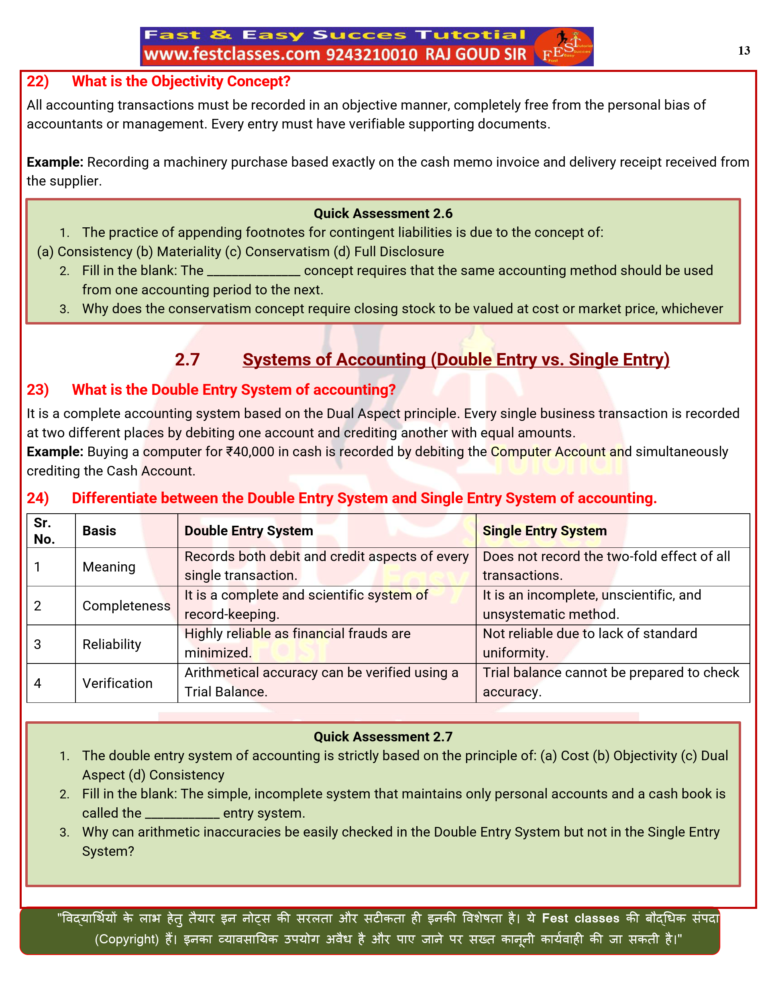
22)
What is the Objectivity Concept?
All accounting transactions must be recorded in an
objective manner, completely free from the personal bias of accountants or
management. Every entry must have verifiable supporting documents.
|
Quick Assessment 2.6
(a) Consistency (b) Materiality (c) Conservatism
(d) Full Disclosure
4. |
1.7
Systems of Accounting (Double Entry vs. Single
Entry)
23)
What is the Double Entry System of accounting?
It is a complete accounting system based on the Dual
Aspect principle. Every single business transaction is recorded at two
different places by debiting one account and crediting another with equal
amounts.
Example: Buying a computer for ₹40,000 in cash is recorded by
debiting the Computer Account and simultaneously crediting the Cash Account.
24)
|
Quick Assessment 2.7
|
|
Sr. No. |
Basis |
Double Entry System |
Single Entry System |
|
1 |
Meaning |
Records both debit and
credit aspects of every single transaction. |
Does not record the
two-fold effect of all transactions. |
|
2 |
Completeness |
It is a complete and
scientific system of record-keeping. |
It is an incomplete,
unscientific, and unsystematic method. |
|
3 |
Reliability |
Highly reliable as
financial frauds are minimized. |
Not reliable due to lack
of standard uniformity. |
|
4 |
Verification |
Arithmetical accuracy can
be verified using a Trial Balance. |
Trial balance cannot be
prepared to check accuracy. |
1.8
Bases of Accounting (Cash Basis vs. Accrual
Basis)
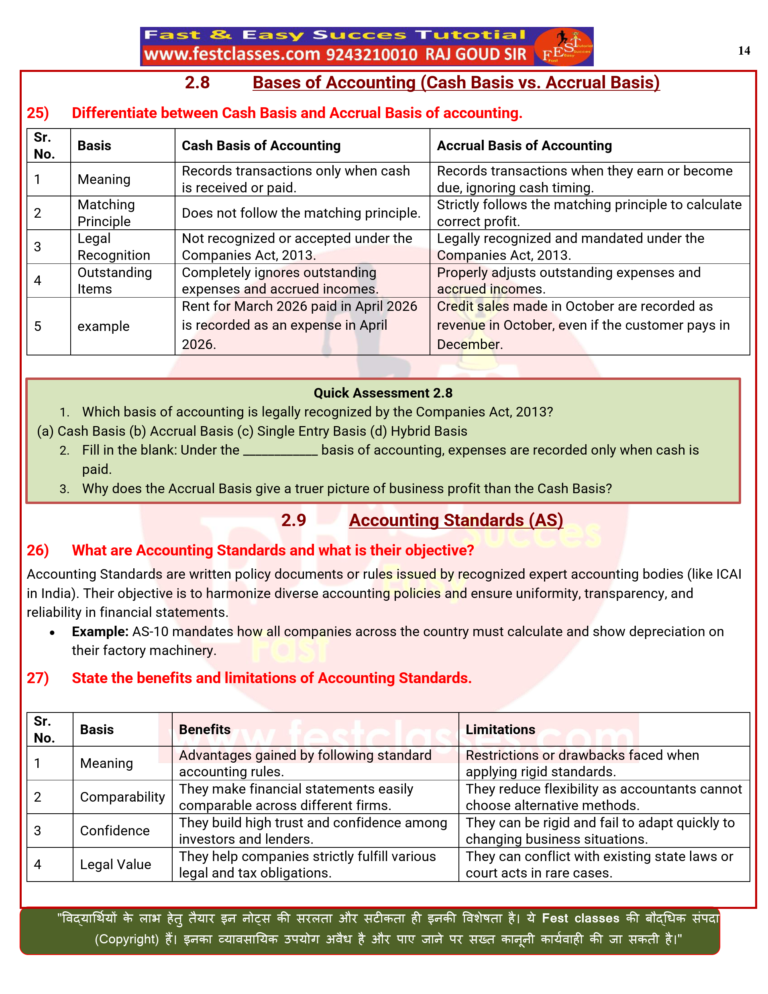
45)
Differentiate between Cash Basis and Accrual
Basis of accounting.
|
Sr. No. |
Basis |
Cash Basis of Accounting |
Accrual Basis of
Accounting |
|
1 |
Meaning |
Records transactions only
when cash is received or paid. |
Records transactions when
they earn or become due, ignoring cash timing. |
|
2 |
Matching Principle |
Does not follow the
matching principle. |
Strictly follows the
matching principle to calculate correct profit. |
|
3 |
Legal Recognition |
Not recognized or accepted
under the Companies Act, 2013. |
Legally recognized and
mandated under the Companies Act, 2013. |
|
4 |
Outstanding Items |
Completely ignores
outstanding expenses and accrued incomes. |
Properly adjusts
outstanding expenses and accrued incomes. |
|
5 |
example |
Rent for March 2026 paid
in April 2026 is recorded as an expense in April 2026. |
Credit sales made in
October are recorded as revenue in October, even if the customer pays in
December. |
|
Quick Assessment 2.8
(a) Cash Basis (b) Accrual Basis (c) Single Entry
Basis (d) Hybrid Basis
4. |
1.9
Accounting Standards (AS)
70)
What are Accounting Standards and what is their
objective?
Accounting Standards are written policy documents or
rules issued by recognized expert accounting bodies (like ICAI in India). Their
objective is to harmonize diverse accounting policies and ensure uniformity,
transparency, and reliability in financial statements.
- Example: AS-10 mandates how all companies across the country must calculate
and show depreciation on their factory machinery.
71)
State the benefits and limitations of Accounting
Standards.
|
Sr. No. |
Basis |
Benefits |
Limitations |
|
1 |
Meaning |
Advantages gained by
following standard accounting rules. |
Restrictions or drawbacks
faced when applying rigid standards. |
|
2 |
Comparability |
They make financial
statements easily comparable across different firms. |
They reduce flexibility as
accountants cannot choose alternative methods. |
|
3 |
Confidence |
They build high trust and
confidence among investors and lenders. |
They can be rigid and fail
to adapt quickly to changing business situations. |
|
4 |
Legal Value |
They help companies
strictly fulfill various legal and tax obligations. |
They can conflict with
existing state laws or court acts in rare cases. |
|
Quick Assessment 2.9
(a) RBI (b) SEBI (c) ICAI (d) Government of India
4. |
1.10
Goods and Services Tax (GST)
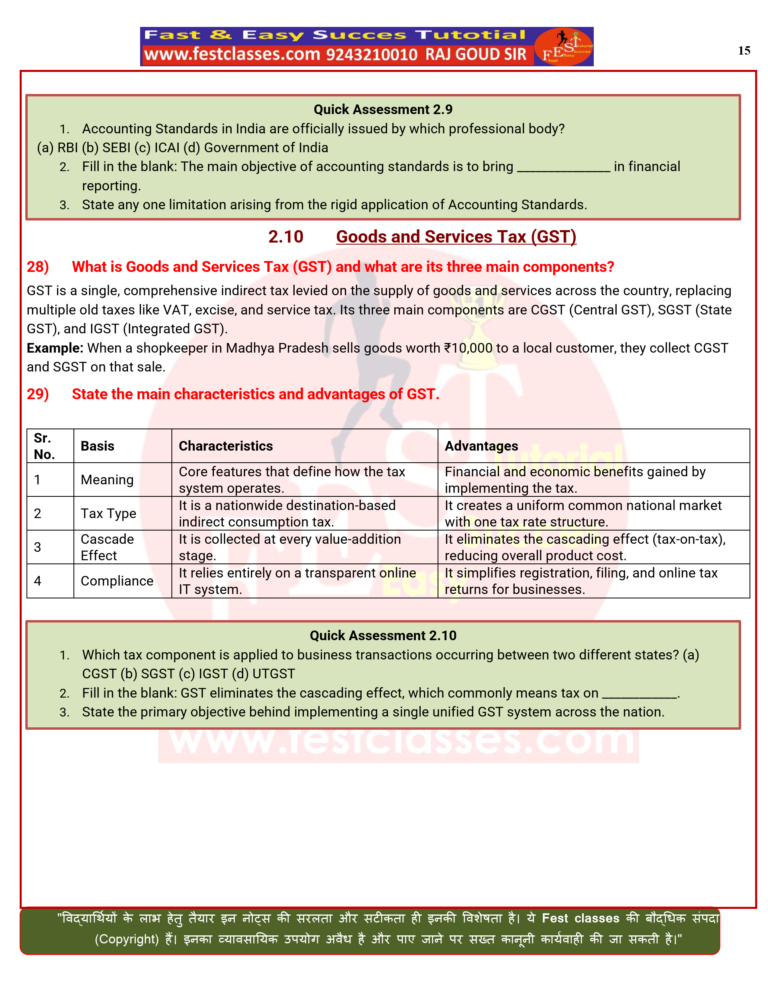
92)
What is Goods and Services Tax (GST) and what
are its three main components?
GST is a single, comprehensive indirect tax levied on
the supply of goods and services across the country, replacing multiple old
taxes like VAT, excise, and service tax. Its three main components are CGST
(Central GST), SGST (State GST), and IGST (Integrated GST).
Example: When a shopkeeper in Madhya Pradesh sells goods worth
₹10,000 to a local customer, they collect CGST and SGST on that sale.
93)
State the main characteristics and advantages of
GST.
|
Sr. No. |
Basis |
Characteristics |
Advantages |
|
1 |
Meaning |
Core features that define
how the tax system operates. |
Financial and economic
benefits gained by implementing the tax. |
|
2 |
Tax Type |
It is a nationwide
destination-based indirect consumption tax. |
It creates a uniform
common national market with one tax rate structure. |
|
3 |
Cascade Effect |
It is collected at every
value-addition stage. |
It eliminates the
cascading effect (tax-on-tax), reducing overall product cost. |
|
4 |
Compliance |
It relies entirely on a
transparent online IT system. |
It simplifies
registration, filing, and online tax returns for businesses. |
|
Quick Assessment 2.10
|