


- Nature and significance of management
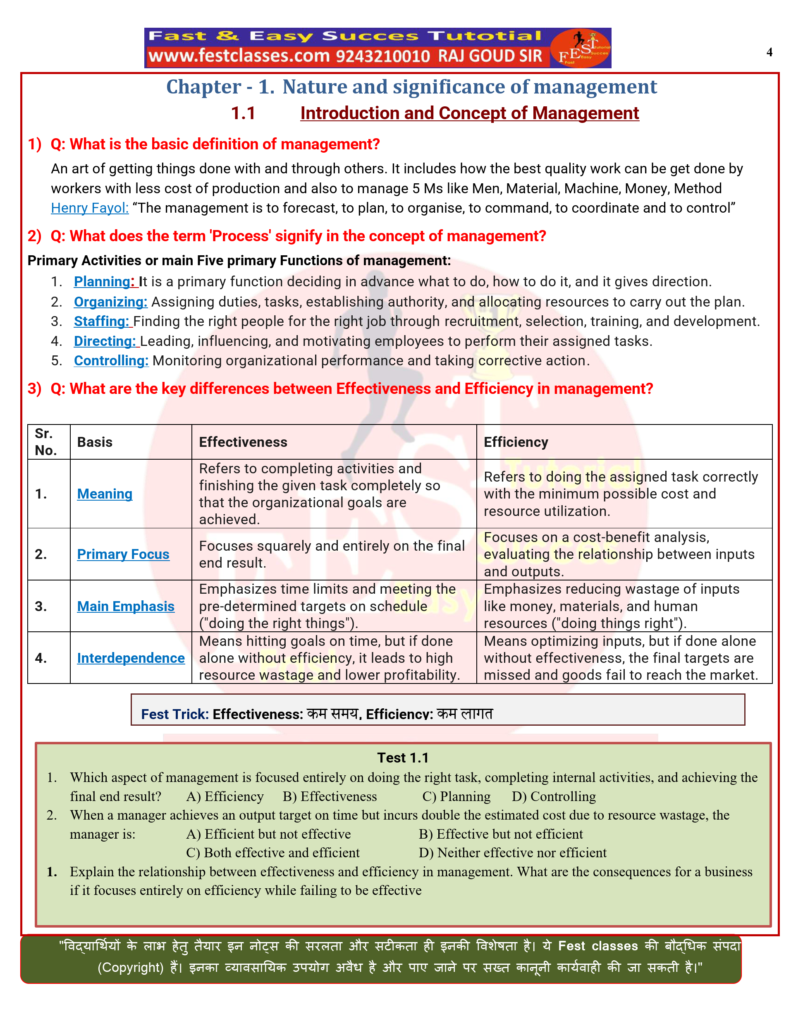
- Q: What is the basic definition of management?
An art of getting things done with and through others. It includes how the best quality work can be get done by workers with less cost of production and also to manage 5 Ms like Men, Material, Machine, Money, Method
Henry Fayol: “The management is to forecast, to plan, to organise, to command, to coordinate and to control”
- Q: What does the term ‘Process’ signify in the concept of management?
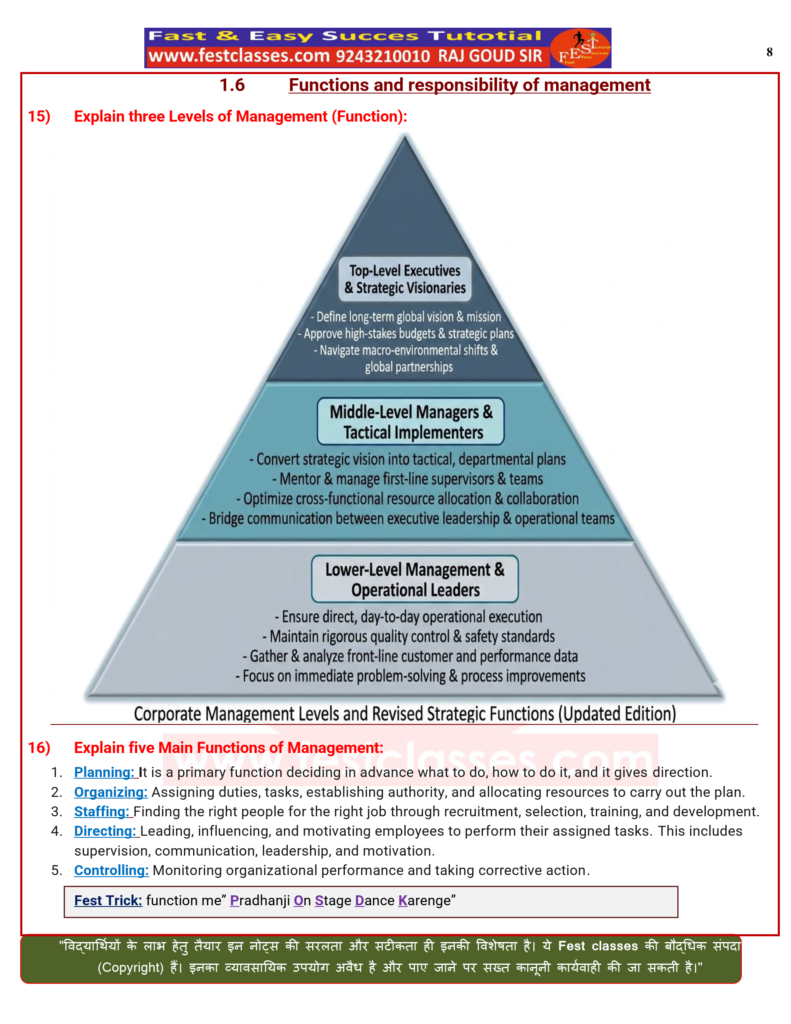
Primary Activities or main Five primary Functions of management:
- Planning: It is a primary function deciding in advance what to do, how to do it, and it gives direction.
- Organizing: Assigning duties, tasks, establishing authority, and allocating resources to carry out the plan.
- Staffing: Finding the right people for the right job through recruitment, selection, training, and development.
- Directing: Leading, influencing, and motivating employees to perform their assigned tasks.
- Controlling: Monitoring organizational performance and taking corrective action.
- Q: What are the key differences between Effectiveness and Efficiency in management?
| Test 1.1Which aspect of management is focused entirely on doing the right task, completing internal activities, and achieving the final end result? A) Efficiency B) Effectiveness C) Planning D) ControllingWhen a manager achieves an output target on time but incurs double the estimated cost due to resource wastage, the manager is: A) Efficient but not effective B) Effective but not efficient C) Both effective and efficient D) Neither effective nor efficientExplain the relationship between effectiveness and efficiency in management. What are the consequences for a business if it focuses entirely on efficiency while failing to be effective |
| Fest Trick: Effectiveness: कम समय, Efficiency: कम लागत |
| Sr. No. | Basis | Effectiveness | Efficiency |
| 1. | Meaning | Refers to completing activities and finishing the given task completely so that the organizational goals are achieved. | Refers to doing the assigned task correctly with the minimum possible cost and resource utilization. |
| 2. | Primary Focus | Focuses squarely and entirely on the final end result. | Focuses on a cost-benefit analysis, evaluating the relationship between inputs and outputs. |
| 3. | Main Emphasis | Emphasizes time limits and meeting the pre-determined targets on schedule (“doing the right things”). | Emphasizes reducing wastage of inputs like money, materials, and human resources (“doing things right”). |
| 4. | Interdependence | Means hitting goals on time, but if done alone without efficiency, it leads to high resource wastage and lower profitability. | Means optimizing inputs, but if done alone without effectiveness, the final targets are missed and goods fail to reach the market. |
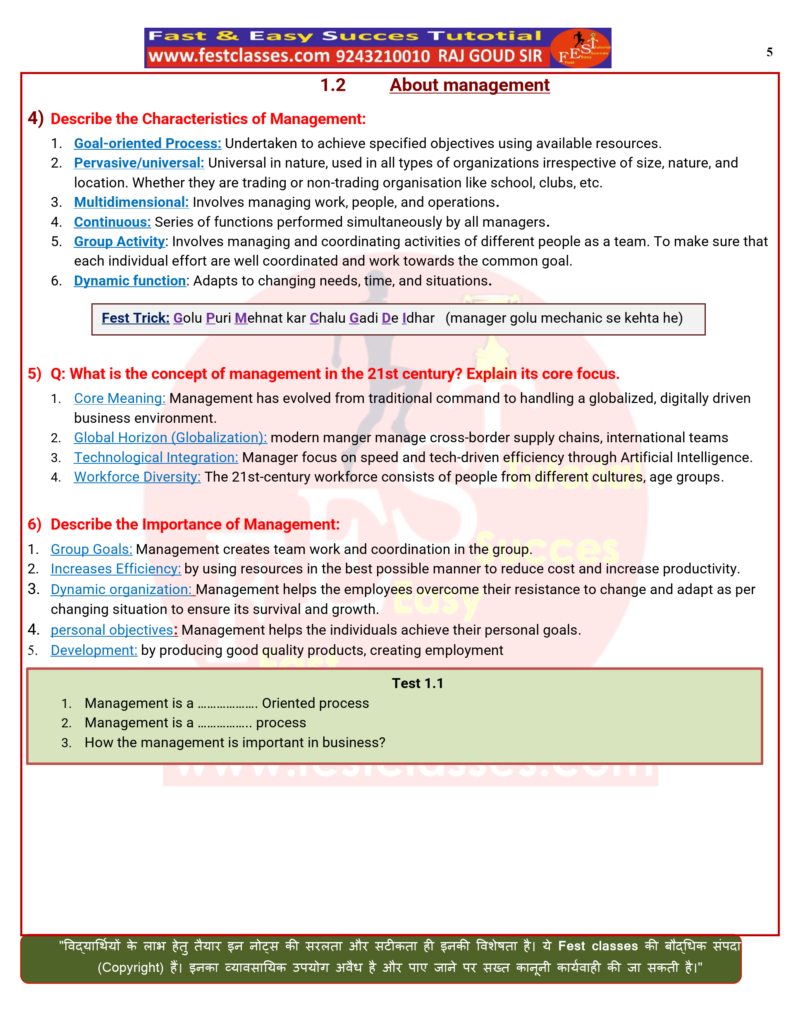
- About management
- Describe the Characteristics of Management:
- Goal-oriented Process: Undertaken to achieve specified objectives using available resources.
- Pervasive/universal: Universal in nature, used in all types of organizations irrespective of size, nature, and location. Whether they are trading or non-trading organisation like school, clubs, etc.
- Multidimensional: Involves managing work, people, and operations.
- Continuous: Series of functions performed simultaneously by all managers.
- Group Activity: Involves managing and coordinating activities of different people as a team. To make sure that each individual effort are well coordinated and work towards the common goal.
- Dynamic function: Adapts to changing needs, time, and situations.
| Fest Trick: Golu Puri Mehnat kar Chalu Gadi De Idhar (manager golu mechanic se kehta he) |
- Q: What is the concept of management in the 21st century? Explain its core focus.
- Core Meaning: Management has evolved from traditional command to handling a globalized, digitally driven business environment.
- Global Horizon (Globalization): modern manger manage cross-border supply chains, international teams
- Technological Integration: Manager focus on speed and tech-driven efficiency through Artificial Intelligence.
- Workforce Diversity: The 21st-century workforce consists of people from different cultures, age groups.
- Describe the Importance of Management:
- Group Goals: Management creates team work and coordination in the group.
- Increases Efficiency: by using resources in the best possible manner to reduce cost and increase productivity.
- Dynamic organization: Management helps the employees overcome their resistance to change and adapt as per changing situation to ensure its survival and growth.
- personal objectives: Management helps the individuals achieve their personal goals.
| Test 1.1Management is a ………………. Oriented processManagement is a …………….. processHow the management is important in business? |
Development: by producing good quality products, creating employment
-
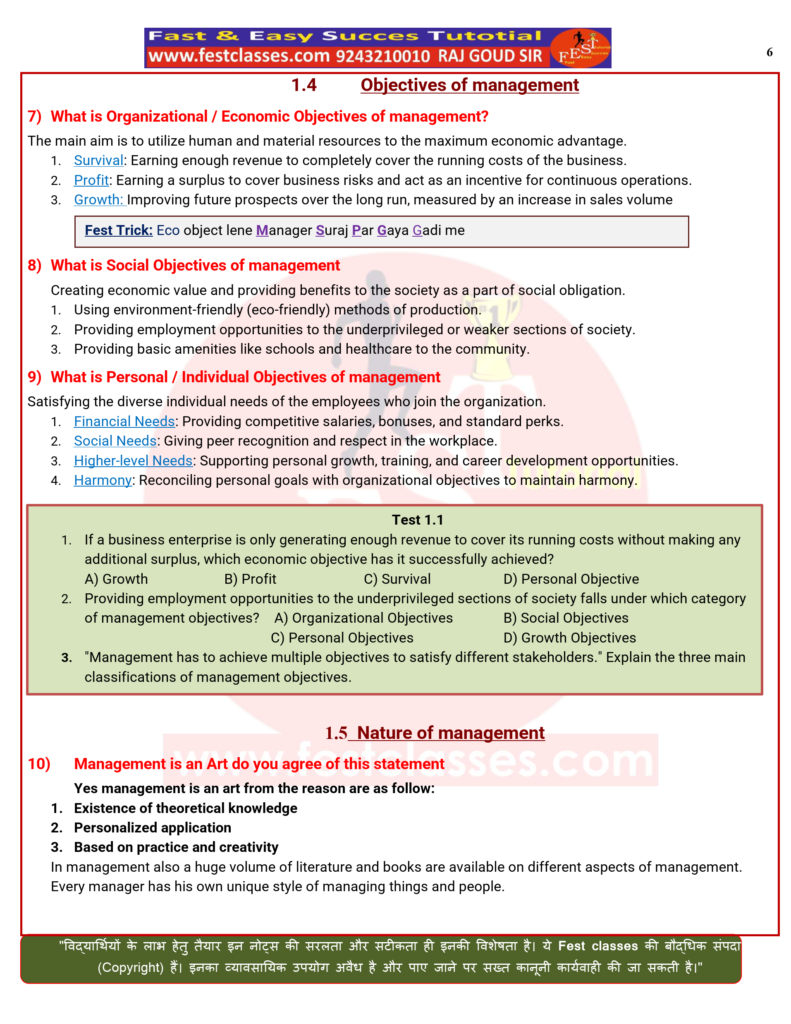
- Objectives of management
- What is Organizational / Economic Objectives of management?
The main aim is to utilize human and material resources to the maximum economic advantage.
- Survival: Earning enough revenue to completely cover the running costs of the business.
- Profit: Earning a surplus to cover business risks and act as an incentive for continuous operations.
| Fest Trick: Eco object lene Manager Suraj Par Gaya Gadi me |
Growth: Improving future prospects over the long run, measured by an increase in sales volume
- What is Social Objectives of management
Creating economic value and providing benefits to the society as a part of social obligation.
- Using environment-friendly (eco-friendly) methods of production.
- Providing employment opportunities to the underprivileged or weaker sections of society.
- Providing basic amenities like schools and healthcare to the community.
- What is Personal / Individual Objectives of management
Satisfying the diverse individual needs of the employees who join the organization.
- Financial Needs: Providing competitive salaries, bonuses, and standard perks.
- Social Needs: Giving peer recognition and respect in the workplace.
- Higher-level Needs: Supporting personal growth, training, and career development opportunities.
| Test 1.1If a business enterprise is only generating enough revenue to cover its running costs without making any additional surplus, which economic objective has it successfully achieved? A) Growth B) Profit C) Survival D) Personal ObjectiveProviding employment opportunities to the underprivileged sections of society falls under which category of management objectives? A) Organizational Objectives B) Social ObjectivesC) Personal Objectives D) Growth Objectives“Management has to achieve multiple objectives to satisfy different stakeholders.” Explain the three main classifications of management objectives. |
Harmony: Reconciling personal goals with organizational objectives to maintain harmony.
- Nature of management
- Management is an Art do you agree of this statement
Yes management is an art from the reason are as follow:
- Existence of theoretical knowledge
- Personalized application
- Based on practice and creativity
In management also a huge volume of literature and books are available on different aspects of management. Every manager has his own unique style of managing things and people.
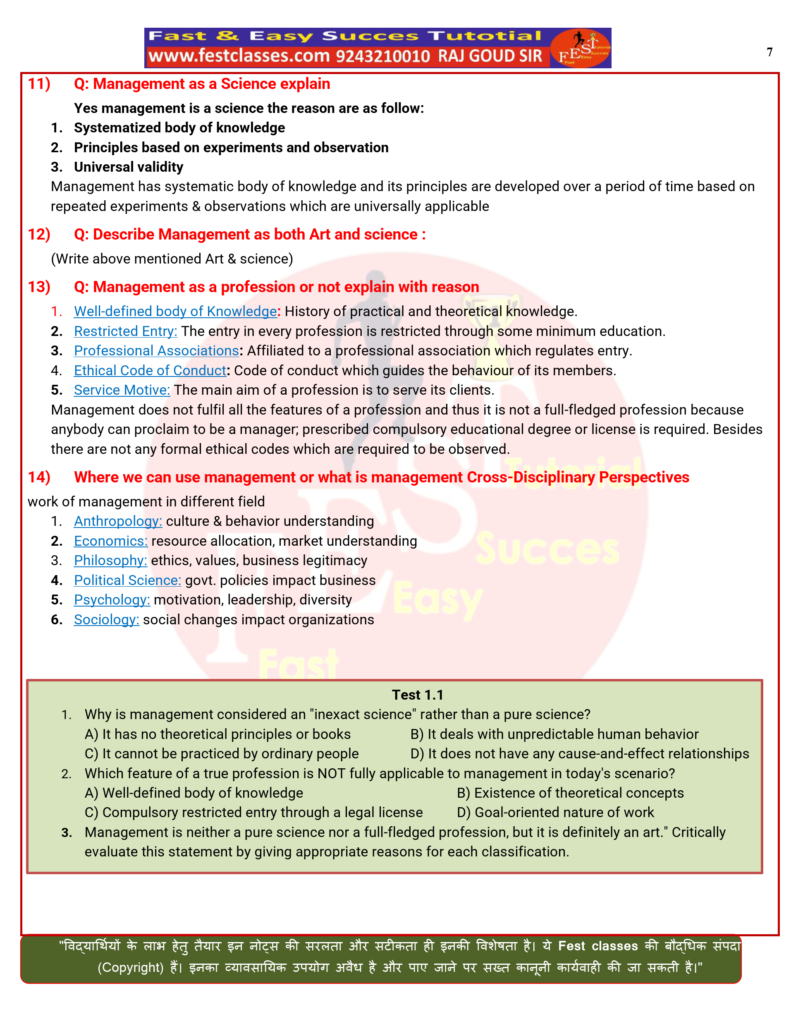
- Q: Management as a Science explain
Yes management is a science the reason are as follow:
- Systematized body of knowledge
- Principles based on experiments and observation
- Universal validity
Management has systematic body of knowledge and its principles are developed over a period of time based on repeated experiments & observations which are universally applicable
- Q: Describe Management as both Art and science :
(Write above mentioned Art & science)
- Q: Management as a profession or not explain with reason
- Well-defined body of Knowledge: History of practical and theoretical knowledge.
- Restricted Entry: The entry in every profession is restricted through some minimum education.
- Professional Associations: Affiliated to a professional association which regulates entry.
- Ethical Code of Conduct: Code of conduct which guides the behaviour of its members.
- Service Motive: The main aim of a profession is to serve its clients.
Management does not fulfil all the features of a profession and thus it is not a full-fledged profession because anybody can proclaim to be a manager; prescribed compulsory educational degree or license is required. Besides there are not any formal ethical codes which are required to be observed.
work of management in different field
- Anthropology: culture & behavior understanding
- Economics: resource allocation, market understanding
- Philosophy: ethics, values, business legitimacy
- Political Science: govt. policies impact business
- Psychology: motivation, leadership, diversity
- Sociology: social changes impact organizations
| Test 1.1Why is management considered an “inexact science” rather than a pure science? A) It has no theoretical principles or books B) It deals with unpredictable human behaviorC) It cannot be practiced by ordinary people D) It does not have any cause-and-effect relationshipsWhich feature of a true profession is NOT fully applicable to management in today’s scenario? A) Well-defined body of knowledge B) Existence of theoretical conceptsC) Compulsory restricted entry through a legal license D) Goal-oriented nature of workManagement is neither a pure science nor a full-fledged profession, but it is definitely an art.” Critically evaluate this statement by giving appropriate reasons for each classification. |
- Explain five Main Functions of Management:
- Planning: It is a primary function deciding in advance what to do, how to do it, and it gives direction.
- Organizing: Assigning duties, tasks, establishing authority, and allocating resources to carry out the plan.
- Staffing: Finding the right people for the right job through recruitment, selection, training, and development.
- Directing: Leading, influencing, and motivating employees to perform their assigned tasks. This includes supervision, communication, leadership, and motivation.
| Fest Trick: function me” Pradhanji On Stage Dance Karenge” |
Controlling: Monitoring organizational performance and taking corrective action.
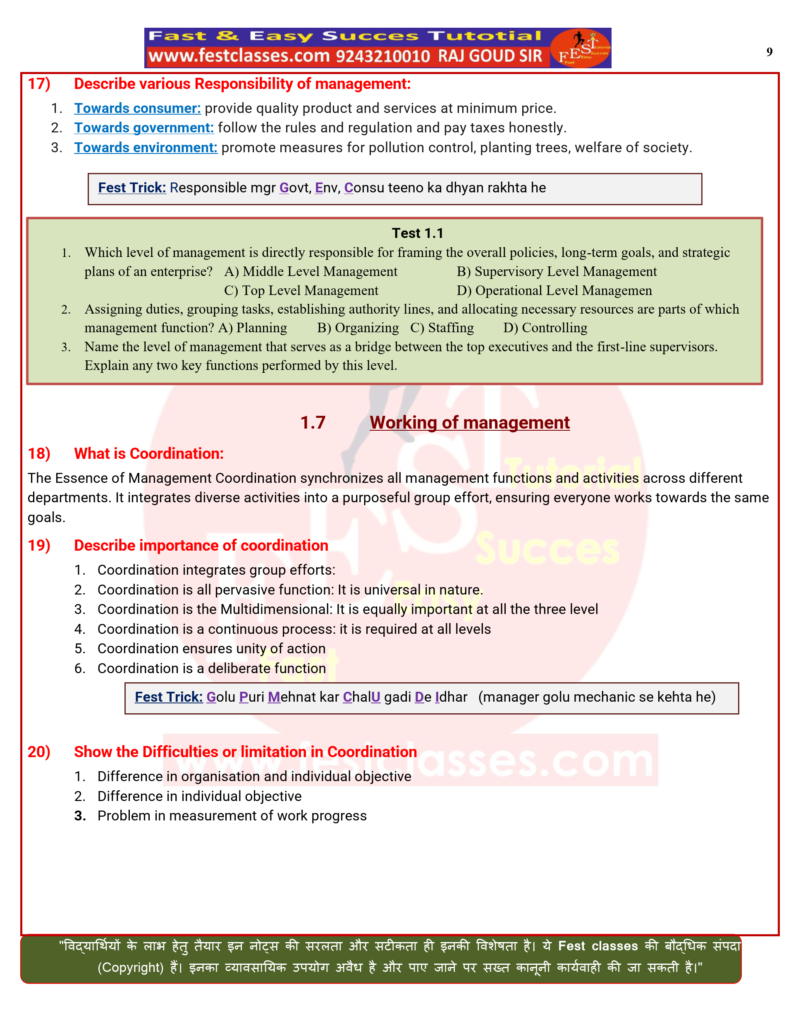
- Describe various Responsibility of management:
- Towards consumer: provide quality product and services at minimum price.
- Towards government: follow the rules and regulation and pay taxes honestly.
| Test 1.1Which level of management is directly responsible for framing the overall policies, long-term goals, and strategic plans of an enterprise? A) Middle Level Management B) Supervisory Level Management C) Top Level Management D) Operational Level ManagemenAssigning duties, grouping tasks, establishing authority lines, and allocating necessary resources are parts of which management function? A) Planning B) Organizing C) Staffing D) ControllingName the level of management that serves as a bridge between the top executives and the first-line supervisors. Explain any two key functions performed by this level. |
| Fest Trick: Responsible mgr Govt, Env, Consu teeno ka dhyan rakhta he |
Towards environment: promote measures for pollution control, planting trees, welfare of society.
The Essence of Management Coordination synchronizes all management functions and activities across different departments. It integrates diverse activities into a purposeful group effort, ensuring everyone works towards the same goals.
- Describe importance of coordination
- Coordination integrates group efforts:
- Coordination is all pervasive function: It is universal in nature.
- Coordination is the Multidimensional: It is equally important at all the three level
- Coordination is a continuous process: it is required at all levels
- Coordination ensures unity of action
| Fest Trick: Golu Puri Mehnat kar ChalU gadi De Idhar (manager golu mechanic se kehta he) |
Coordination is a deliberate function
- Show the Difficulties or limitation in Coordination
- Difference in organisation and individual objective
- Difference in individual objective
- Problem in measurement of work progress
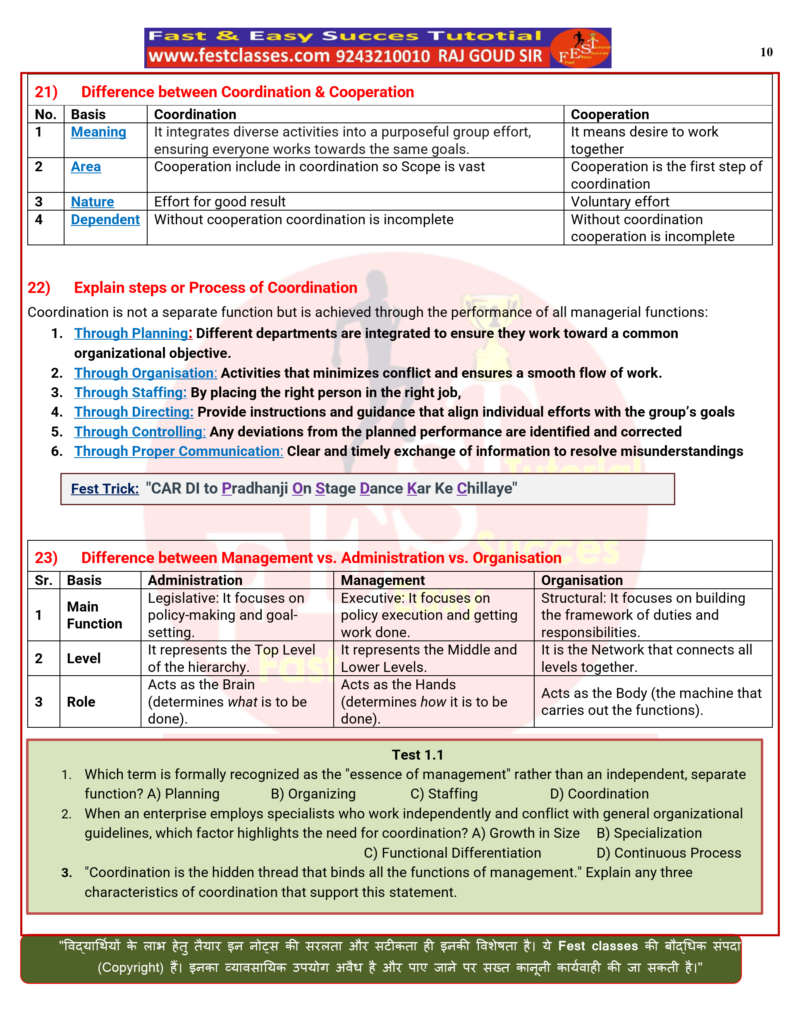
| Difference between Coordination & Cooperation | |||
| No. | Basis | Coordination | Cooperation |
| 1 | Meaning | It integrates diverse activities into a purposeful group effort, ensuring everyone works towards the same goals. | It means desire to work together |
| 2 | Area | Cooperation include in coordination so Scope is vast | Cooperation is the first step of coordination |
| 3 | Nature | Effort for good result | Voluntary effort |
| 4 | Dependent | Without cooperation coordination is incomplete | Without coordination cooperation is incomplete |
Coordination is not a separate function but is achieved through the performance of all managerial functions:
- Through Planning: Different departments are integrated to ensure they work toward a common organizational objective.
- Through Organisation: Activities that minimizes conflict and ensures a smooth flow of work.
- Through Staffing: By placing the right person in the right job,
- Through Directing: Provide instructions and guidance that align individual efforts with the group’s goals
- Through Controlling: Any deviations from the planned performance are identified and corrected
| Fest Trick: “CAR DI to Pradhanji On Stage Dance Kar Ke Chillaye” |
Through Proper Communication: Clear and timely exchange of information to resolve misunderstandings
| Test 1.1Which term is formally recognized as the “essence of management” rather than an independent, separate function? A) Planning B) Organizing C) Staffing D) CoordinationWhen an enterprise employs specialists who work independently and conflict with general organizational guidelines, which factor highlights the need for coordination? A) Growth in Size B) SpecializationC) Functional Differentiation D) Continuous Process“Coordination is the hidden thread that binds all the functions of management.” Explain any three characteristics of coordination that support this statement. |
| Difference between Management vs. Administration vs. Organisation | ||||
| Sr. | Basis | Administration | Management | Organisation |
| 1 | Main Function | Legislative: It focuses on policy-making and goal-setting. | Executive: It focuses on policy execution and getting work done. | Structural: It focuses on building the framework of duties and responsibilities. |
| 2 | Level | It represents the Top Level of the hierarchy. | It represents the Middle and Lower Levels. | It is the Network that connects all levels together. |
| 3 | Role | Acts as the Brain (determines what is to be done). | Acts as the Hands (determines how it is to be done). | Acts as the Body (the machine that carries out the functions). |
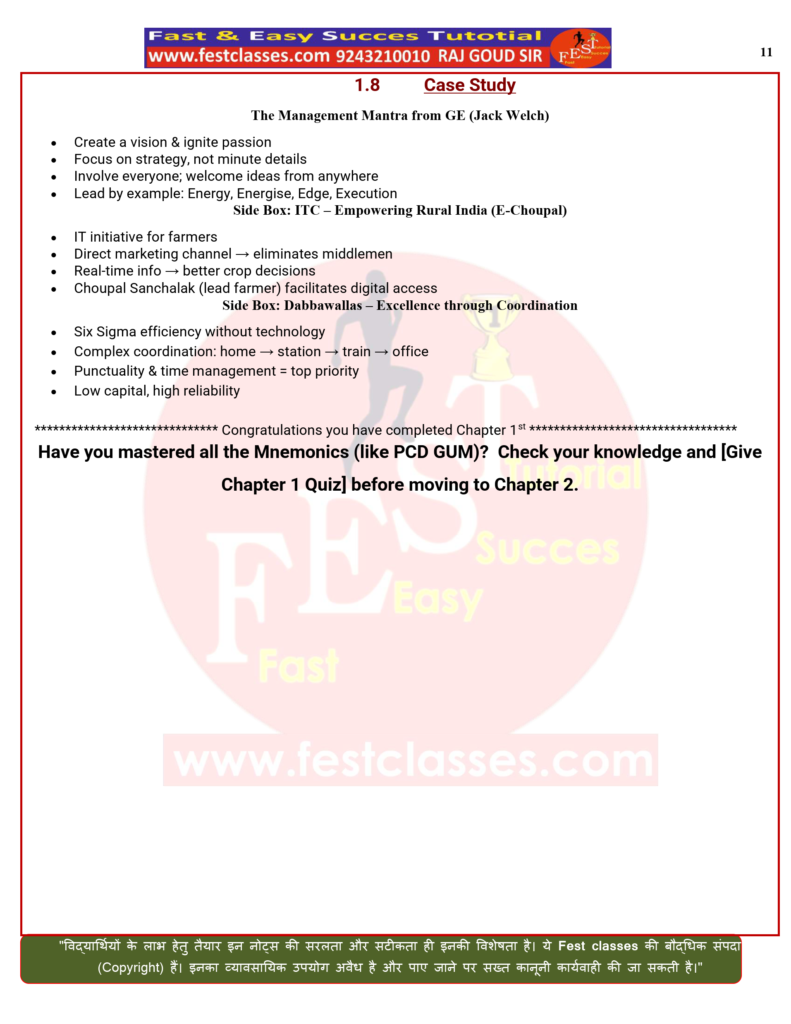
The Management Mantra from GE (Jack Welch)
- Create a vision & ignite passion
- Focus on strategy, not minute details
- Involve everyone; welcome ideas from anywhere
- Lead by example: Energy, Energise, Edge, Execution
Side Box: ITC – Empowering Rural India (E-Choupal)
- IT initiative for farmers
- Direct marketing channel → eliminates middlemen
- Real-time info → better crop decisions
- Choupal Sanchalak (lead farmer) facilitates digital access
Side Box: Dabbawallas – Excellence through Coordination
- Six Sigma efficiency without technology
- Complex coordination: home → station → train → office
- Punctuality & time management = top priority
- Low capital, high reliability