


CHAPTER – 5 ACCOUNTING FOR SHARE CAPITAL
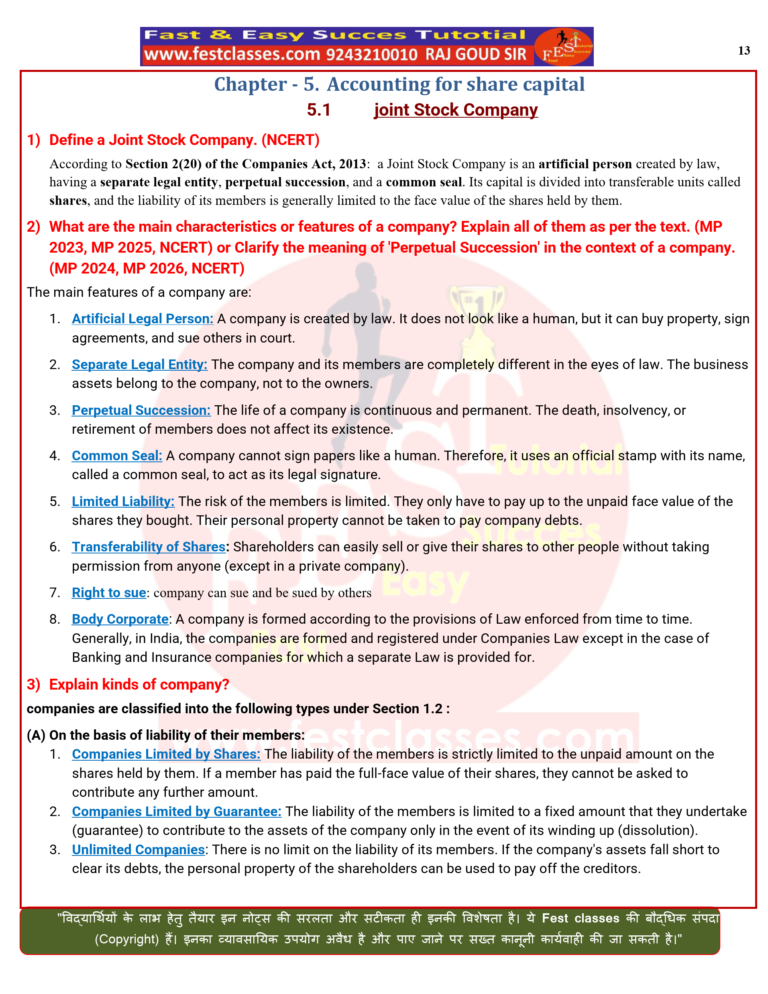
According to Section 2(20) of the Companies Act, 2013: a Joint Stock Company is an artificial person created by law, having a separate legal entity, perpetual succession, and a common seal. Its capital is divided into transferable units called shares, and the liability of its members is generally limited to the face value of the shares held by them.
- What are the main characteristics or features of a company? Explain all of them as per the text. (MP 2023, MP 2025, NCERT) or Clarify the meaning of ‘Perpetual Succession’ in the context of a company. (MP 2024, MP 2026, NCERT)
The main features of a company are:
- Artificial Legal Person: A company is created by law. It does not look like a human, but it can buy property, sign agreements, and sue others in court.
- Separate Legal Entity: The company and its members are completely different in the eyes of law. The business assets belong to the company, not to the owners.
- Perpetual Succession: The life of a company is continuous and permanent. The death, insolvency, or retirement of members does not affect its existence.
- Common Seal: A company cannot sign papers like a human. Therefore, it uses an official stamp with its name, called a common seal, to act as its legal signature.
- Limited Liability: The risk of the members is limited. They only have to pay up to the unpaid face value of the shares they bought. Their personal property cannot be taken to pay company debts.
- Transferability of Shares: Shareholders can easily sell or give their shares to other people without taking permission from anyone (except in a private company).
- Right to sue: company can sue and be sued by others
- Body Corporate: A company is formed according to the provisions of Law enforced from time to time. Generally, in India, the companies are formed and registered under Companies Law except in the case of Banking and Insurance companies for which a separate Law is provided for.
- Explain kinds of company?
companies are classified into the following types under Section 1.2 :
- On the basis of liability of their members:
- Companies Limited by Shares: The liability of the members is strictly limited to the unpaid amount on the shares held by them. If a member has paid the full-face value of their shares, they cannot be asked to contribute any further amount.
- Companies Limited by Guarantee: The liability of the members is limited to a fixed amount that they undertake (guarantee) to contribute to the assets of the company only in the event of its winding up (dissolution).
- Unlimited Companies: There is no limit on the liability of its members. If the company’s assets fall short to clear its debts, the personal property of the shareholders can be used to pay off the creditors.
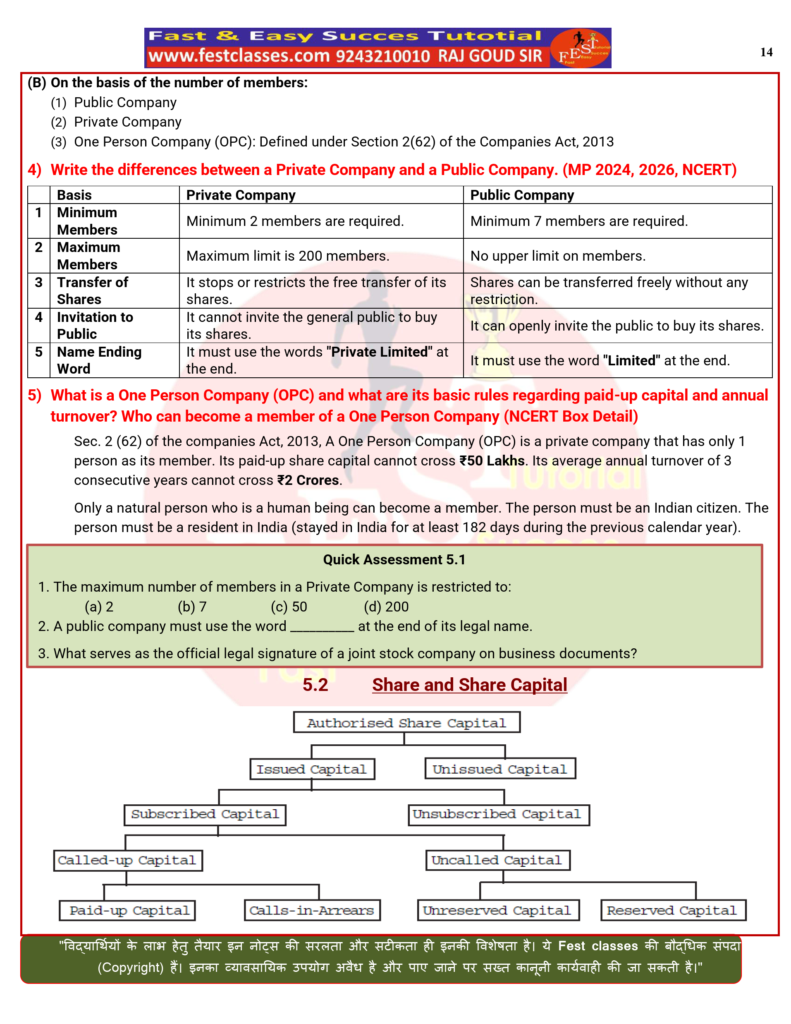
- On the basis of the number of members:
- Public Company
- Private Company
- One Person Company (OPC): Defined under Section 2(62) of the Companies Act, 2013
- Write the differences between a Private Company and a Public Company. (MP 2024, 2026, NCERT)
| Basis | Private Company | Public Company |
1 | Minimum Members | Minimum 2 members are required. | Minimum 7 members are required. |
2 | Maximum Members | Maximum limit is 200 members. | No upper limit on members. |
3 | Transfer of Shares | It stops or restricts the free transfer of its shares. | Shares can be transferred freely without any restriction. |
4 | Invitation to Public | It cannot invite the general public to buy its shares. | It can openly invite the public to buy its shares. |
5 | Name Ending Word | It must use the words “Private Limited” at the end. | It must use the word “Limited” at the end. |
- What is a One Person Company (OPC) and what are its basic rules regarding paid-up capital and annual turnover? Who can become a member of a One Person Company (NCERT Box Detail)
Sec. 2 (62) of the companies Act, 2013, A One Person Company (OPC) is a private company that has only 1 person as its member. Its paid-up share capital cannot cross ₹50 Lakhs. Its average annual turnover of 3 consecutive years cannot cross ₹2 Crores.
Quick Assessment 5.1 1. The maximum number of members in a Private Company is restricted to: (a) 2 (b) 7 (c) 50 (d) 200 2. A public company must use the word __________ at the end of its legal name. 3. What serves as the official legal signature of a joint stock company on business documents? |
Only a natural person who is a human being can become a member. The person must be an Indian citizen. The person must be a resident in India (stayed in India for at least 182 days during the previous calendar year).
- Share and Share Capital
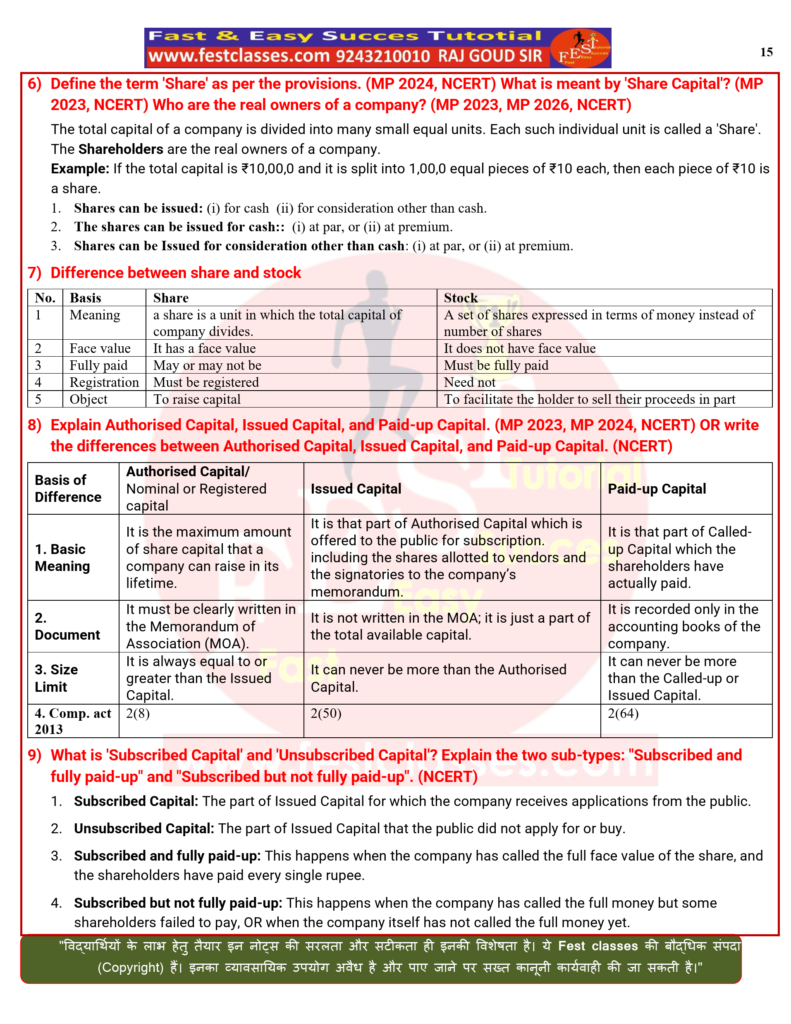
- Define the term ‘Share’ as per the provisions. (MP 2024, NCERT) What is meant by ‘Share Capital’? (MP 2023, NCERT) Who are the real owners of a company? (MP 2023, MP 2026, NCERT)
The total capital of a company is divided into many small equal units. Each such individual unit is called a ‘Share’. The Shareholders are the real owners of a company.
Example: If the total capital is ₹10,00,0 and it is split into 1,00,0 equal pieces of ₹10 each, then each piece of ₹10 is a share.
- Shares can be issued: (i) for cash (ii) for consideration other than cash.
- The shares can be issued for cash:: (i) at par, or (ii) at premium.
- Shares can be Issued for consideration other than cash: (i) at par, or (ii) at premium.
- Difference between share and stock
No. | Basis | Share | Stock |
1 | Meaning | a share is a unit in which the total capital of company divides. | A set of shares expressed in terms of money instead of number of shares |
2 | Face value | It has a face value | It does not have face value |
3 | Fully paid | May or may not be | Must be fully paid |
4 | Registration | Must be registered | Need not |
5 | Object | To raise capital | To facilitate the holder to sell their proceeds in part |
- Explain Authorised Capital, Issued Capital, and Paid-up Capital. (MP 2023, MP 2024, NCERT) OR write the differences between Authorised Capital, Issued Capital, and Paid-up Capital. (NCERT)
Basis of Difference | Authorised Capital/ Nominal or Registered capital | Issued Capital | Paid-up Capital |
1. Basic Meaning | It is the maximum amount of share capital that a company can raise in its lifetime. | It is that part of Authorised Capital which is offered to the public for subscription. including the shares allotted to vendors and the signatories to the company’s memorandum. | It is that part of Called-up Capital which the shareholders have actually paid. |
2. Document | It must be clearly written in the Memorandum of Association (MOA). | It is not written in the MOA; it is just a part of the total available capital. | It is recorded only in the accounting books of the company. |
3. Size Limit | It is always equal to or greater than the Issued Capital. | It can never be more than the Authorised Capital. | It can never be more than the Called-up or Issued Capital. |
4. Comp. act 2013 | 2(8) | 2(50) | 2(64) |
- What is ‘Subscribed Capital’ and ‘Unsubscribed Capital’? Explain the two sub-types: “Subscribed and fully paid-up” and “Subscribed but not fully paid-up”. (NCERT)
- Subscribed Capital: The part of Issued Capital for which the company receives applications from the public.
- Unsubscribed Capital: The part of Issued Capital that the public did not apply for or buy.
- Subscribed and fully paid-up: This happens when the company has called the full face value of the share, and the shareholders have paid every single rupee.
- Subscribed but not fully paid-up: This happens when the company has called the full money but some shareholders failed to pay, OR when the company itself has not called the full money yet.
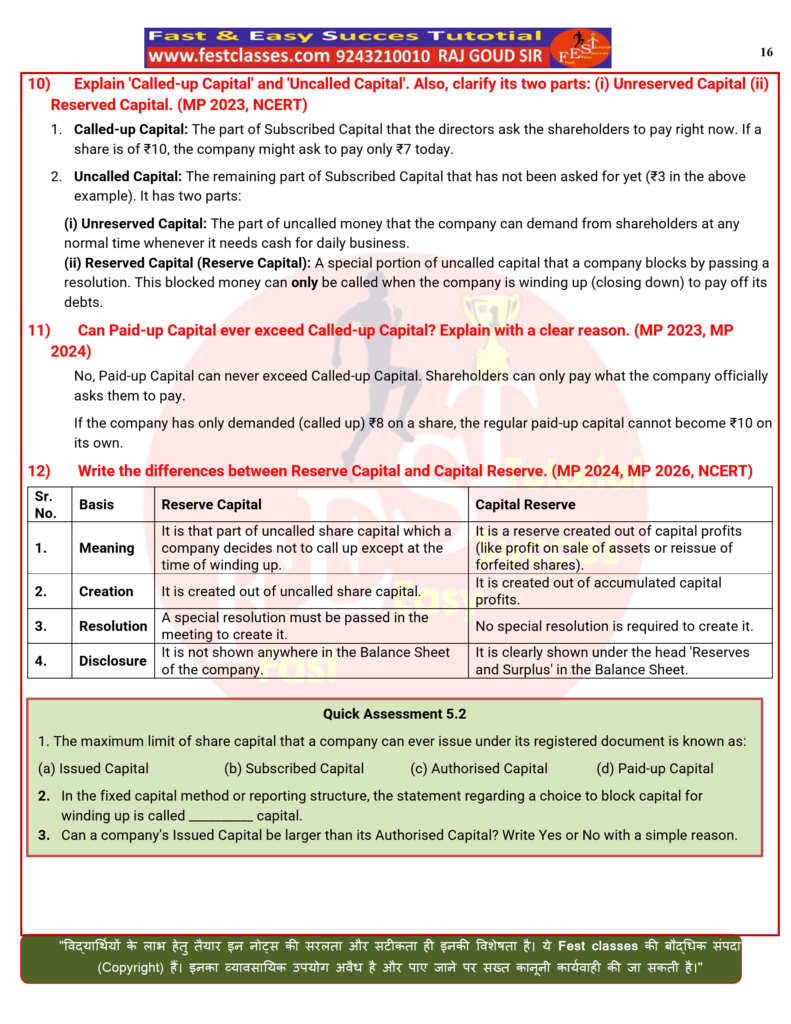
- Explain ‘Called-up Capital’ and ‘Uncalled Capital’. Also, clarify its two parts: (i) Unreserved Capital (ii) Reserved Capital. (MP 2023, NCERT)
- Called-up Capital: The part of Subscribed Capital that the directors ask the shareholders to pay right now. If a share is of ₹10, the company might ask to pay only ₹7 today.
- Uncalled Capital: The remaining part of Subscribed Capital that has not been asked for yet (₹3 in the above example). It has two parts:
(i) Unreserved Capital: The part of uncalled money that the company can demand from shareholders at any normal time whenever it needs cash for daily business.
(ii) Reserved Capital (Reserve Capital): A special portion of uncalled capital that a company blocks by passing a resolution. This blocked money can only be called when the company is winding up (closing down) to pay off its debts.
- Can Paid-up Capital ever exceed Called-up Capital? Explain with a clear reason. (MP 2023, MP 2024)
No, Paid-up Capital can never exceed Called-up Capital. Shareholders can only pay what the company officially asks them to pay.
If the company has only demanded (called up) ₹8 on a share, the regular paid-up capital cannot become ₹10 on its own.
Quick Assessment 5.2 1. The maximum limit of share capital that a company can ever issue under its registered document is known as: (a) Issued Capital (b) Subscribed Capital (c) Authorised Capital (d) Paid-up Capital 2. In the fixed capital method or reporting structure, the statement regarding a choice to block capital for winding up is called __________ capital. 3. Can a company’s Issued Capital be larger than its Authorised Capital? Write Yes or No with a simple reason. |
- Write the differences between Reserve Capital and Capital Reserve. (MP 2024, MP 2026, NCERT)
Sr. No. | Basis | Reserve Capital | Capital Reserve |
1. | Meaning | It is that part of uncalled share capital which a company decides not to call up except at the time of winding up. | It is a reserve created out of capital profits (like profit on sale of assets or reissue of forfeited shares). |
2. | Creation | It is created out of uncalled share capital. | It is created out of accumulated capital profits. |
3. | Resolution | A special resolution must be passed in the meeting to create it. | No special resolution is required to create it. |
4. | Disclosure | It is not shown anywhere in the Balance Sheet of the company. | It is clearly shown under the head ‘Reserves and Surplus’ in the Balance Sheet. |
- Kinds of Shares: Equity Shares vs. Preference Share
- What are Preference and equity Shares and characteristics? (MP 2023, MP 2024, MP 2025, 2026)
Sr. | Basis | Equity Shares | Preference Shares |
1. | Meaning | These are regular shares that do not carry any special priority rights regarding dividends or capital repayment. | These are special shares that enjoy priority rights for dividends and capital repayment before equity shares. |
2. | Rate of Dividend | The rate of dividend is not fixed. | The rate of dividend is completely fixed |
3. | Right to Dividend | Dividend on these shares is paid only after paying the dividend to preference shareholders first. | Dividend on these shares is always paid before any dividend is given to equity shareholders. |
4. | Voting Rights | Equity shareholders enjoy full voting rights | Preference shareholders do not have general voting rights |
5. | Arrears of Dividend | Dividends can never accumulate. If a company skips a dividend in a loss year, it is lost forever. | Unpaid dividends can accumulate or build up for future years in the case of cumulative preference shares. |
6. | Repayment of Capital | On closing down (winding up), their capital is returned at the very end, after paying all outsiders and preference shares. | On closing down (winding up), their capital is returned safely before anything is paid to equity shareholders. |
- Explain the following types of Preference Shares as per the provisions: (MP 2023, NCERT)
- Cumulative and non-cumulative:
- Cumulative: If the company suffers a loss in one year and cannot pay a dividend, that unpaid dividend accumulates (grows) and must be paid in the coming years when profits are made.
- Non-cumulative: Unpaid dividends do not accumulate. If a company misses a dividend in a loss-making year, shareholders can never claim it in the future.
- Participating and non-participating:
- Participating: After paying a fixed dividend to everyone, these shareholders have a right to take a share in the remaining extra profits or surplus assets.
- Non-participating: They only get their fixed rate of dividend and have absolutely no right to claim any extra surplus profits of the company.
- Convertible and non-convertible:
- Convertible: These shareholders have the option or right to change their preference shares into regular equity shares after a fixed time period.
- Non-convertible: These shares can never be changed or converted into equity shares.
- Redeemable and Irredeemable:
- Redeemable: The company pays back the principal share amount to these shareholders after a fixed time period during its lifetime.
Quick Assessment 5.3 1. Which of the following shares are given a fixed rate of return and priority in the payment of dividends? (a) Equity Shares (b) Preference Shares (c) Deferred Shares (d) Bonus Shares 2. Preference shares that hold the legal right to change into regular equity shares after a specified time frame are called __________ preference shares. 3. Do equity shareholders possess the right to vote on all critical matters of a company? Write Yes or No based on their basic features. |
- Irredeemable: The capital amount of these shares is never repaid during the lifetime of the company. It is paid back only when the company finally winds up.
- Issue of Shares: Prospectus, Subscription
- What is a ‘Prospectus’ issued by a company? Is it compulsory for a company to issue a prospectus? (MP 2026, NCERT)
A prospectus is an official circular, notice, or document issued by a public company to invite the general public to buy its shares or debentures. It contains complete information about the company’s future plans, profits, and directors so that investors can make a safe decision.
Compulsory Rule: No, it is not compulsory for every company. A private company does not require to issue a prospectus because it cannot invite the public to buy its shares.
- Explain the meaning of ‘Minimum Subscription’. What is the minimum percentage required as per SEBI guidelines? (NCERT Box Detail)
Minimum subscription is the minimum amount of money that a company must receive from public applications before it can start allocating or issuing shares.
- As per SEBI rules, a company must receive at least 90% of the total issued shares as applications.
- If the company fails to get this 90% subscription within the fixed time, it cannot issue any shares. It must return all the application money back to the public immediately.
- What is an Employees Stock Option Plan (ESOP)? What is meant by ‘Sweat Equity Shares’? To whom are these shares issued? (NCERT)
Sr. No. | Basis of Difference | ESOP (Employees Stock Option Plan) | Sweat Equity Shares |
1. | Meaning | It is a scheme that gives employees a right or choice to buy regular shares of the company at a lower price in the future. | These are shares directly issued to employees right away as a reward for their special skills, hard work, or intellectual property. |
2. | Purpose of Issue | It is issued to motivate employees, give them ownership, and retain them in the company for a longer period. | It is issued to compensate or reward employees for providing technical know-how or creating value for the company. |
3. | Cash Consideration | Employees must pay cash to buy these shares at the pre-determined lower price when they exercise their option. | These can be issued either at a discount or completely for consideration other than cash (meaning without taking money). |
- What is meant by ‘Full Subscription’ and ‘Under-subscription’ of shares? (NCERT) OR What is meant by ‘Over-subscription’ of shares? (MP 2025, NCERT) OR What are the options available with a company under the condition of Over-subscription? (MP 2023, MP 2025, NCERT) or Write the differences between Over-subscription and Under-subscription of shares. (NCERT)
Sr. No. | Basis of Difference | Over-subscription | Under-subscription |
1. | Meaning | This happens when the public applies for exactly the same number of shares that the company offered for sale | This happens when the public applies for fewer shares than what the company offered for sale |
| Example | Issue 20,000 shares of rs 10 but application received for 25,000 shares | Issue 20000 shares of rs 10 but application received for 18,000 shares |
2. | Accounting Entries | entries are processed on the basis of shares actually issued by the company. | entries are processed on the basis of the lower number of shares applied |
3. | Excess Application Money | The company receives either refund or adjust using pro-rata rules or both (imp) | There is no excess application money received |
4. | Minimum Subscription Risk | no risk of failing the minimum | There is a high risk that if applications drop below 90% |
5. | Allotment of Shares | they must use rejection or proportionate rules. | Directors can easily accept all valid applications |
6. | Pro-rata Allotment | Pro-rata allotment is frequently used | Pro-rata allotment can never be used |
- What do you mean by Pro rata Allotment
means allotment of shares in a fixed proportion. Pro rata allotment takes place only when the shares are oversubscribed.
Difference According to section 43 companies act 2013
Quick Assessment 5.4 1. When applications received exceed the number of issued shares, the situation is called: (a) Under-subscription (b) Full Subscription (c) Over-subscription (d) Minimum Subscription 2. A private company is not legally required to issue a __________ to the general public.
|
- Issue of Shares at Premium and Accounting Treatment
- What is meant by the ‘Issue of Shares at a Premium’? Give a simple example. (NCERT)
When a company issues its shares at a price that is higher than their nominal (face) value, it is called the issue of shares at a premium. Example: If a share has a face value of ₹10, and the company offers it to the public at ₹14, the extra ₹4 is the premium amount.
- What is the ‘Securities Premium Account’ (or Securities Premium Reserve)? Under which head is it shown in the company’s Balance Sheet? (MP 2024, NCERT)
- The extra money collected as premium cannot be treated as normal profit. It must be credited to a special statutory account called the Securities Premium Reserve Account.
- Balance Sheet Disclosure: It shown on the Equity and Liabilities side under the main head ‘Shareholders’ Funds’ and sub-head ‘Reserves and Surplus’.
- State the five specific purposes for which the Securities Premium Reserve can be legally used under Section 52(2) of the Companies Act, 2013. (MP 2023, MP 2025, MP 2026, NCERT)
- To issue fully paid-up bonus shares to the existing members/shareholders.
- To write off the preliminary expenses incurred during the formation of the company.
- To write off expenses, commission paid, or discount allowed on the issue of shares or debentures of the company.
- To provide for the premium payable on the redemption of redeemable preference shares or debentures.
- To buy back its own shares (called buy-back of shares).
- When is the premium amount usually called up by a company? What is the standard accounting assumption if the question is silent? (NCERT)
A company can demand the premium money at any stage—either with Application, Allotment, or along with Calls. If a question is completely silent regarding the stage at which the premium is due, it is always assumed that the premium money is demanded and due along with the Allotment stage.
- Write the necessary journal entries when shares are issued at a premium and the premium money is demanded along with Allotment. (MP 2024, NCERT)
When the premium is due at the time of allotment, the accounting entries are:
- Entry A: For making Allotment and Premium Money due
Share Allotment A/c ……………………………… Dr. [Total Due: Allotment + Premium]
To Share Capital A/c [With Face Value portion]
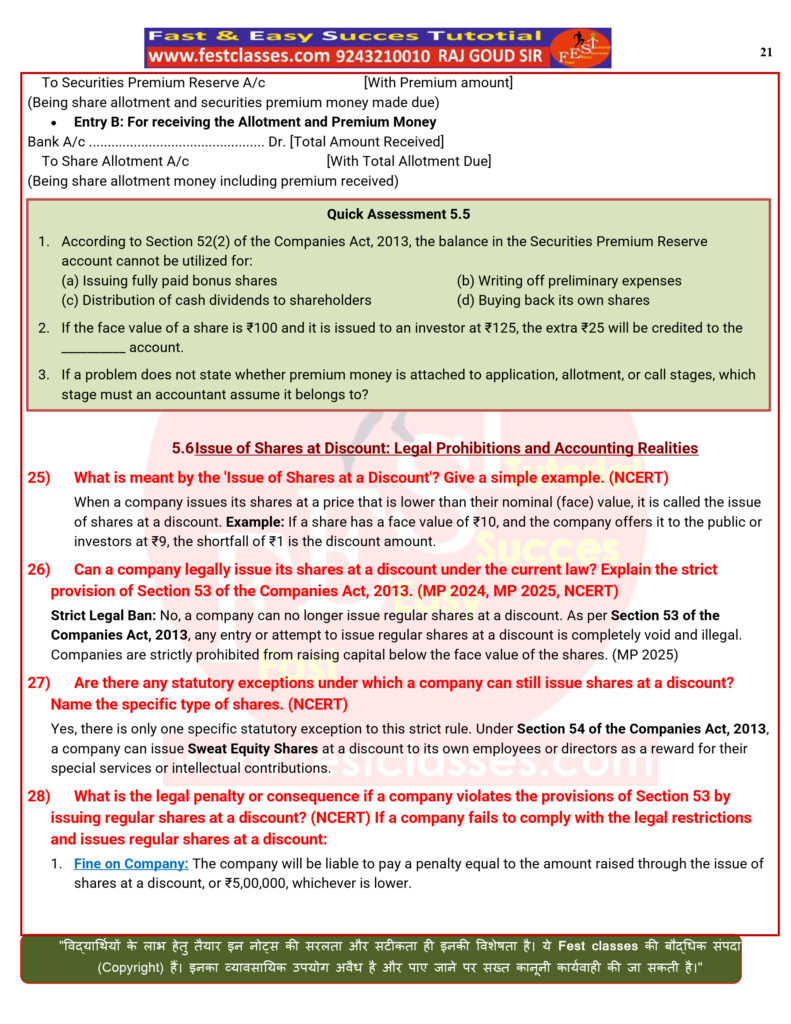
To Securities Premium Reserve A/c [With Premium amount]
(Being share allotment and securities premium money made due)
- Entry B: For receiving the Allotment and Premium Money
Bank A/c ……………………………………….. Dr. [Total Amount Received]
To Share Allotment A/c [With Total Allotment Due]
(Being share allotment money including premium received)
Quick Assessment 5.5 1. According to Section 52(2) of the Companies Act, 2013, the balance in the Securities Premium Reserve account cannot be utilized for: (a) Issuing fully paid bonus shares (b) Writing off preliminary expenses (c) Distribution of cash dividends to shareholders (d) Buying back its own shares 2. If the face value of a share is ₹100 and it is issued to an investor at ₹125, the extra ₹25 will be credited to the __________ account. 3. If a problem does not state whether premium money is attached to application, allotment, or call stages, which stage must an accountant assume it belongs to? |
- Issue of Shares at Discount: Legal Prohibitions and Accounting Realities
- What is meant by the ‘Issue of Shares at a Discount’? Give a simple example. (NCERT)
When a company issues its shares at a price that is lower than their nominal (face) value, it is called the issue of shares at a discount. Example: If a share has a face value of ₹10, and the company offers it to the public or investors at ₹9, the shortfall of ₹1 is the discount amount.
- Can a company legally issue its shares at a discount under the current law? Explain the strict provision of Section 53 of the Companies Act, 2013. (MP 2024, MP 2025, NCERT)
Strict Legal Ban: No, a company can no longer issue regular shares at a discount. As per Section 53 of the Companies Act, 2013, any entry or attempt to issue regular shares at a discount is completely void and illegal. Companies are strictly prohibited from raising capital below the face value of the shares. (MP 2025)
- Are there any statutory exceptions under which a company can still issue shares at a discount? Name the specific type of shares. (NCERT)
Yes, there is only one specific statutory exception to this strict rule. Under Section 54 of the Companies Act, 2013, a company can issue Sweat Equity Shares at a discount to its own employees or directors as a reward for their special services or intellectual contributions.
- What is the legal penalty or consequence if a company violates the provisions of Section 53 by issuing regular shares at a discount? (NCERT) If a company fails to comply with the legal restrictions and issues regular shares at a discount:
- Fine on Company: The company will be liable to pay a penalty equal to the amount raised through the issue of shares at a discount, or ₹5,00,000, whichever is lower.
Quick Assessment 5.6
- According to Section 53 of the Companies Act, 2013, a company cannot issue regular shares at a discount except in the case of:
(a) Preference Shares (b) Equity Shares to the general public (c) Sweat Equity Shares (d) Right Shares
- Any issue of regular shares by a company at a discount to its face value under the current Companies Act is legally considered completely __________.
- If a company illegally issues shares at a discount, what is the specific annual interest rate it must pay while refunding that money back to the investors?
Refund Rule: The company is legally bound to refund all the money received from such an issue to the respective investors along with an interest rate of 12% per annum from the date of receipt.
- Accounting Treatment for Calls-in-Arrears and Calls-in-Advance
- What is meant by ‘Calls-in-Arrears’? How is it shown in the company’s Balance Sheet? (MP 2024, MP 2025, NCERT)
- When a company demands a call installment (like first call or final call) from the shareholders, but some shareholders fail to pay that amount by the due date, the unpaid amount is called Calls-in-Arrears.
- Balance Sheet Disclosure: In the Balance Sheet, it is not shown as a separate liability. Instead, it is subtracted/deducted from the ‘Subscribed but not fully paid up’ capital under the main head ‘Share Capital’.
- What is meant by ‘Calls-in-Advance’? How is it disclosed in Balance Sheet? (MP 2024, NCERT)
- When a shareholder pays a part or whole of the uncalled future installments (like second call money along with the allotment or first call) in advance, it is called Calls-in-Advance.
- Balance Sheet Disclosure: It cannot be added to the share capital because shares have not been officially called yet. It is shown separately on the Liabilities side under the head ‘Current Liabilities’ and sub-head ‘Other Current Liabilities’.
- State the maximum annual interest rates applicable on Calls-in-Arrears and Calls-in-Advance as per Table F of the Companies Act, 2013. (MP 2023, MP 2026, NCERT)
If a company adopts Table F of Schedule I of the Companies Act, 2013, the strict interest rules are:
- Interest on Calls-in-Arrears: The company can charge interest from defaulting shareholders at a maximum rate of 10% per annum for the delayed period.
- Interest on Calls-in-Advance: The company is legally bound to pay interest to the advancing shareholders at a maximum rate of 12% per annum from the date of receipt till the date the call becomes officially due.
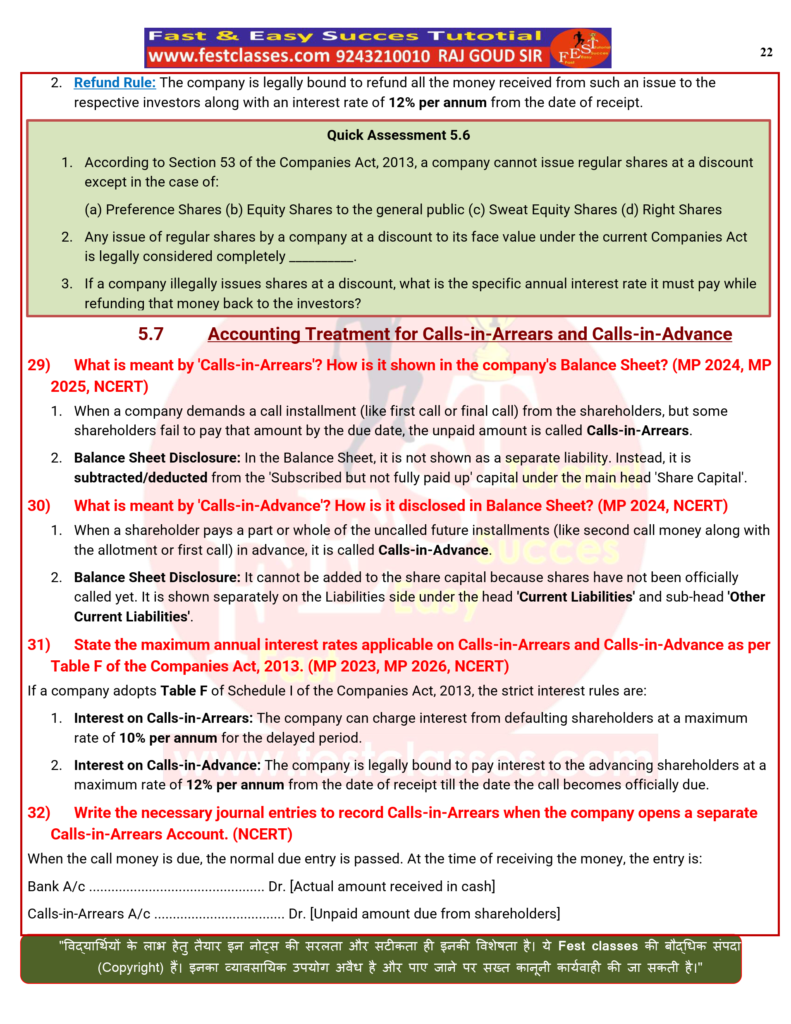
- Write the necessary journal entries to record Calls-in-Arrears when the company opens a separate Calls-in-Arrears Account. (NCERT)
When the call money is due, the normal due entry is passed. At the time of receiving the money, the entry is:
Bank A/c ……………………………………….. Dr. [Actual amount received in cash]
Calls-in-Arrears A/c …………………………….. Dr. [Unpaid amount due from shareholders]
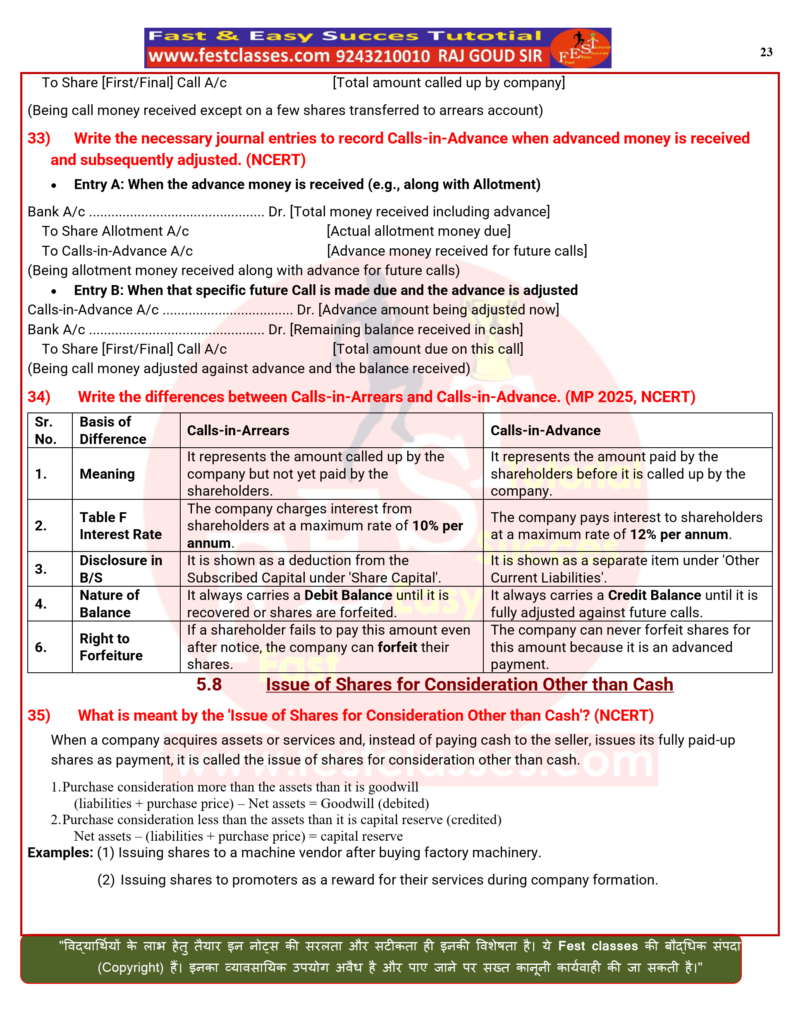
To Share [First/Final] Call A/c [Total amount called up by company]
(Being call money received except on a few shares transferred to arrears account)
- Write the necessary journal entries to record Calls-in-Advance when advanced money is received and subsequently adjusted. (NCERT)
- Entry A: When the advance money is received (e.g., along with Allotment)
Bank A/c ……………………………………….. Dr. [Total money received including advance]
To Share Allotment A/c [Actual allotment money due]
To Calls-in-Advance A/c [Advance money received for future calls]
(Being allotment money received along with advance for future calls)
- Entry B: When that specific future Call is made due and the advance is adjusted
Calls-in-Advance A/c …………………………….. Dr. [Advance amount being adjusted now]
Bank A/c ……………………………………….. Dr. [Remaining balance received in cash]
To Share [First/Final] Call A/c [Total amount due on this call]
(Being call money adjusted against advance and the balance received)
- Write the differences between Calls-in-Arrears and Calls-in-Advance. (MP 2025, NCERT)
Sr. No. | Basis of Difference | Calls-in-Arrears | Calls-in-Advance |
1. | Meaning | It represents the amount called up by the company but not yet paid by the shareholders. | It represents the amount paid by the shareholders before it is called up by the company. |
2. | Table F Interest Rate | The company charges interest from shareholders at a maximum rate of 10% per annum. | The company pays interest to shareholders at a maximum rate of 12% per annum. |
3. | Disclosure in B/S | It is shown as a deduction from the Subscribed Capital under ‘Share Capital’. | It is shown as a separate item under ‘Other Current Liabilities’. |
4. | Nature of Balance | It always carries a Debit Balance until it is recovered or shares are forfeited. | It always carries a Credit Balance until it is fully adjusted against future calls. |
6. | Right to Forfeiture | If a shareholder fails to pay this amount even after notice, the company can forfeit their shares. | The company can never forfeit shares for this amount because it is an advanced payment. |
- Issue of Shares for Consideration Other than Cash
- What is meant by the ‘Issue of Shares for Consideration Other than Cash’? (NCERT)
When a company acquires assets or services and, instead of paying cash to the seller, issues its fully paid-up shares as payment, it is called the issue of shares for consideration other than cash.
- Purchase consideration more than the assets than it is goodwill
(liabilities + purchase price) – Net assets = Goodwill (debited)
- Purchase consideration less than the assets than it is capital reserve (credited)
Net assets – (liabilities + purchase price) = capital reserve
Examples: (1) Issuing shares to a machine vendor after buying factory machinery.
- Issuing shares to promoters as a reward for their services during company formation.
Quick Assessment 5.7 1. According to Table F of the Companies Act, 2013, the maximum rate of interest payable by a company on Calls-in-Advance is: (a) 5% p.a. (b) 10% p.a. (c) 12% p.a. (d) 6% p.a. 2. In the company’s Balance Sheet, Calls-in-Arrears is shown as a deduction from the __________ Capital. 3. Does a company pay dividends to a shareholder on the amount received as Calls-in-Advance? State the rule. |
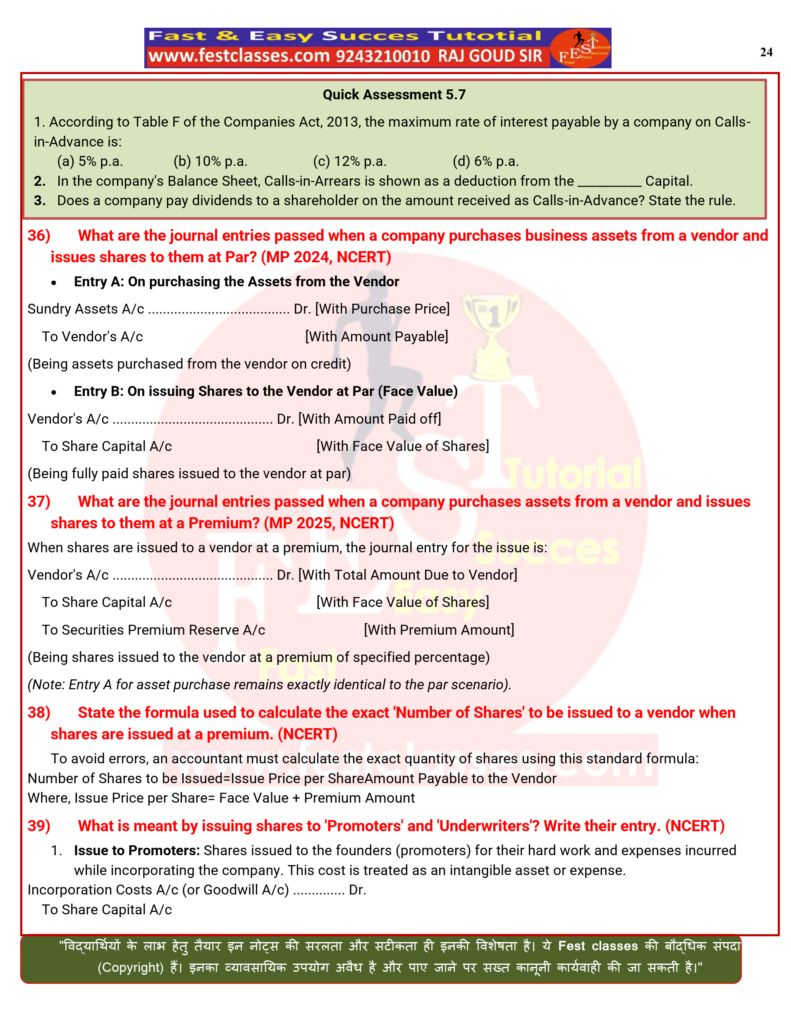
- What are the journal entries passed when a company purchases business assets from a vendor and issues shares to them at Par? (MP 2024, NCERT)
- Entry A: On purchasing the Assets from the Vendor
Sundry Assets A/c ……………………………….. Dr. [With Purchase Price]
To Vendor’s A/c [With Amount Payable]
(Being assets purchased from the vendor on credit)
- Entry B: On issuing Shares to the Vendor at Par (Face Value)
Vendor’s A/c ……………………………………. Dr. [With Amount Paid off]
To Share Capital A/c [With Face Value of Shares]
(Being fully paid shares issued to the vendor at par)
- What are the journal entries passed when a company purchases assets from a vendor and issues shares to them at a Premium? (MP 2025, NCERT)
When shares are issued to a vendor at a premium, the journal entry for the issue is:
Vendor’s A/c ……………………………………. Dr. [With Total Amount Due to Vendor]
To Share Capital A/c [With Face Value of Shares]
To Securities Premium Reserve A/c [With Premium Amount]
(Being shares issued to the vendor at a premium of specified percentage)
(Note: Entry A for asset purchase remains exactly identical to the par scenario).
- State the formula used to calculate the exact ‘Number of Shares’ to be issued to a vendor when shares are issued at a premium. (NCERT)
To avoid errors, an accountant must calculate the exact quantity of shares using this standard formula:
Number of Shares to be Issued=Issue Price per ShareAmount Payable to the Vendor
Where, Issue Price per Share= Face Value + Premium Amount
- What is meant by issuing shares to ‘Promoters’ and ‘Underwriters’? Write their entry. (NCERT)
- Issue to Promoters: Shares issued to the founders (promoters) for their hard work and expenses incurred while incorporating the company. This cost is treated as an intangible asset or expense.
Incorporation Costs A/c (or Goodwill A/c) ………….. Dr.
To Share Capital A/c
(Being fully paid shares issued to promoters for incorporation services)
- Issue to Underwriters: Shares issued to underwriters as settlement for their underwriting commission when they guarantee the minimum sale of public shares.
Underwriting Commission A/c ………………………. Dr.
To Underwriters A/c
(Being commission due to underwriters)
Underwriters A/c ………………………………… Dr.
To Share Capital A/c
Quick Assessment 5.8 1. If a company purchases machinery worth ₹1,10,000 from a vendor and issues shares of ₹100 each at a premium of 10%, the total number of shares to be issued will be: (a) 1,100 shares (b) 1,000 shares (c) 900 shares (d) 1,200 shares 2. When shares are issued to promoters for their initial services, the account debited is either Goodwill Account or __________ Account. 3. Can a company legally issue shares to a machine vendor at a discount under the current provisions of Section 53 of the Companies Act, 2013? State your answer in one word. |
(Being fully paid shares issued to underwriters in settlement of commission)
- Forfeiture of Shares: Meaning, Legal Provisions
- What is meant by the ‘Forfeiture of Shares’? Under what condition can a company forfeit shares? (MP 2024, MP 2025, NCERT)
- Forfeiture of shares means the cancellation of a person’s membership and ownership in a company due to the non-payment of called-up installments (like allotment money or call money).
- Condition for Forfeiture: A company can forfeit shares only if its Articles of Association (AOA) allows it, and after the shareholder fails to pay the due amount even after being given proper legal warnings.
- Consequence: Upon forfeiture, the shareholder’s name is removed from the register of members, and the money they have already paid to the company is confiscated (seized) forever.
- What is the mandatory legal procedure regarding notice that a company must follow before forfeiting a member’s shares? (NCERT)
Before a company can legally cancel shares, it must follow the strict procedure laid down in Table F:
- The company secretary prepare list
- The Board of directors prepare the list
- Notice is served to pay call amount within 14 days
- If no respond, a second notice is served
- If no respond than BOD passes a resolution for forfeiture
- A notice is served to respective the shareholders that is shares have been forfeited and e is requested to return the share certificate.
- Shareholder name removed from the list and information provided in the newspaper so the share may not be sold in the market
- What is the ‘Share Forfeiture Account’? Under which head is its remaining balance shown in the Balance Sheet? (NCERT)
- The amount already paid up by the defaulting shareholder is seized by the company. This confiscated cash is transferred to a special account called the Share Forfeiture Account.
- Balance Sheet Disclosure: Until these forfeited shares are reissued to someone else, the balance of the Share Forfeiture Account is added to the paid-up capital under the head ‘Share Capital’ on the Liabilities side of the Balance Sheet.
- Write the journal entry for the forfeiture of shares which were originally issued at Par. (MP 2024, MP 2026, NCERT)
When shares originally issued at par are cancelled, the entry is:
Share Capital A/c ……………………………….. Dr. [Number of Shares × Total Called-up Value]
To Share Forfeiture A/c [Amount actually received/paid up]
To Share Allotment A/c [Unpaid allotment amount, if any]
To Share [First/Final] Call A/c [Unpaid call amount, if any]
(Being specified number of shares forfeited for non-payment of dues)
(Note: If you maintain a separate Calls-in-Arrears account, credit “To Calls-in-Arrears A/c” with the total unpaid amount instead of naming individual instalments).
- journal entries for the forfeiture of shares which were issued at a Premium. (MP 2025, NCERT)
- Case A: When the premium amount has NOT been received by the company If the shareholder failed to pay the premium (e.g., they didn’t pay allotment money where premium was due), the premium account must be cancelled by debiting it:
Share Capital A/c ……………………………….. Dr. [Shares × Called-up Face Value]
Securities Premium Reserve A/c ……………………. Dr. [Shares × Unpaid Premium per Share]
To Share Forfeiture A/c [Amount actually received on Face Value]
To Calls-in-Arrears A/c (or individual unpaid calls) [Total unpaid amount including premium]
(Being shares originally issued at premium forfeited for non-payment)
- Case B: When the premium amount has already been fully received According to Section 52(2), once securities premium is received, it cannot be cancelled or reversed. Therefore, we completely ignore the premium amount in this entry:
Share Capital A/c ……………………………….. Dr. [Shares × Called-up Face Value]
To Share Forfeiture A/c [Amount actually received on Face Value]
To Calls-in-Arrears A/c (or individual unpaid calls) [Unpaid face value portion only]
Quick Assessment 5.9 1. At the time of forfeiture of shares, the Share Capital Account is debited with: (a) Paid-up value of shares (b) Called-up value of shares (c) Face value of shares (d) Market value of shares 2. Before forfeiting a shareholder’s shares for non-payment of calls, a minimum of __________ days’ notice must be served to them. 3. If a company forfeits shares on which a premium of ₹2 per share was already received in cash at the time of allotment, will the Securities Premium Reserve Account be debited in the forfeiture journal entry? Yes or No |
(Being shares forfeited; premium already received is left untouched)