


- Cell: The Building Block of Life
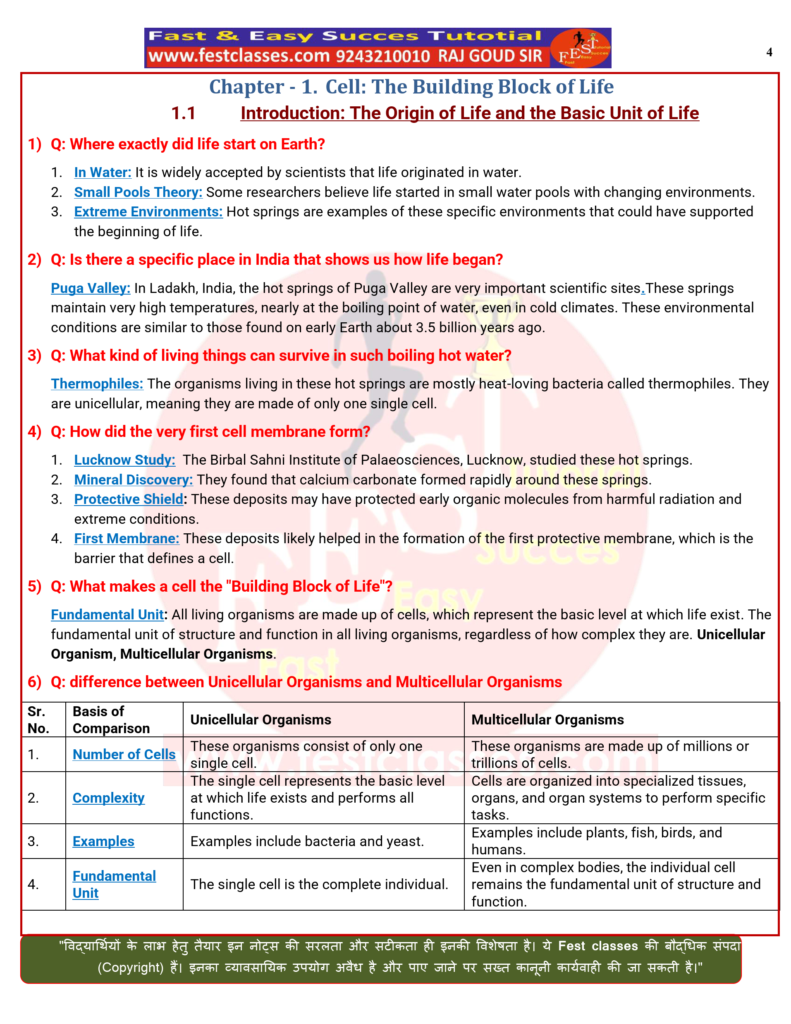
- Q: Where exactly did life start on Earth?
- In Water: It is widely accepted by scientists that life originated in water.
- Small Pools Theory: Some researchers believe life started in small water pools with changing environments.
- Extreme Environments: Hot springs are examples of these specific environments that could have supported the beginning of life.
- Q: Is there a specific place in India that shows us how life began?
Puga Valley: In Ladakh, India, the hot springs of Puga Valley are very important scientific sites.These springs maintain very high temperatures, nearly at the boiling point of water, even in cold climates. These environmental conditions are similar to those found on early Earth about 3.5 billion years ago.
- Q: What kind of living things can survive in such boiling hot water?
Thermophiles: The organisms living in these hot springs are mostly heat-loving bacteria called thermophiles. They are unicellular, meaning they are made of only one single cell.
- Q: How did the very first cell membrane form?
- Lucknow Study: The Birbal Sahni Institute of Palaeosciences, Lucknow, studied these hot springs.
- Mineral Discovery: They found that calcium carbonate formed rapidly around these springs.
- Protective Shield: These deposits may have protected early organic molecules from harmful radiation and extreme conditions.
- First Membrane: These deposits likely helped in the formation of the first protective membrane, which is the barrier that defines a cell.
- Q: What makes a cell the “Building Block of Life”?
Fundamental Unit: All living organisms are made up of cells, which represent the basic level at which life exist. The fundamental unit of structure and function in all living organisms, regardless of how complex they are. Unicellular Organism, Multicellular Organisms.
- Q: difference between Unicellular Organisms and Multicellular Organisms
| Sr. No. | Basis of Comparison | Unicellular Organisms | Multicellular Organisms |
| 1. | Number of Cells | These organisms consist of only one single cell. | These organisms are made up of millions or trillions of cells. |
| 2. | Complexity | The single cell represents the basic level at which life exists and performs all functions. | Cells are organized into specialized tissues, organs, and organ systems to perform specific tasks. |
| 3. | Examples | Examples include bacteria and yeast. | Examples include plants, fish, birds, and humans. |
| 4. | Fundamental Unit | The single cell is the complete individual. | Even in complex bodies, the individual cell remains the fundamental unit of structure and function. |
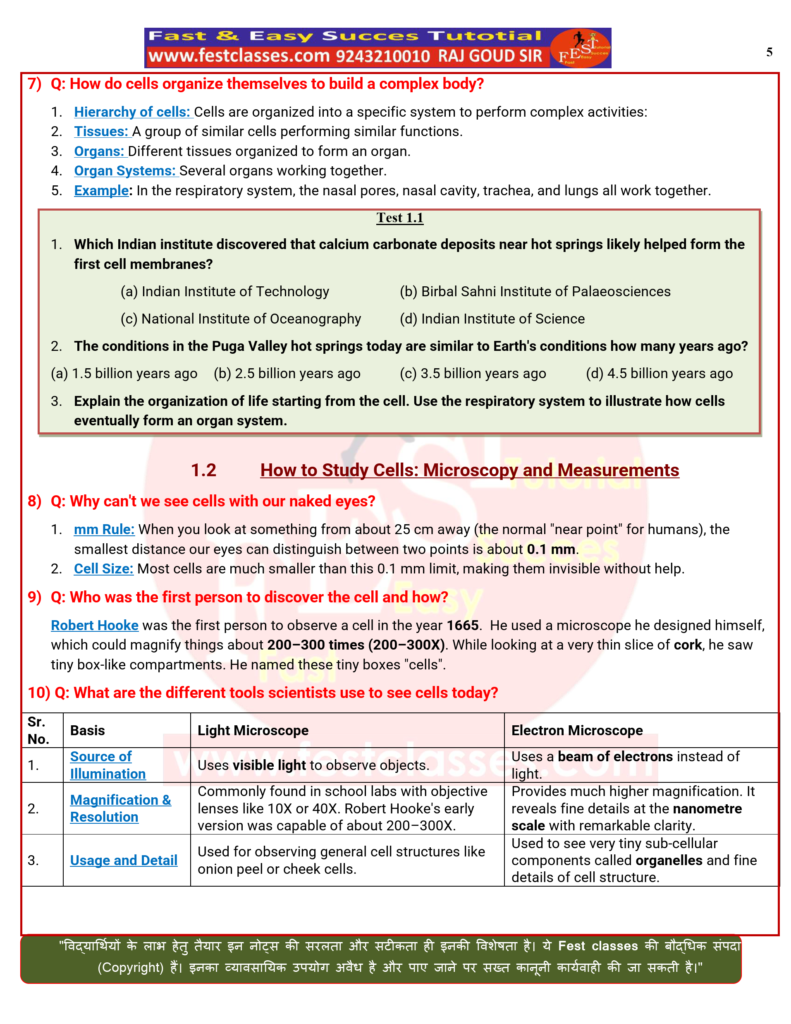
- Q: How do cells organize themselves to build a complex body?
- Hierarchy of cells: Cells are organized into a specific system to perform complex activities:
- Tissues: A group of similar cells performing similar functions.
- Organs: Different tissues organized to form an organ.
- Organ Systems: Several organs working together.
- Example: In the respiratory system, the nasal pores, nasal cavity, trachea, and lungs all work together.
Test 1.1
- Which Indian institute discovered that calcium carbonate deposits near hot springs likely helped form the first cell membranes?
(a) Indian Institute of Technology (b) Birbal Sahni Institute of Palaeosciences
(c) National Institute of Oceanography (d) Indian Institute of Science
- The conditions in the Puga Valley hot springs today are similar to Earth’s conditions how many years ago?
(a) 1.5 billion years ago (b) 2.5 billion years ago (c) 3.5 billion years ago (d) 4.5 billion years ago
- Explain the organization of life starting from the cell. Use the respiratory system to illustrate how cells eventually form an organ system.
- How to Study Cells: Microscopy and Measurements
- Q: Why can’t we see cells with our naked eyes?
- mm Rule: When you look at something from about 25 cm away (the normal “near point” for humans), the smallest distance our eyes can distinguish between two points is about 0.1 mm.
- Cell Size: Most cells are much smaller than this 0.1 mm limit, making them invisible without help.
- Q: Who was the first person to discover the cell and how?
Robert Hooke was the first person to observe a cell in the year 1665. He used a microscope he designed himself, which could magnify things about 200–300 times (200–300X). While looking at a very thin slice of cork, he saw tiny box-like compartments. He named these tiny boxes “cells”.
- Q: What are the different tools scientists use to see cells today?
| Sr. No. | Basis | Light Microscope | Electron Microscope |
| 1. | Source of Illumination | Uses visible light to observe objects. | Uses a beam of electrons instead of light. |
| 2. | Magnification & Resolution | Commonly found in school labs with objective lenses like 10X or 40X. Robert Hooke’s early version was capable of about 200–300X. | Provides much higher magnification. It reveals fine details at the nanometre scale with remarkable clarity. |
| 3. | Usage and Detail | Used for observing general cell structures like onion peel or cheek cells. | Used to see very tiny sub-cellular components called organelles and fine details of cell structure. |
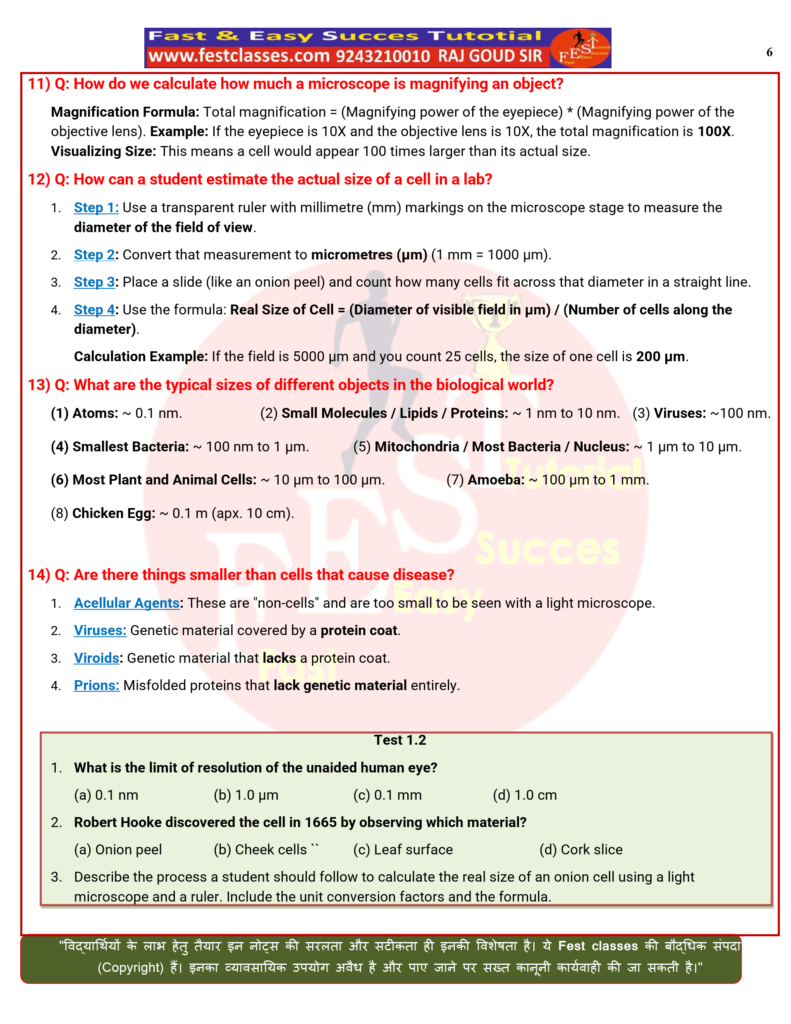
- Q: How do we calculate how much a microscope is magnifying an object?
Magnification Formula: Total magnification = (Magnifying power of the eyepiece) * (Magnifying power of the objective lens). Example: If the eyepiece is 10X and the objective lens is 10X, the total magnification is 100X. Visualizing Size: This means a cell would appear 100 times larger than its actual size.
- Q: How can a student estimate the actual size of a cell in a lab?
- Step 1: Use a transparent ruler with millimetre (mm) markings on the microscope stage to measure the diameter of the field of view.
- Step 2: Convert that measurement to micrometres (µm) (1 mm = 1000 µm).
- Step 3: Place a slide (like an onion peel) and count how many cells fit across that diameter in a straight line.
- Step 4: Use the formula: Real Size of Cell = (Diameter of visible field in µm) / (Number of cells along the diameter).
Calculation Example: If the field is 5000 µm and you count 25 cells, the size of one cell is 200 µm.
- Q: What are the typical sizes of different objects in the biological world?
(1) Atoms: ~ 0.1 nm. (2) Small Molecules / Lipids / Proteins: ~ 1 nm to 10 nm. (3) Viruses: ~100 nm.
(4) Smallest Bacteria: ~ 100 nm to 1 µm. (5) Mitochondria / Most Bacteria / Nucleus: ~ 1 µm to 10 µm.
(6) Most Plant and Animal Cells: ~ 10 µm to 100 µm. (7) Amoeba: ~ 100 µm to 1 mm.
(8) Chicken Egg: ~ 0.1 m (apx. 10 cm).
- Q: Are there things smaller than cells that cause disease?
- Acellular Agents: These are “non-cells” and are too small to be seen with a light microscope.
- Viruses: Genetic material covered by a protein coat.
- Viroids: Genetic material that lacks a protein coat.
- Prions: Misfolded proteins that lack genetic material entirely.
Test 1.2
- What is the limit of resolution of the unaided human eye?
(a) 0.1 nm (b) 1.0 µm (c) 0.1 mm (d) 1.0 cm
- Robert Hooke discovered the cell in 1665 by observing which material?
(a) Onion peel (b) Cheek cells “ (c) Leaf surface (d) Cork slice
- Describe the process a student should follow to calculate the real size of an onion cell using a light microscope and a ruler. Include the unit conversion factors and the formula.
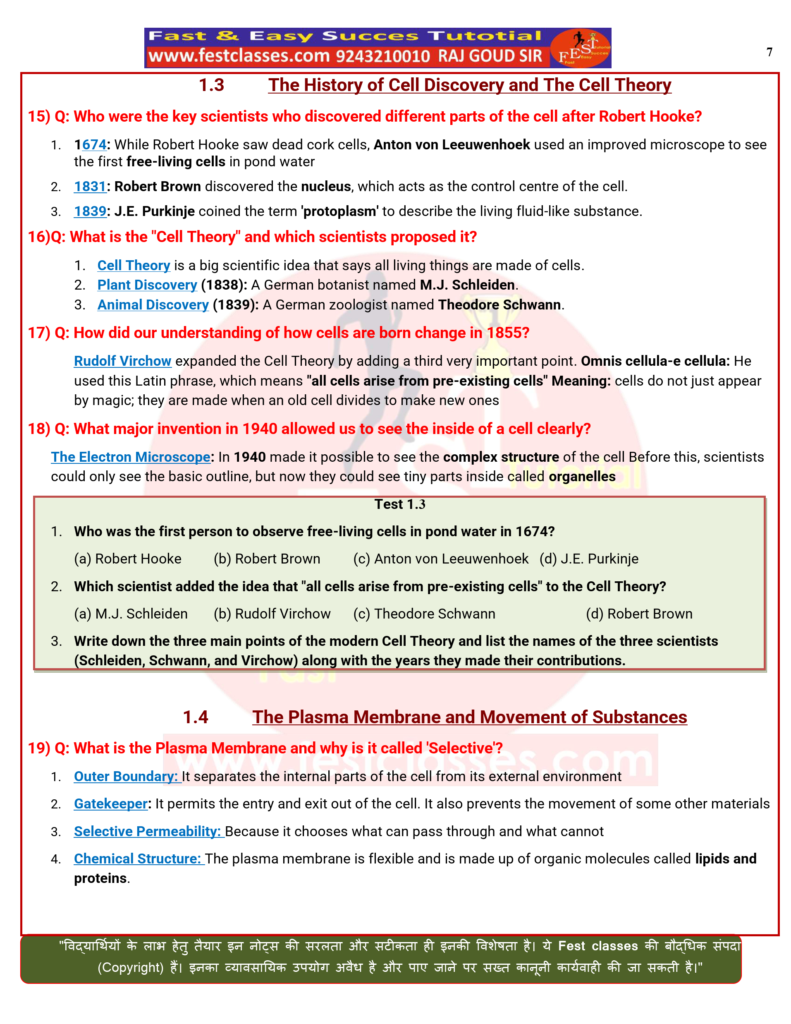
- The History of Cell Discovery and The Cell Theory
- Q: Who were the key scientists who discovered different parts of the cell after Robert Hooke?
- 1674: While Robert Hooke saw dead cork cells, Anton von Leeuwenhoek used an improved microscope to see the first free-living cells in pond water
- 1831: Robert Brown discovered the nucleus, which acts as the control centre of the cell.
- 1839: J.E. Purkinje coined the term ‘protoplasm’ to describe the living fluid-like substance.
- Q: What is the “Cell Theory” and which scientists proposed it?
- Cell Theory is a big scientific idea that says all living things are made of cells.
- Plant Discovery (1838): A German botanist named M.J. Schleiden.
- Animal Discovery (1839): A German zoologist named Theodore Schwann.
- Q: How did our understanding of how cells are born change in 1855?
Rudolf Virchow expanded the Cell Theory by adding a third very important point. Omnis cellula-e cellula: He used this Latin phrase, which means “all cells arise from pre-existing cells” Meaning: cells do not just appear by magic; they are made when an old cell divides to make new ones
- Q: What major invention in 1940 allowed us to see the inside of a cell clearly?
The Electron Microscope: In 1940 made it possible to see the complex structure of the cell Before this, scientists could only see the basic outline, but now they could see tiny parts inside called organelles
Test 1.3
- Who was the first person to observe free-living cells in pond water in 1674?
(a) Robert Hooke (b) Robert Brown (c) Anton von Leeuwenhoek (d) J.E. Purkinje
- Which scientist added the idea that “all cells arise from pre-existing cells” to the Cell Theory?
(a) M.J. Schleiden (b) Rudolf Virchow (c) Theodore Schwann (d) Robert Brown
- Write down the three main points of the modern Cell Theory and list the names of the three scientists (Schleiden, Schwann, and Virchow) along with the years they made their contributions.
- The Plasma Membrane and Movement of Substances
- Q: What is the Plasma Membrane and why is it called ‘Selective’?
- Outer Boundary: It separates the internal parts of the cell from its external environment
- Gatekeeper: It permits the entry and exit out of the cell. It also prevents the movement of some other materials
- Selective Permeability: Because it chooses what can pass through and what cannot
- Chemical Structure: The plasma membrane is flexible and is made up of organic molecules called lipids and proteins.
- Q: How is the science of osmosis used in real life for food preservation?
Perishable items like amla, lemons, or meat can be spoiled by bacteria and fungi. Adding high concentrations of salt, sugar, or jaggery creates a “Hypertonic” environment. When bacteria or fungi land on these preserved foods, the high salt/sugar concentration causes water to be drawn out of the microbe’s cells via osmosis. This prevents the microbes from growing and preserves the food (like pickles and murabbas).
- Q: How do gases like Oxygen and Carbon Dioxide move across the cell membrane? OR difference between Diffusion and Osmosis
| Sr. No. | Basis | Diffusion | Osmosis |
| 1. | Meaning | It is the natural movement of a substance from an area where there is a lot of it (high concentration) to an area where there is less of it (low concentration). | It is the movement of water molecules through a special thin skin (selectively permeable membrane) from an area with high water concentration to an area with low water concentration. |
| 2. | Type of Substance | It involves the movement of various things like gases (Oxygen or Carbon Dioxide) and liquids. | It involves only the movement of water molecules. |
| 3. | Membrane require | It can happen anywhere and does not need a membrane or barrier to take place. | It must happen through a selectively permeable membrane. |
| 4. | Example | When Carbon Dioxide (waste) builds up inside a cell and moves out into the air. | When plant roots suck up water from the soil or when a dry grape swells in water. |
- Q: What happens to a cell when placed in different types of water solutions?
- Hypotonic Solution (Dilute): If the medium outside has more water than the cell, the cell will gain water by osmosis and swell up.
- Isotonic Solution (Same): If the water concentration is exactly the same inside and outside, there is no net movement of water. The cell stays the same size.
- Hypertonic Solution (Concentrated): If the medium outside has less water (very concentrated with salt/sugar) than the cell, water leaves the cell. The cell will shrink in size.
- Q: How do organisms like Amoeba use their flexible membrane to eat?
Endocytosis: The flexibility of the plasma membrane allows the cell to engulf (wrap around) food and other materials from its external environment. Amoeba uses “false feet” (pseudopodia) to trap food particles
- Test 1.4
- If a cell is placed in a solution and it begins to swell, what kind of solution is it?
(a) Hypertonic (b) Isotonic (c) Hypotonic (d) Concentrated
- Amoeba acquires its food through which process involving the flexibility of the plasma membrane?
(a) Diffusion (b) Endocytosis (c) Plasmolysis (d) Exocytosis
- Explain why a dried raisin swells when placed in plain water but shrinks when placed in a concentrated salt solution. Use the terms “high concentration,” “low concentration,” and “osmosis” in your answer.
- Q: Why do plants need a Cell Wall, and what happens when they lose water?
Cell Wall: While animal cells only have a cell membrane, plant cells, fungi, and some bacteria have an extra, tough outer layer. It is located outside the cell membrane. the cell wall is primarily made of Cellulose. This is a complex carbohydrate made of glucose. It is very strong and It helps the plant stay upright and allows leaves and flowers to keep their firm shape. The cell wall protects plant from environmental stress like high winds and heavy rain.
- Q: Difference between Plant cell and Animal cell
| Sr. No. | Basis of Comparison | Plant Cell | Animal Cell |
| 1. | Meaning | These are the eukaryotic cells that make up green plants. | These are the eukaryotic cells that make up animals and humans. |
| 2. | Cell Wall | A rigid outer cell wall made of cellulose is always present. | The cell wall is completely absent. |
| 3. | Chloroplasts (Plastids) | Present; these contain chlorophyll to help in photosynthesis. | Absent; animal cells cannot perform photosynthesis. |
| 4. | Vacuoles | Typically contains one very large central vacuole filled with cell sap. | Vacuoles are either absent or very small and temporary. |
| 5. | Shape | Usually has a fixed, regular, or box-like shape due to the rigid cell wall. | Generally has an irregular or flexible shape. |
| 6. | Growth Pattern | They do not show contact inhibition and follow a unique growth pattern. | Cell division usually stops when they touch neighbours (contact inhibition). |
- Q: What do you mean by Plasmolysis:
This is a special event that happens in plant cells: When a living plant cell (like a Rhoeo leaf peel or Cradle lily) is placed in a concentrated sugar or salt solution, it loses water due to osmosis. As the water leaves, the inner contents of the cell (cytoplasm) shrink and pull away from the rigid cell wall. This shrinkage of the cell content away from the cell wall is called Plasmolysis.
Test 1.5
- Which of these is the primary substance that makes up the plant cell wall?
(a) Lipids (b) Proteins (c) Cellulose (d) Mitochondria
- The process where the cell membrane pulls away from the cell wall due to water loss is called:
(a) Diffusion (b) Plasmolysis (c) Endocytosis (d) Cell Division
- What is the function of the cell wall in plants? Explain why a plant cell does not lose its shape entirely during plasmolysis.
- The Nucleus: House of Coded Instructions
- Q: What is the basic structure of the nucleus?
The nucleus is surrounded by a double-layered covering known as the nuclear membrane. This membrane contains nuclear pores. These pores allow substances to move between the inside of the nucleus and the cytoplasm outside.
- Q: What are Chromatin and Chromosomes?
- chromatin In a cell that is not dividing, the genetic material looks like an entangled mass of thread-like structures called chromatin.
- Chromosomes: When a cell is about to divide, this chromatin organizes into rod-shaped structures called chromosomes.Chromosomes are made of two main things: DNA (Deoxyribonucleic acid) and specific proteins.
- Genes: The functional pieces or segments of DNA are called genes.
- Q: Difference between Nucleus and Nucleolus
| Sr. No. | Basis of Comparison | Nucleus | Nucleolus |
| 1. | Meaning | It is the large, prominent control center of the cell that houses the genetic material. | It is a dense, round body found specifically inside the nucleus. |
| 2. | Membrane Boundary | It is surrounded by a double-layered covering called the nuclear membrane. | It does not have its own membrane; it is a non-membrane bound dense structure. |
| 3. | Main Components | It contains chromatin (DNA and proteins), chromosomes, and the nucleolus. | It is primarily composed of RNA and proteins for ribosome assembly. |
| 4. | Primary Function | It stores genetic information and controls all cellular activities like growth and division. | It is the specific site where the subunits of ribosomes are synthesized. |
- Q: Can some cells survive without a nucleus?
Mature human Red Blood Cells (RBCs) do not have a nucleus. Lacking a nucleus provides more space for haemoglobin, which allows the cell to carry a larger amount of oxygen. Because they have no nucleus, RBCs cannot repair themselves or divide. As a result, they only live for approximately 120 days.
Test 1.6
- What are the functional segments of DNA called?
(a) Chromatin (b) Genes (c) Nucleolus (d) Nuclear Pores
- Which of these cells lacks a nucleus to make more room for transporting oxygen?
(a) Nerve cell (b) Muscle cell (c) Mature human Red Blood Cell (d) Onion peel cell
- Explain how the appearance of genetic material changes when a cell prepares to divide. Include the terms chromatin and chromosomes in your explanation.
- Cytoplasm and Specialized Cell Organelles
- Q: What is Cytoplasm and why is it important for the cell?
Cytoplasm is a semi-fluid , jelly-like substance that fills the space inside the cell membrane. In prokaryotic cells, most cellular activities happen directly in the cytoplasm. In eukaryotic cells, the cytoplasm contains specialized structures called organelles. The cytoplasm also stores non-living things like starch (in plant cells) or crystals of silica and calcium oxalate. These stored materials are known as cell inclusions.
- Q: differences between primitive cells and complex modern cells?
| Sr. No. | Basis of Comparison | Prokaryotic Cells | Eukaryotic Cells |
| 1. | Nucleus Structure | They lack a well-defined nucleus. The genetic material is not enclosed by a membrane and is found in a region called the nucleoid. | They have a well-defined nucleus where the genetic material is enclosed by a nuclear membrane. |
| 2. | Cell Size (Diameter) | Generally small, ranging from 1 to 10 µm. | Generally larger, ranging from 10 to 100 µm. |
| 3. | Membrane-bound Organelles | They lack membrane-bound organelles like mitochondria or plastids. | They possess various membrane-bound organelles to perform life processes. |
| 4. | Number of Cells | These organisms are usually unicellular. | These organisms can be either unicellular or multicellular. |
| 5. | DNA Structure | Genetic material is usually present as a single circular DNA molecule. | Genetic material is organized into linear chromosomes containing DNA and proteins. |
- Q: What is the Endoplasmic Reticulum (ER) and what are its two types?
The ER is a large organelle that looks like a network of tubes and sheets spreading through the cytoplasm. It is continuous with the outer membrane of the nucleus.
- Rough ER (RER): It looks rough because tiny particles called ribosomes are attached to its surface. Its main job is to manufacture and secrete proteins.
- Smooth ER (SER): It has no ribosomes on its surface, so it looks smooth. Its main job is to synthesize (make) and store fats (lipids) and hormones.
- Q: What are Ribosomes and why are they called “Protein Factories”?
Ribosomes are very small structures found floating freely in the cytoplasm or stuck to the RER. They are the specific sites where protein synthesis (making proteins) takes place. The parts of ribosomes are made in the nucleolus inside the nucleus before moving out to the cytoplasm.
- Q: What is the Golgi Apparatus and who discovered it?
It was first observed in 1898 by an Italian scientist named Camillo Golgi. He first saw it as a thread-like network in the nerve cells of a barn owl. It consists of stacks of flattened, sac-like structures. It acts like the cell’s shipping center. It modifies, sorts, and packages proteins and lipids into tiny bags called vesicles for transport. It is functionally linked to the ER and is also involved in making lysosomes.
- Q: What are Lysosomes and why are they called the “Clean-up System”?
Lysosomes are single membrane-bound bags filled with powerful digestive enzymes. They break down unwanted proteins, fats, and even old, damaged parts of the cell to keep the cell healthy. Human sperm cells contain lysosomal enzymes that help break down the outer layer of an egg so fertilization can happen.
Test 1.7
- Which organelle is responsible for the synthesis of lipids and hormones?
(a) Rough ER (b) Smooth ER (c) Ribosomes (d) Lysosomes
- Who discovered the Golgi apparatus while studying the nerve cells of an owl?
(a) Robert Hooke (b) Robert Brown (c) Camillo Golgi (d) Rudolf Virchow
- Describe how the ER, Golgi apparatus, and Lysosomes work together as a coordinated system in a cell. Which one manufactures, which one packages, and which one cleans up?
- Energy and Food: Mitochondria and Plastids
- Q: Why are Mitochondria called the “Powerhouses” of the cell?
Mitochondria supply the energy needed for almost all cellular activities. They release energy by breaking down glucose and other molecules during a process called cellular respiration. This energy is stored in a special molecule called Adenosine Triphosphate (ATP), which acts as the “energy currency” of the cell.
Double Membrane: Each mitochondrion is surrounded by two membranes:
- Outer Membrane: It is smooth and contains tiny holes (porous).
- Inner Membrane: It is folded into finger-like shapes called cristae, which create more surface area for chemical reactions to produce energy.
- Q: What are Plastids and what are their three main types?
Plastids are special organelles used for food synthesis and storage, found in plant cells.
- Chloroplasts (Green):
- They contain a green pigment called chlorophyll.
- They are the site of photosynthesis, where plants use sunlight to make food.
- Inside, they have a fluid called stroma and disc-shaped structures that hold the chlorophyll.
- Chromoplasts (Coloured):
- These contain pigments other than green, such as yellow, orange, or red.
- They give bright colours to flowers and fruits to attract insects for pollination and animals for seed dispersal.
- Leucoplasts (Colourless):
- These lack pigments and are used to store food material like starch, oils, or proteins.
- For example, leucoplasts in potatoes and taro (Colocasia) store starch.
- Q: Why are Mitochondria and Plastids considered “Semi-Autonomous”?
Both organelles have features similar to certain bacteria. Unlike other organelles, both mitochondria and plastids have their own DNA and ribosomes. Because they have these, they can make some of their own proteins independently. These characteristics suggest they share an evolutionary history with single-celled organisms.
Test 1.8
- Which molecule is known as the “energy currency” of the cell?
(a) DNA (b) ATP (c) RNA (d) Glucose
- Which type of plastid is responsible for storing oils and proteins?
(a) Chloroplast (b) Chromoplast (c) Leucoplast (d) Mitochondria
- Explain the structural difference between the outer and inner membranes of a mitochondrion. Why is the inner membrane folded into cristae?
- Vacuoles and Cell Division (Mitosis and Meiosis)
- Q: What are Vacuoles and how do they differ in plants and animals?
Vacuoles are membrane-bound organelles used for storage and support. Mature plant cells usually have one large central vacuole filled with a watery fluid called cell sap. By storing water, the central vacuole maintains pressure, which keeps the plant cell firm and upright. If a plant lacks water, the vacuole loses its content, the cell becomes less firm, and the plant wilts. In animal cells, vacuoles are either absent or very small and are used for temporary storage.
- Q: What is Cell Division and why is it necessary?
Cell division is the process by which new cells are formed from pre-existing cells. It is necessary for growth, replacing old or damaged cells (like healing a cut), and reproduction. Every day, hundreds of billions of cells are replaced in the human body, which is about 1% of our total cells.
- Q: How do the two main types of cell division differ in their purpose and results?
| Sr. No. | Basis of Comparison | Mitosis | Meiosis |
| 1. | Primary Purpose | Used for normal growth, tissue repair, maintenance, and asexual reproduction. | Used specifically for sexual reproduction and to create genetic diversity. |
| 2. | Number of Divisions | The parent cell divides only once to form new cells. | The parent cell divides twice, one after the other. |
| 3. | Number of Daughter Cells | Produces two daughter cells from one parent cell. | Produces four daughter cells from one parent cell. |
| 4. | Genetic Composition | Daughter cells are genetically identical and have the same number of chromosomes as the parent. | Daughter cells (gametes) have half the number of chromosomes compared to the parent cell. |
- Q: What happens if cell division goes wrong?
- Mitosis Errors: Uncontrolled cell division can lead to the formation of tumors (cancer) or abnormal chromosome numbers in body cells.
- Meiosis Errors: Faulty meiosis can result in genetic disorders, developmental problems, early pregnancy loss, or reduced fertility.
Test 1.9
- …………… type of cell division produces four daughter cells with half the number of chromosomes?
- ………….. fills the large central vacuole of a plant cell to keep it firm?
- Differentiate between Mitosis and Meiosis based on the number of daughter cells produced and the genetic similarity to the parent cell. Why is meiosis important for sexual reproduction?
- Q: Who was Arun Kumar Sharma and what was his contribution to science?
He wasrenowned Indian botanist and scientist and best known for his work on chromosomes. His scientific contributions covered plant taxonomy, evolution, and development. He invented many useful laboratory methods specifically to study chromosomes. he received the Shanti Swarup Bhatnagar Award and the Padma Bhushan.
- Q: What is “Totipotency” and who proposed this idea?
In 1902, the Austrian botanist Gottlieb Haberlandt proposed this concept. He suggested that any living plant cell has the ability to develop into a complete plant if given the right nutrients and conditions. This special ability of plant cells to form different types of cells and regenerate an entire organism is called totipotency. Haberlandt’s idea laid the foundation for Plant Tissue Culture Technology.
- Q: What was the significance of J. Craig Venter’s experiment in 2010?
His team made a major discovery by creating a cell controlled by synthetic DNA. They chemically synthesized an exact copy of the DNA of a bacterium called Mycoplasma mycoides. They removed the original DNA from a living cell and replaced it with this laboratory-made synthetic DNA. The cell began to grow and divide following the instructions of the synthetic DNA. This experiment proved that DNA is the primary component that controls the structure and activities of a cell.
- Q: What is Programmed Cell Death (PCD) and why is it necessary?
PCD is a genetically regulated and organized process of selective cell destruction. It is essential for normal growth; for example, it helps form fingers in an embryo by removing the cells between the digits. Without PCD, humans would be born with webbed hands. It acts as a balance to maintain health by eliminating cells that are no longer needed or are damaged.
- Q: How do cancer cells differ from normal cells in their growth?
Normal cells grow, age, and die in a controlled manner and often stop dividing when they touch other cells (contact inhibition). Cancer cells lose this system and keep dividing uncontrollably. This uncontrolled division leads to the formation of masses called tumours. Cancerous tumours can invade nearby tissues and spread to other parts of the body to form new tumours.
Test 1.10
- Which scientist is known for laying the foundation of Plant Tissue Culture Technology through the idea of totipotency ……….….
- What is the term for the organized, genetically regulated destruction of cells during development ………….
- Describe the experiment conducted by J. Craig Venter in 2010. What did this experiment prove the role of DNA
- Scientific Concepts in Food Preservation and Synthetic Biology
- Q: How does the science of osmosis help in preserving foods like amla and lemons?
- Spoilage: Foods like amla and lemons can be spoiled by the growth of microorganisms like bacteria and fungi. Adding high amounts of salt, sugar, or jaggery creates a very concentrated environment around the food.
- Water Loss in Microbes: When a bacteria or fungus lands on these preserves, the high salt/sugar concentration outside causes water to move out of the microbe’s cells through osmosis. This water loss causes the microbe cells to shrink, which prevents them from growing or multiplying, thus extending the shelf life of the food.
- Economic Benefit: This method, called agro-processing, helps farmers prevent post-harvest wastage and increase their income by creating products like pickles and murabbas.
- Q: What is the future of synthetic cells and what are the ethical concerns?
- Laboratory Creation: Scientists are working on developing “synthetic cells” using non-living chemicals in a laboratory.
- Current Progress: While scientists have successfully inserted synthetic DNA into existing cells to control them, they have not yet created a completely new living cell from scratch.
- Ethical Issues: The creation of life in a lab raises serious questions, such as whether humans should “play God” or the risks of synthetic organisms escaping into the natural environment.
- Q: How do the cell membrane components move from their origin to the final boundary?
- Manufacturing Sites: The proteins are made by ribosomes on the Rough ER, and lipids are made by the Smooth ER.These materials are sent to the Golgi apparatus.
- Packaging and Delivery: The Golgi apparatus modifies and packages these lipids and proteins into tiny bags called vesicles.
- Final Assembly: These vesicles travel to the edge of the cell and fuse with the existing plasma membrane to help it grow or repair itself.
Test 1.11
- ……………. scientific process is primarily responsible for preventing microbe growth in heavily salted pickles?
- ……… organelle acts as the “packaging and shipping centre” to send membrane materials to their destination?
- Explain the step-by-step path a protein molecule takes from its synthesis in the ER to becoming part of the cell membrane. Mention the organelles involved in this “coordinated system.”