


Chapter – 1.
Private, Public and Global enterprises
1.1
Private Sector and Public Sector
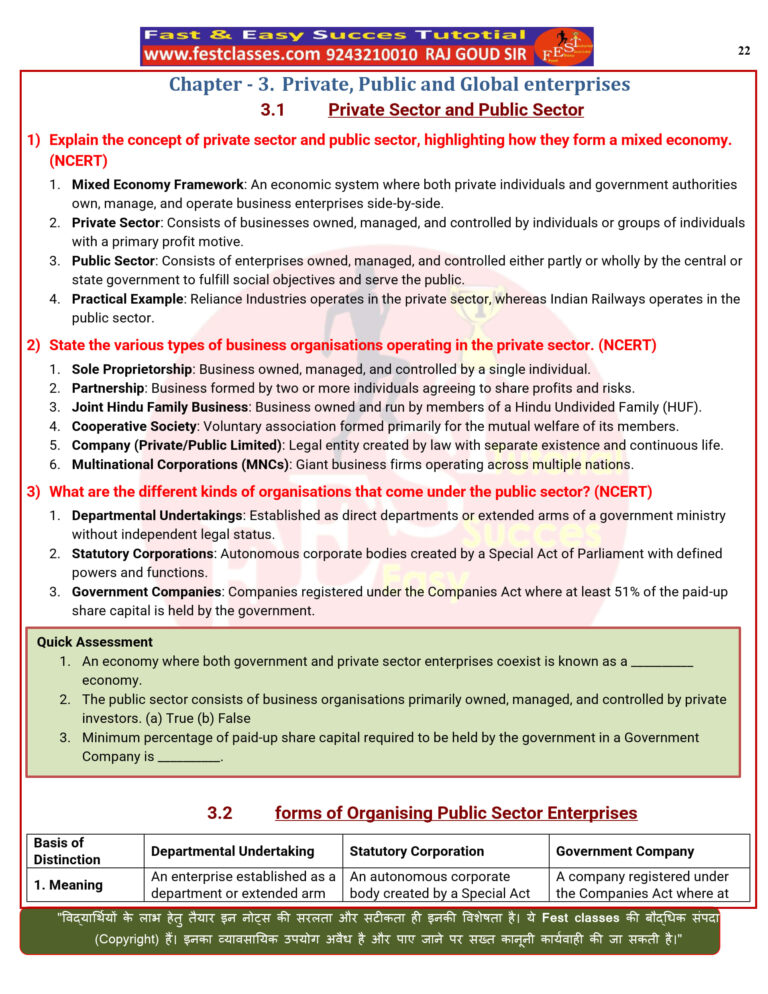
1) Explain
the concept of private sector and public sector, highlighting how they form a
mixed economy. (NCERT)
- Mixed
Economy Framework:
An economic system where both private individuals and government
authorities own, manage, and operate business enterprises side-by-side.
- Private
Sector: Consists of
businesses owned, managed, and controlled by individuals or groups of
individuals with a primary profit motive.
- Public
Sector: Consists of
enterprises owned, managed, and controlled either partly or wholly by the
central or state government to fulfill social objectives and serve the
public.
- Practical
Example: Reliance
Industries operates in the private sector, whereas Indian Railways
operates in the public sector.
2) State
the various types of business organisations operating in the private sector.
(NCERT)
- Sole
Proprietorship:
Business owned, managed, and controlled by a single individual.
- Partnership: Business formed by two or more
individuals agreeing to share profits and risks.
- Joint
Hindu Family Business:
Business owned and run by members of a Hindu Undivided Family (HUF).
- Cooperative
Society: Voluntary
association formed primarily for the mutual welfare of its members.
- Company
(Private/Public Limited): Legal entity created by law with separate existence and
continuous life.
- Multinational
Corporations (MNCs):
Giant business firms operating across multiple nations.
3) What
are the different kinds of organisations that come under the public sector?
(NCERT)
- Departmental
Undertakings:
Established as direct departments or extended arms of a government
ministry without independent legal status.
- Statutory
Corporations:
Autonomous corporate bodies created by a Special Act of Parliament with
defined powers and functions.
Quick Assessment
- An
economy where both government and private sector enterprises
coexist is known as a __________ economy.
- The
public sector consists of business organisations primarily owned,
managed, and controlled by private investors. (a) True (b) False
- Minimum
percentage of paid-up share capital required to be held by the
government in a Government Company is __________.
- An
economy where both government and private sector enterprises
coexist is known as a __________ economy.
1.2
forms of Organising Public Sector Enterprises
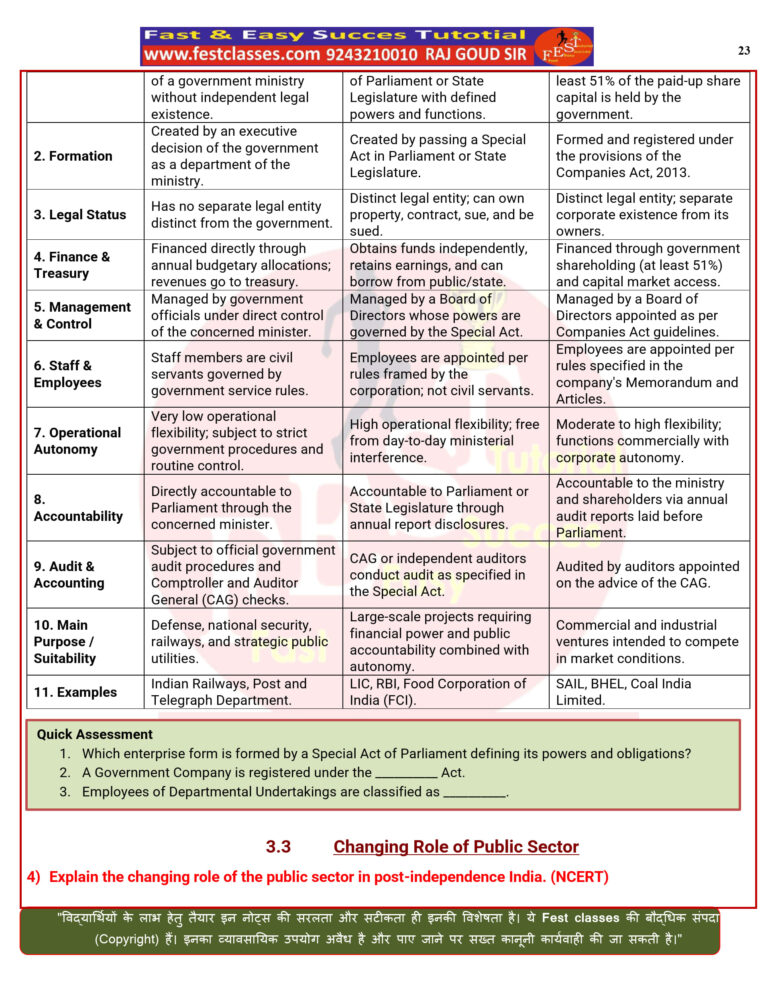
|
Basis of Distinction |
Departmental Undertaking |
Statutory Corporation |
Government Company |
|
1. Meaning |
An enterprise established as a
department or extended arm of a government ministry without independent legal
existence. |
An autonomous corporate body created by
a Special Act of Parliament or State Legislature with defined powers and
functions. |
A company registered under the
Companies Act where at least 51% of the paid-up share capital is held by the
government. |
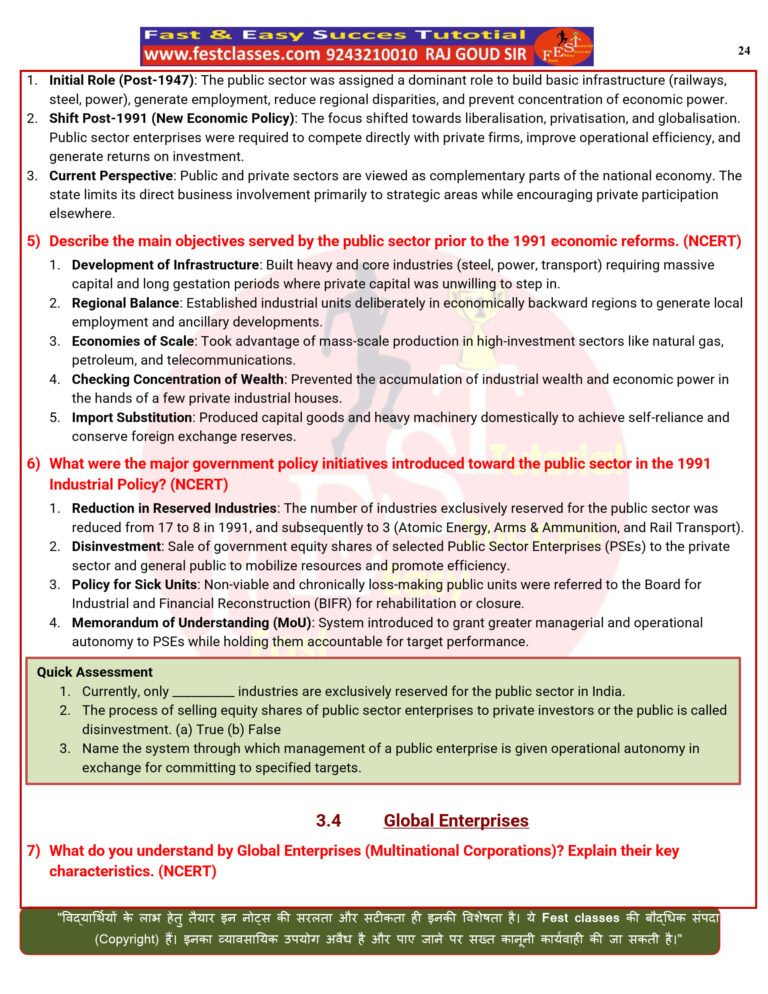
|
2. Formation |
Created by an executive decision of the
government as a department of the ministry. |
Created by passing a Special Act in
Parliament or State Legislature. |
Formed and registered under the
provisions of the Companies Act, 2013. |
|
3. Legal Status |
Has no separate legal entity distinct
from the government. |
Distinct legal entity; can own
property, contract, sue, and be sued. |
Distinct legal entity; separate
corporate existence from its owners. |
|
4. Finance & Treasury |
Financed directly through annual
budgetary allocations; revenues go to treasury. |
Obtains funds independently, retains
earnings, and can borrow from public/state. |
Financed through government
shareholding (at least 51%) and capital market access. |
|
5. Management & Control |
Managed by government officials under
direct control of the concerned minister. |
Managed by a Board of Directors whose
powers are governed by the Special Act. |
Managed by a Board of Directors
appointed as per Companies Act guidelines. |
|
6. Staff & Employees |
Staff members are civil servants
governed by government service rules. |
Employees are appointed per rules
framed by the corporation; not civil servants. |
Employees are appointed per rules
specified in the company’s Memorandum and Articles. |
|
7. Operational Autonomy |
Very low operational flexibility;
subject to strict government procedures and routine control. |
High operational flexibility; free from
day-to-day ministerial interference. |
Moderate to high flexibility; functions
commercially with corporate autonomy. |
|
8. Accountability |
Directly accountable to Parliament
through the concerned minister. |
Accountable to Parliament or State
Legislature through annual report disclosures. |
Accountable to the ministry and
shareholders via annual audit reports laid before Parliament. |
|
9. Audit & Accounting |
Subject to official government audit
procedures and Comptroller and Auditor General (CAG) checks. |
CAG or independent auditors conduct
audit as specified in the Special Act. |
Audited by auditors appointed on the
advice of the CAG. |
|
10. Main Purpose / Suitability |
Defense, national security, railways,
and strategic public utilities. |
Large-scale projects requiring
financial power and public accountability combined with autonomy. |
Commercial and industrial ventures
intended to compete in market conditions. |
|
11. Examples |
Indian Railways, Post and Telegraph
Department. |
LIC, RBI, Food Corporation of India
(FCI). |
SAIL, BHEL, Coal India Limited. |
|
Quick Assessment
|
1.3
Changing Role of Public Sector
4) Explain
the changing role of the public sector in post-independence India. (NCERT)
1.
Initial
Role (Post-1947): The
public sector was assigned a dominant role to build basic infrastructure
(railways, steel, power), generate employment, reduce regional disparities, and
prevent concentration of economic power.
2.
Shift
Post-1991 (New Economic Policy): The focus shifted towards liberalisation, privatisation, and
globalisation. Public sector enterprises were required to compete directly with
private firms, improve operational efficiency, and generate returns on
investment.
3.
Current
Perspective: Public and
private sectors are viewed as complementary parts of the national economy. The
state limits its direct business involvement primarily to strategic areas while
encouraging private participation elsewhere.
5) Describe
the main objectives served by the public sector prior to the 1991 economic
reforms. (NCERT)
- Development
of Infrastructure:
Built heavy and core industries (steel, power, transport) requiring
massive capital and long gestation periods where private capital was
unwilling to step in.
- Regional
Balance:
Established industrial units deliberately in economically backward regions
to generate local employment and ancillary developments.
- Economies
of Scale: Took
advantage of mass-scale production in high-investment sectors like natural
gas, petroleum, and telecommunications.
- Checking
Concentration of Wealth: Prevented the accumulation of industrial wealth and economic
power in the hands of a few private industrial houses.
- Import
Substitution:
Produced capital goods and heavy machinery domestically to achieve
self-reliance and conserve foreign exchange reserves.
6) What
were the major government policy initiatives introduced toward the public
sector in the 1991 Industrial Policy? (NCERT)
- Reduction
in Reserved Industries:
The number of industries exclusively reserved for the public sector was
reduced from 17 to 8 in 1991, and subsequently to 3 (Atomic Energy, Arms
& Ammunition, and Rail Transport).
- Disinvestment: Sale of government equity shares
of selected Public Sector Enterprises (PSEs) to the private sector and
general public to mobilize resources and promote efficiency.
- Policy
for Sick Units:
Non-viable and chronically loss-making public units were referred to the
Board for Industrial and Financial Reconstruction (BIFR) for
rehabilitation or closure.
Quick Assessment
- Currently,
only __________ industries are exclusively reserved for the
public sector in India.
- The
process of selling equity shares of public sector enterprises to
private investors or the public is called disinvestment. (a) True
(b) False
- Name
the system through which management of a public enterprise is
given operational autonomy in exchange for committing to
specified targets.
- Currently,
only __________ industries are exclusively reserved for the
public sector in India.
1.4
Global Enterprises
7) What
do you understand by Global Enterprises (Multinational Corporations)? Explain
their key characteristics. (NCERT)
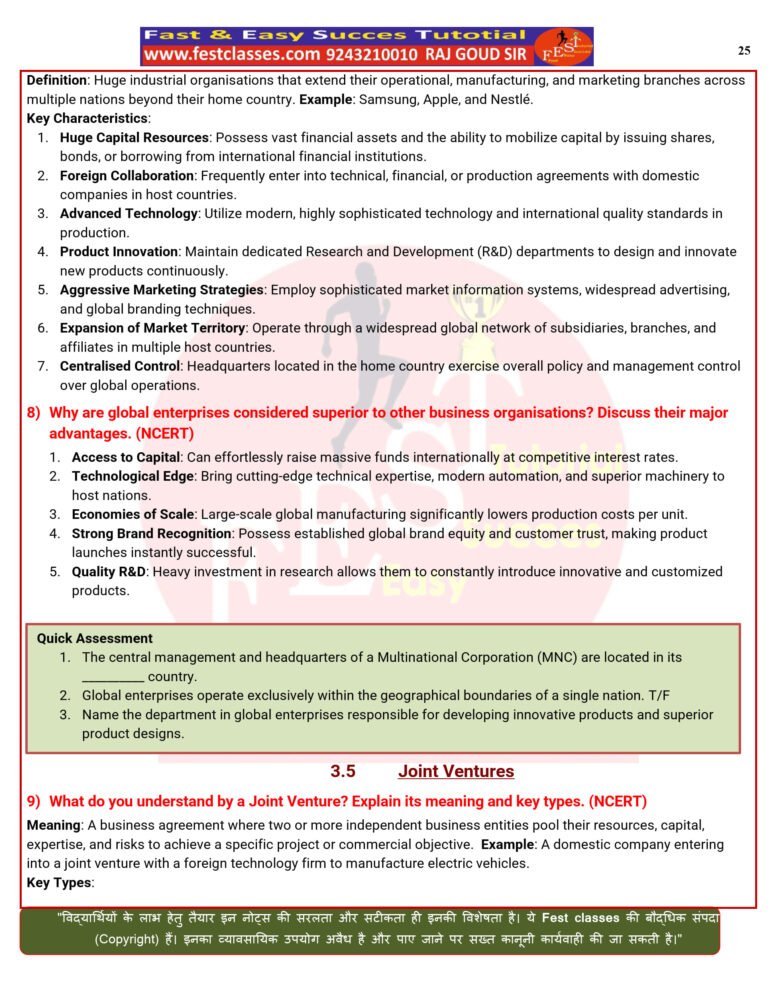
Definition: Huge industrial organisations that extend their
operational, manufacturing, and marketing branches across multiple nations
beyond their home country. Example: Samsung, Apple, and Nestlé.
Key Characteristics:
1.
Huge
Capital Resources:
Possess vast financial assets and the ability to mobilize capital by issuing
shares, bonds, or borrowing from international financial institutions.
2.
Foreign
Collaboration:
Frequently enter into technical, financial, or production agreements with
domestic companies in host countries.
3.
Advanced
Technology: Utilize
modern, highly sophisticated technology and international quality standards in
production.
4.
Product
Innovation: Maintain
dedicated Research and Development (R&D) departments to design and innovate
new products continuously.
5.
Aggressive
Marketing Strategies:
Employ sophisticated market information systems, widespread advertising, and
global branding techniques.
6.
Expansion
of Market Territory:
Operate through a widespread global network of subsidiaries, branches, and
affiliates in multiple host countries.
7.
Centralised
Control: Headquarters
located in the home country exercise overall policy and management control over
global operations.
8) Why
are global enterprises considered superior to other business organisations?
Discuss their major advantages. (NCERT)
- Access
to Capital: Can
effortlessly raise massive funds internationally at competitive interest
rates.
- Technological
Edge: Bring
cutting-edge technical expertise, modern automation, and superior
machinery to host nations.
- Economies
of Scale:
Large-scale global manufacturing significantly lowers production costs per
unit.
- Strong
Brand Recognition:
Possess established global brand equity and customer trust, making product
launches instantly successful.
- Quality
R&D: Heavy
investment in research allows them to constantly introduce innovative and
customized products.
|
Quick Assessment
|
1.5
Joint Ventures
9) What
do you understand by a Joint Venture? Explain its meaning and key types.
(NCERT)
Meaning: A business agreement where two or more independent business entities
pool their resources, capital, expertise, and risks to achieve a specific
project or commercial objective. Example: A domestic company entering into
a joint venture with a foreign technology firm to manufacture electric
vehicles.
Key Types:
1.
Contractual
Joint Venture (CJV):
§ No separate legal entity or new company
is created.
§ Parties enter into a legal agreement to
work together on a specific project or business relationship.
§ Control is shared based on contractual
terms rather than equity ownership (e.g., franchising or strategic distribution
alliances).
2.
Equity-based
Joint Venture (EJV):
§ A distinct legal business entity is newly
formed and jointly owned by two or more participating entities.
§ Capital, management control, profits, and
losses are shared in agreed proportions.
§ Can take the legal structure of a private
company, public company, or limited liability partnership.
10) What are the major benefits of entering into a joint
venture? (NCERT)
- Increased
Resources and Capacity:
Combining financial capital, physical assets, and human resources allows
the new business to scale operations rapidly.
- Access
to New Markets and Distribution Networks: Foreign firms gain immediate access to
domestic markets and established distribution channels of local partners.
- Access
to Advanced Technology:
Eliminates the need to develop proprietary technology from scratch, saving
time and research expenditure.
- Innovation
and Product Development: Enables partner firms to pool creative ideas, engineering
skills, and R&D capabilities for innovative product offerings.
- Low
Cost of Production:
Allows global partners to leverage lower labor, raw material, and
operational costs in host developing nations.
- Established
Brand Name: One
partner can leverage the existing market goodwill and established brand
identity of the other partner.
|
Quick Assessment
|
1.6
Public Private Partnership (PPP)
11)What
is meant by Public Private Partnership (PPP)? Discuss its features, strengths,
and weaknesses. (NCERT)
Meaning: A long-term business relationship between government entities and
private sector enterprises designed to finance, build, operate, and maintain
public infrastructure projects and services. Example: The Kundli Manesar
Expressway project, where the government provided land while a private
enterprise constructed and managed the roadway surface.
Key Features:
o Resource Sharing: Public entities provide land, statutory
approvals, and capital assets, while private partners contribute financial
capital, operational efficiency, and innovation.
o Risk Allocation: Project design, construction, and
operational risks are systematically transferred to the private partner.
o Focus on Social Priorities: Ensures public utility obligations and
infrastructure goals are met efficiently.
2. Strengths:
o Project Acceleration: Speeds up the execution and completion
of capital-intensive projects.
o Risk Transfer: Relieves the public sector from bearing initial
design and execution risks.
o Operational Efficiency: Leverages private sector expertise,
management practices, and technology.
3. Weaknesses:
o Complex Contracting: Conflicts may arise between public and
private entities over environmental or social considerations.
o
|
Quick Assessment
|