


Chapter – 1.
Organising
1.1
Meaning, Concept, and Importance of Organising
1) What
is meant by organising? Explain its core concept and step-by-step process.
(NCERT) (MP 2018, 2021, 2024)
It
determines what activities and resources are required and decides who will do a
particular task, where it will be done and when it will be done. Thus,
organizing means establishing relationship between various factors of
production.
1. Identification and: First step in organising. The total work to be
performed is identified
2. Division of Work By dividing the work, the
burden of work can be shared among the employees. It facilitates specialization
of work & skills.
3. Departmentalisation: Creating departments. Activities of a similar
nature are grouped together into major units or departments (e.g., Marketing,
Purchase, Finance, Human Resources).
4. Assignment of Duties: Work is assigned to individual members
according to their skill, knowledge, and qualification, placing the right
person in the right job.
5. Establishing Reporting Relationships: Reporting lines. Clear hierarchical lines are
established so that every employee knows who they are to take orders from and
to whom they are accountable.
2) Explain
the importance or significance of organising in an enterprise. (NCERT) (MP
2019, 2022, 2025)
Organising is crucial
for smooth management and operational efficiency within an enterprise:
1.
Benefits
of Specialisation: It leads to
high efficiency and employee expertise through repetitive execution.
2.
Clarity
in Working Relationships: Authority
and reporting structures eliminate confusion regarding roles.
3.
Optimum
Utilisation of Resources:
Proper assignment of jobs avoids overlapping or duplication of work.
4.
Adaptation
to Change: Allows business
structures to adjust to dynamic economic, technological, or market conditions.
5.
Effective
Administration: Clear
descriptions of jobs and duties prevent confusion and simplify daily executive
supervision.
6.
Development
of Personnel: Delegating
authority encourages creative problem-solving among subordinate managers.
7.
|
Quick Assessment 5.1 1.
Which
step in the organising process involves grouping similar activities into
specialized units? (a)
Identification of Work (b) Departmentalisation (c) Assignment of Duties (d)
Delegation 2.
Organising
leads to duplication of efforts and confusion regarding authority lines.
(T/F) 3.
Name
the step in the organising process that establishes clear reporting lines
between superior and subordinate. 4. What is the primary benefit of dividing
work into smaller, repetitive tasks? |
1.2
Organisation Structure
3) What
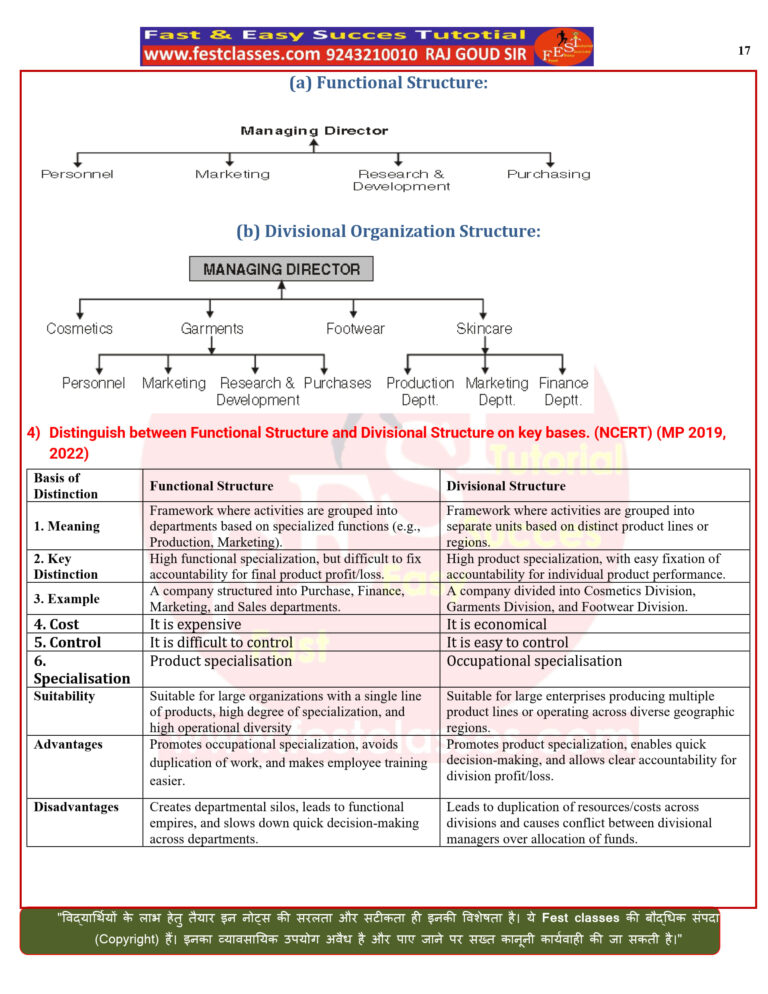
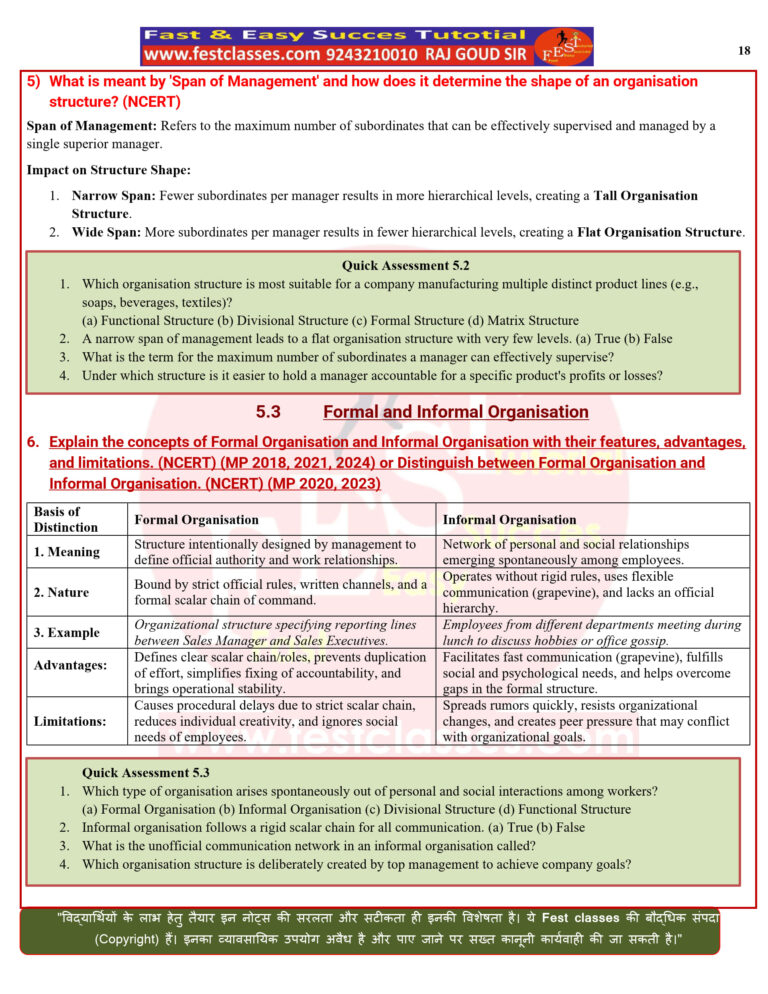
is an organisation structure? Explain its types: Functional Structure and
Divisional Structure with their suitability, advantages, and disadvantages.
(NCERT) (MP 2017, 2020, 2023)
An organisation
structure is the framework of managerial and operating tasks within which
authority-responsibility relationships are clearly defined.
(a) Functional Structure:
(b) Divisional Organization Structure:
4) Distinguish
between Functional Structure and Divisional Structure on key bases. (NCERT) (MP
2019, 2022)
|
Basis of Distinction |
Functional Structure |
Divisional Structure |
|
1. Meaning |
Framework where activities are grouped into
departments based on specialized functions (e.g., Production, Marketing). |
Framework where activities are grouped into
separate units based on distinct product lines or regions. |
|
2. Key Distinction |
High functional specialization, but difficult
to fix accountability for final product profit/loss. |
High product specialization, with easy
fixation of accountability for individual product performance. |
|
3. Example |
A company structured into Purchase, Finance,
Marketing, and Sales departments. |
A company divided into Cosmetics Division,
Garments Division, and Footwear Division. |
|
4. Cost |
It is expensive |
It is economical |
|
5. Control |
It is difficult to control |
It is easy to control |
|
6. Specialisation |
Product specialisation |
Occupational specialisation |
|
Suitability
|
Suitable for large organizations with a
single line of products, high degree of specialization, and high operational
diversity |
Suitable for large enterprises producing
multiple product lines or operating across diverse geographic regions. |
|
Advantages |
Promotes occupational specialization, avoids
duplication of work, and makes employee training easier. |
Promotes product specialization, enables
quick decision-making, and allows clear accountability for division
profit/loss. |
|
Disadvantages |
Creates departmental silos, leads to
functional empires, and slows down quick decision-making across departments. |
Leads to duplication of resources/costs
across divisions and causes conflict between divisional managers over
allocation of funds. |
5) What
is meant by ‘Span of Management’ and how does it determine the shape of an
organisation structure? (NCERT)
Span of Management: Refers to the maximum number of subordinates
that can be effectively supervised and managed by a single superior manager.
Impact on Structure
Shape:
1. Narrow Span: Fewer subordinates per manager results in more hierarchical levels,
creating a Tall Organisation Structure.
2.
|
Quick Assessment 5.2 1.
Which
organisation structure is most suitable for a company manufacturing
multiple distinct product lines (e.g., soaps, beverages, textiles)? (a)
Functional Structure (b) Divisional Structure (c) Formal Structure (d)
Matrix Structure 2.
A
narrow span of management leads to a flat organisation structure with very
few levels. (a) True (b) False 3.
What
is the term for the maximum number of subordinates a manager can
effectively supervise? 4.
Under
which structure is it easier to hold a manager accountable for a specific
product’s profits or losses? 5. |
1.3
Formal and Informal Organisation
6.
|
Quick
Assessment 5.3 1.
Which
type of organisation arises spontaneously out of personal and social
interactions among workers? (a)
Formal Organisation (b) Informal Organisation (c) Divisional Structure (d)
Functional Structure 2.
Informal
organisation follows a rigid scalar chain for all communication. (a) True
(b) False 3.
What
is the unofficial communication network in an informal organisation called? 4. Which organisation structure is
deliberately created by top management to achieve company goals? |
|
Basis of Distinction |
Formal Organisation |
Informal Organisation |
|
1. Meaning |
Structure intentionally designed by
management to define official authority and work relationships. |
Network of personal and social relationships
emerging spontaneously among employees. |
|
2. Nature |
Bound by strict official rules, written
channels, and a formal scalar chain of command. |
Operates without rigid rules, uses flexible
communication (grapevine), and lacks an official hierarchy. |
|
3. Example |
Organizational structure specifying reporting
lines between Sales Manager and Sales Executives. |
Employees from different departments meeting
during lunch to discuss hobbies or office gossip. |
|
Advantages:
|
Defines clear scalar chain/roles, prevents
duplication of effort, simplifies fixing of accountability, and brings
operational stability. |
Facilitates fast communication (grapevine),
fulfills social and psychological needs, and helps overcome gaps in the
formal structure. |
|
Limitations: |
Causes procedural delays due to strict scalar
chain, reduces individual creativity, and ignores social needs of employees. |
Spreads rumors quickly, resists
organizational changes, and creates peer pressure that may conflict with
organizational goals. |
1.4
Delegation of Authority
7. Define
Delegation. Explain the three essential elements of delegation: Authority,
Responsibility, and Accountability. (NCERT) (MP 2017, 2022, 2025)
Delegation is the downward transfer of authority from a
superior to a subordinate. It is essential for the efficient functioning of an
organization because no manager can personally perform all tasks.
- 1. Authority, 2. Responsibility: 3. Accountability:
8. Distinguish between Authority, Responsibility,
and Accountability. (NCERT)
|
Basis of Distinction |
Authority |
Responsibility |
Accountability |
|
1. Meaning |
Right to command, make decisions, and take
action. |
Obligation to perform the assigned task or
duty. |
Answerability for the final outcome of the
delegated task. |
|
2. Key Distinction |
Can be fully delegated to a subordinate. |
Delegated partially along with assigned work. |
Cannot be delegated under any circumstances. |
|
3. Example |
A manager’s right to issue raw materials from
the store. |
A foreman’s duty to produce 100 units by the
end of the day. |
The manager remains answerable to top
management if the target is missed. |
|
Origin |
Arises from formal position. |
Arises from delegated authority. |
Arises from responsibility. |
|
Flow |
Downward- from superior to
subordinate. |
Upward- from
subordinate to superior.
|
Upward- from subordinate to superior |
|
Withdrawal |
Can be withdrawn anytime by giving notice. |
Cannot be withdrawn once created. |
Cannot be withdrawn
once created.
|
9. Explain
the importance or benefits of delegation in an organisation. (NCERT) (MP 2019,
2023)
1.
Effective
Management: Relieves managers
of routine operational tasks, allowing them to focus on high-priority
2.
Employee
Development: Empowers
subordinates with decision-making power, building confidence
3.
Motivation
of Employees: Trusting
subordinates with authority boosts their morale, job satisfaction, and
commitment to targets.
4.
Facilitates
Growth: Builds a trained
workforce, making business expansion and creation of new departments smoother.
5.
Basis
of Management Hierarchy:
Establishes clear superior-subordinate relationships and defines who reports to
whom.
6.
|
Quick
Assessment 5.4 1.
Which
element of delegation cannot be passed on or delegated to a subordinate
under any circumstances? (a)
Authority (b) Responsibility (c) Accountability (d) Work 2.
Authority
flows upward while responsibility flows downward in an organization
hierarchy.(a) True (b) False 3.
What
is the principle that states a superior remains answerable for the final
output even after delegating authority? 4. Name the element of delegation that means
the obligation of a subordinate to properly perform an assigned duty. |
1.5
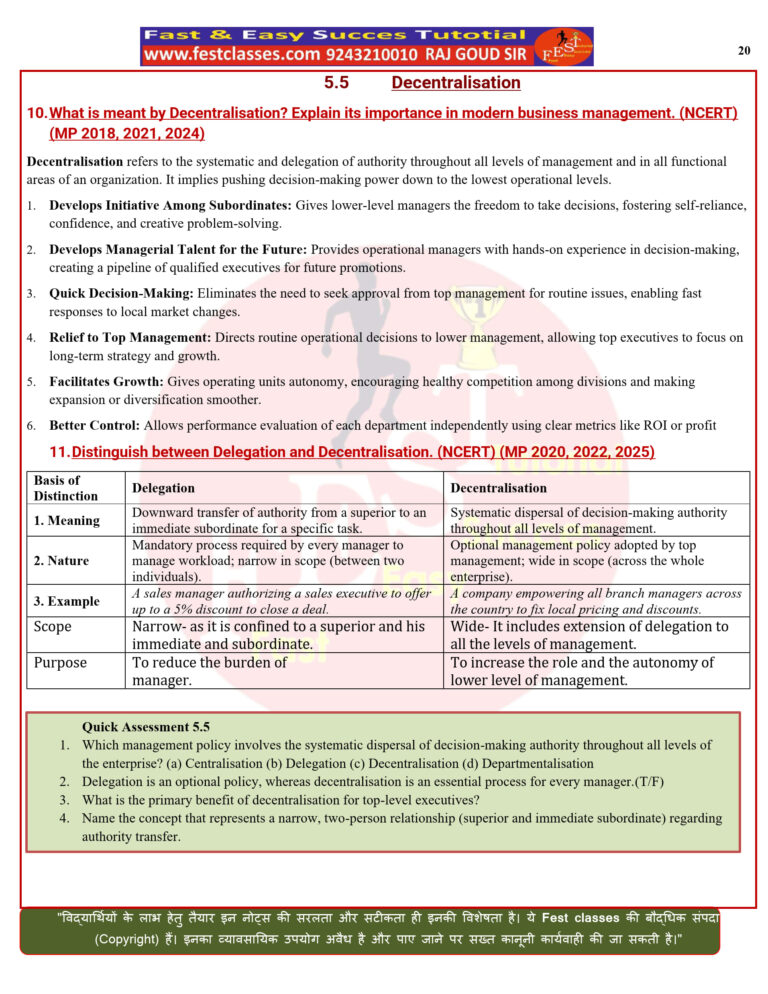
Decentralisation
10. What is
meant by Decentralisation? Explain its importance in modern business
management. (NCERT) (MP 2018, 2021, 2024)
Decentralisation refers to the systematic and delegation of
authority throughout all levels of management and in all functional areas of an
organization. It implies pushing decision-making power down to the lowest
operational levels.
1.
Develops
Initiative Among Subordinates:
Gives lower-level managers the freedom to take decisions, fostering
self-reliance, confidence, and creative problem-solving.
2.
Develops
Managerial Talent for the Future: Provides operational managers with hands-on experience in
decision-making, creating a pipeline of qualified executives for future
promotions.
3.
Quick
Decision-Making: Eliminates
the need to seek approval from top management for routine issues, enabling fast
responses to local market changes.
4.
Relief
to Top Management: Directs
routine operational decisions to lower management, allowing top executives to
focus on long-term strategy and growth.
5.
Facilitates
Growth: Gives operating units
autonomy, encouraging healthy competition among divisions and making expansion
or diversification smoother.
6.
Better
Control: Allows performance
evaluation of each department independently using clear metrics like ROI or
profit
11. Distinguish
between Delegation and Decentralisation. (NCERT) (MP 2020, 2022, 2025)
|
Basis of Distinction |
Delegation |
Decentralisation |
|
1. Meaning |
Downward transfer of authority from a
superior to an immediate subordinate for a specific task. |
Systematic dispersal of decision-making
authority throughout all levels of management. |
|
2. Nature |
Mandatory process required by every manager
to manage workload; narrow in scope (between two individuals). |
Optional management policy adopted by top
management; wide in scope (across the whole enterprise). |
|
3. Example |
A sales manager authorizing a sales executive
to offer up to a 5% discount to close a deal. |
A company empowering all branch managers
across the country to fix local pricing and discounts. |
|
Scope |
Narrow- as it is confined to a superior and
his immediate and subordinate. |
Wide- It includes extension of delegation to
all the levels of management. |
|
Purpose |
To reduce the burden of manager. |
To increase the role and the autonomy of
lower level of management. |
|
Quick
Assessment 5.5 1.
Which
management policy involves the systematic dispersal of decision-making
authority throughout all levels of the enterprise? (a) Centralisation (b)
Delegation (c) Decentralisation (d) Departmentalisation 2.
Delegation
is an optional policy, whereas decentralisation is an essential process for
every manager.(T/F) 3.
What
is the primary benefit of decentralisation for top-level executives? 4. Name the concept that represents a narrow,
two-person relationship (superior and immediate subordinate) regarding
authority transfer. |