


Chapter – 1 Introduction of an Economy (Micro Economics)
Chapter – 1.
Introduction
of an econnomy
1.1
A Simple Economy and the Central Problems of an
Economy
1) Q:
What do you mean by Economics?
Economics is the study of how
individuals, households, and society choose to allocate their highly scarce
resources to satisfy their unlimited human wants .
Root
Cause: The
absolute root cause of all economic issues is scarcity. (V.V.V imp)
2)
Q: What do you mean by scarcity: (imp)
It is defined as excess of demand over available
supply, i.e., demand of resources greater than supply of resources.
3) Q: What do you mean by
a Simple Economy?
A simple
economy is an introductory model of a society where independent individuals
act as both producers and consumers to fulfil their needs through mutual
exchange.(like a farmer growing corn) and trade away their surplus to get other
daily necessities .
4)
Q: Why does the “Problem of Choice” arise in
every economy?
Every
economy have limited resources and resources have their alternative uses. the problem
of choice arises due to scarcity of resources .
5)
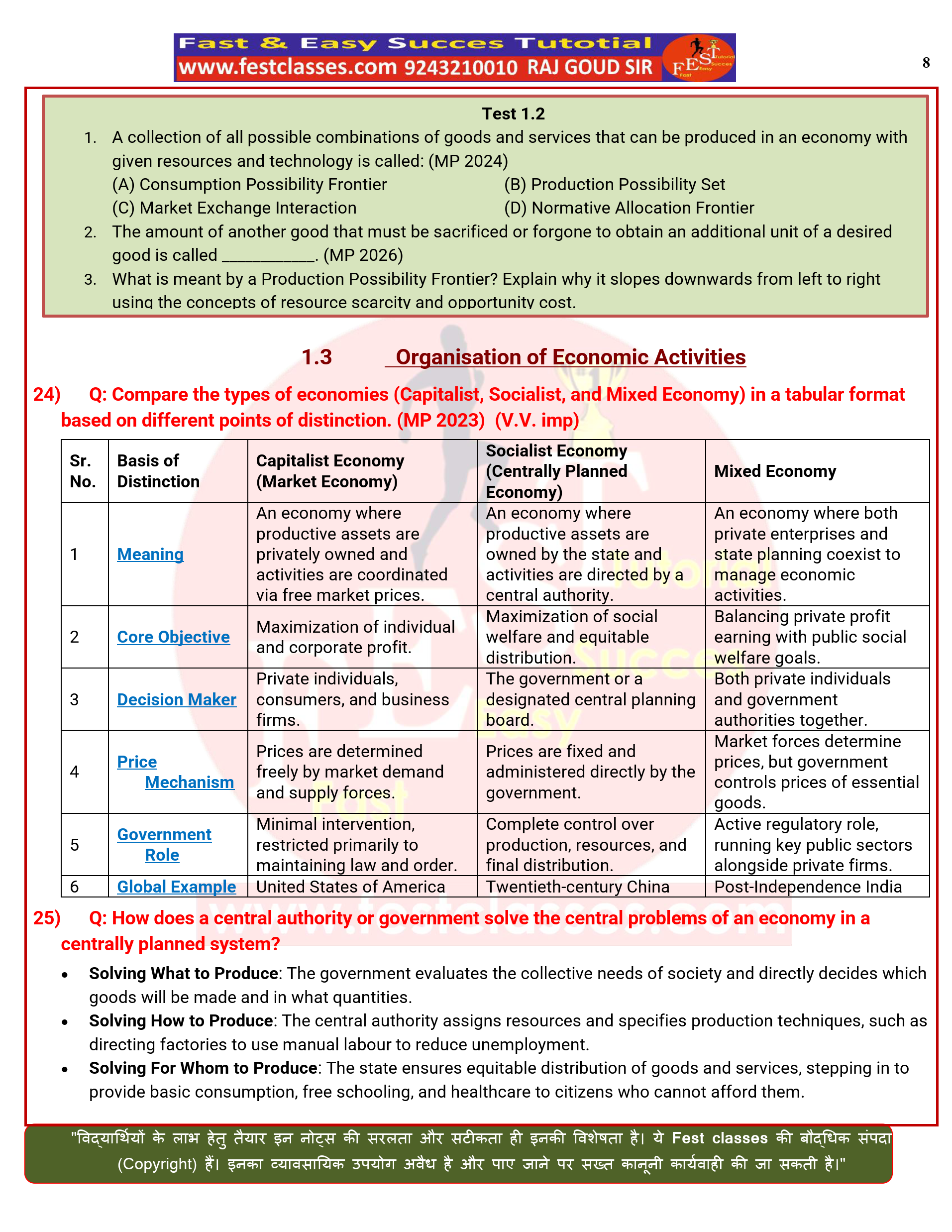
Q: What are the fundamental economic problems being
faced by any society?
completely
unlimited human wants and highly scarce resources .
6) Q:
What specific bundle of resources does a family farm, a weaver, a school
teacher, and a poor labourer own in a society or in a simple economy?
1.
Farm: Agricultural Land Plot, Seed
and Grain Stocks, Cultivation Equipment, Animal, Human Labour
2.
Weaver: yarn and cotton, Machinery for weaving cloth.
3.
Teacher: Specialized mental skills
and knowledge.
4.
Labourer: no resource excepting
their own labour services.
7) Q:
What is the exact formal definition of ‘goods’ in economic terms, and what are
its examples?
1.
Tangible Goods are physical, material
objects that a person can see, hold, and touch .and used specifically to
satisfy the various material wants and needs of individuals. Ex: Fan, computer
2.
Intangible Character: Services are
non-physical actions or tasks that cannot be touched. Services are created to fulfil
human desires and provide utility through action. Ex: service of teacher,
doctor
8) Q:
What does the term ‘individual’ actually mean as a decision-making unit in
economic text?
Individual does not merely signify a
single separate human being; it means any single cohesive decision-making
entity in the economy. ex: Single Humans, Collective Households (family), Organisations:
.
9) Q:
Why must there be compatibility between collective production and collective
consumption in an economy?
Total
production choices made by all units together must match up perfectly with the
total consumption desires of the whole population because we assume the society is completely
isolated, meaning all items consumed must be grown or made internally with zero
outside imports .
10)
Q: What happens to resource allocation if
society collectively produces more corn or less corn than what people actually
want to consume?
- Overproduction
Adjustment:
resources must be moved out of farming to produce other goods that are in
high demand by the public .
- Underproduction
Adjustment:
the economy must step in and change its resource map. Society must take
inputs away from other goods and reallocate them into growing more corn to
satisfy the public.
11)
Q: What are the three specific central problems
that every single economy must solve? (imp)
- What to Produce: Deciding exactly which
goods and services are to be produced and in what total quantities.
- How to Produce: Deciding the exact
methods, resource combinations, and techniques used to create those chosen
goods
- For Whom to Produce: Deciding the final
distribution layout to determine who gets how much of the finished
national output
12)
Q: What detailed choices and trade-offs come
under the central problem of ‘What to produce and in what quantities’?
Food Vs Luxury Dilemma: A society must choose
whether to allocate its scarce land and factories to produce basic food,
clothes, and housing, or high-end luxury items
13)
Q: What detailed choices regarding resource
combinations and techniques come under the central problem of ‘How to produce’?
Producers
must choose whether to adopt a technique that uses more human hands
(labour-intensive) or one that relies heavily on mechanical equipment
(capital-intensive)
14)
Q: What detailed choices regarding the final
share of distribution and minimum standards come under the central problem of
‘For whom to produce’?
|
Test 1.1 1.
Among the competing usage of resources, the main cause of the
“Problem of Choice” in economy (MP 2026) (A) Abundance of resources (B)
Scarcity of resources (C) Misuses
of resources (D)
No uses of resources 2.
The fundamental economic problems being faced: (MP 2025) (a) Unlimited human
wants (b)
Limited wants and unlimited resources (c) Unlimited wants and scarcity resources (d) Limited wants and limited resources 3.
What do you understand by the term “Scarcity”? Explain how
scarcity acts as the root cause behind the problem of choice and list the
three central problems that every economy must solve.
|
1.2
Production Possibility Frontier and Opportunity
Cost
15)
Q: What do you understand by the production
possibilities or the Production Possibility Set of an economy?
A Production
Possibility Set is the complete collection of all the different
combinations of goods and services that an economy can possibly produce using
its given resources and available technology
16)
Q: What are the fixed parameters or conditions
assumed when determining the Production Possibility Set of an economy? Or
assumption of ppc curve (imp)
Assumptions of the
Production Possibility Frontier (PPF)
- Fixed Quantity of
Resources:
The total stock of productive resources available in the economy is
completely fixed and given.
- Constant Technology: The state of
technology and technical knowledge remains unchanged throughout the
analysis.
- Full and Efficient Employment: All available
resources are assumed to be fully utilized and employed with maximum
efficiency (zero wastage).
- Transferable Resources: Resources are not
specific to one job; they can be freely shifted from the production of one
good to another.
- Two-Good Economy Model: For simple graphic
representation, it is assumed that the economy produces only two distinct
goods (e.g., corn and cotton).
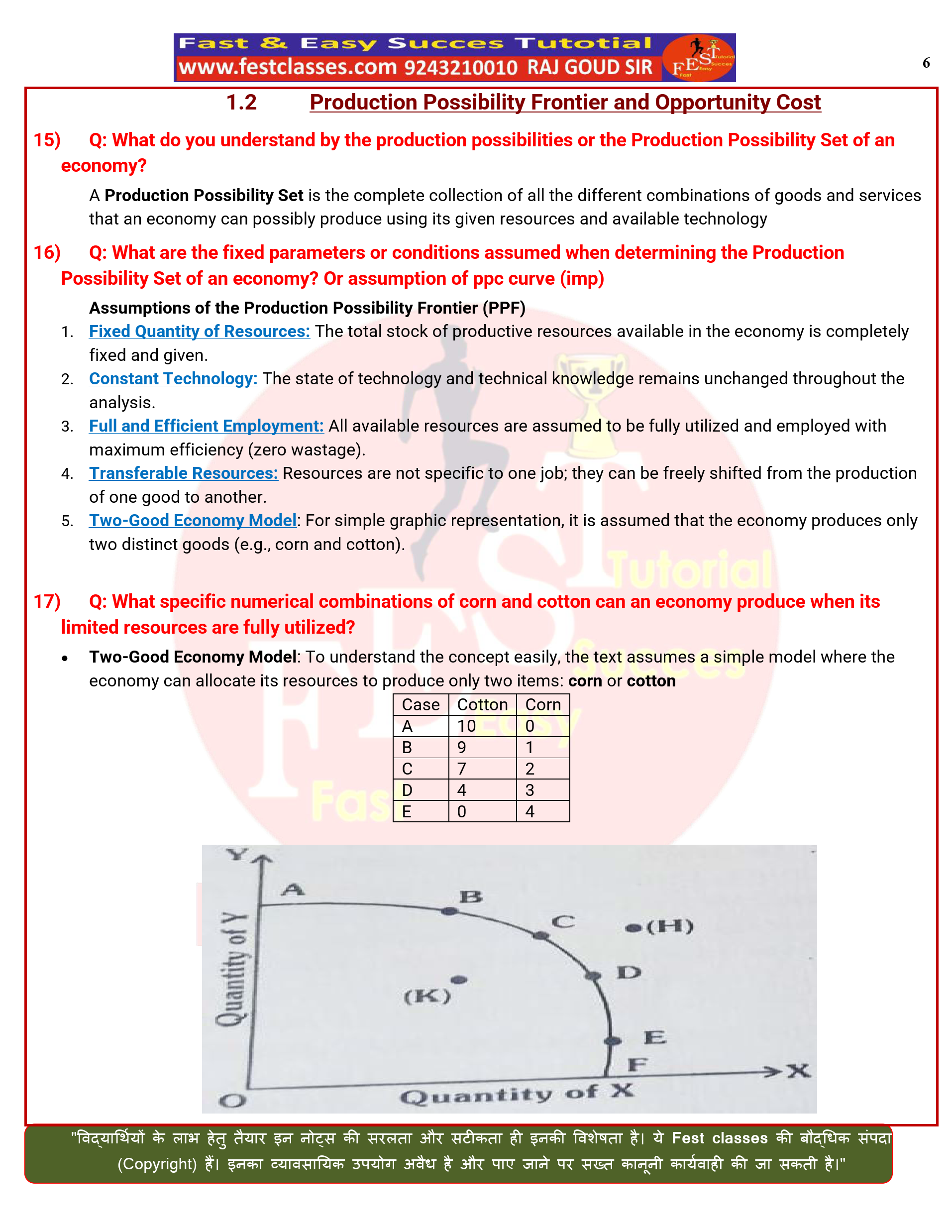
17)
Q: What specific numerical combinations of corn
and cotton can an economy produce when its limited resources are fully
utilized?
- Two-Good Economy Model: To understand the concept easily, the text
assumes a simple model where the economy can allocate its resources to
produce only two items: corn or cotton
|
Case |
Cotton |
Corn |
|
A |
10 |
0 |
|
B |
9 |
1 |
|
C |
7 |
2 |
|
D |
4 |
3 |
|
E |
0 |
4 |
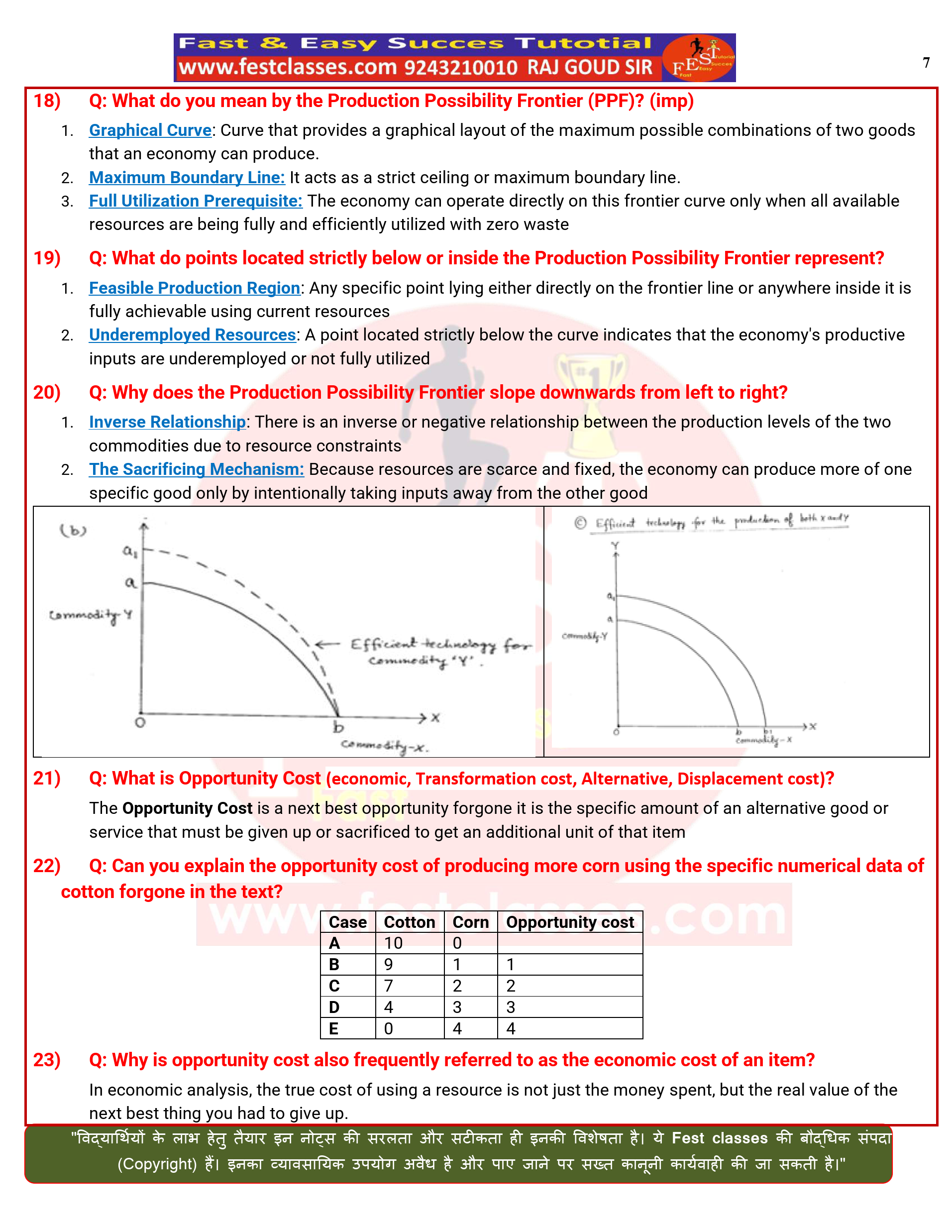
21)
Q: What do you mean by the Production
Possibility Frontier (PPF)? (imp)
- Graphical Curve: Curve that provides a
graphical layout of the maximum possible combinations of two goods that an
economy can produce.
- Maximum Boundary Line: It acts as a strict
ceiling or maximum boundary line.
- Full Utilization
Prerequisite: The economy can operate directly on this frontier curve only when
all available resources are being fully and efficiently utilized with zero
waste
22)
Q: What do points located strictly below or
inside the Production Possibility Frontier represent?
- Feasible Production
Region:
Any specific point lying either directly on the frontier line or anywhere
inside it is fully achievable using current resources
- Underemployed Resources: A point located
strictly below the curve indicates that the economy’s productive inputs
are underemployed or not fully utilized
23)
Q: Why does the Production Possibility Frontier
slope downwards from left to right?
- Inverse Relationship: There is an inverse
or negative relationship between the production levels of the two
commodities due to resource constraints
- The Sacrificing
Mechanism:
Because resources are scarce and fixed, the economy can produce more of
one specific good only by intentionally taking inputs away from the other
good
|
|
|
26)
Q: What is Opportunity Cost (economic, Transformation cost, Alternative, Displacement cost)?
The
Opportunity Cost is a next best opportunity forgone it is the specific
amount of an alternative good or service that must be given up or sacrificed to
get an additional unit of that item
27)
Q: Can you explain the opportunity cost of
producing more corn using the specific numerical data of cotton forgone in the
text?
|
Case |
Cotton |
Corn |
Opportunity cost |
|
A |
10 |
0 |
|
|
B |
9 |
1 |
1 |
|
C |
7 |
2 |
2 |
|
D |
4 |
3 |
3 |
|
E |
0 |
4 |
4 |
32)
Q: Why
is opportunity cost also frequently referred to as the economic cost of an
item?
In economic analysis, the true cost of using a
resource is not just the money spent, but the real value of the next best thing
you had to give up.
|
Test 1.2 1.
A collection of all possible combinations of goods and services that
can be produced in an economy with given resources and technology is
called: (MP 2024) (A)
Consumption Possibility Frontier (B)
Production Possibility Set (C) Market
Exchange Interaction (D)
Normative Allocation Frontier 2.
The amount of another good that must be sacrificed or forgone to
obtain an additional unit of a desired good is called ____________. (MP
2026) 3.
What is meant by a Production Possibility Frontier? Explain why it
slopes downwards from left to right using the concepts of resource scarcity
and opportunity cost. |
1.3
Organisation of Economic Activities
33)
Q: Compare the types of economies (Capitalist,
Socialist, and Mixed Economy) in a tabular format based on different points of
distinction. (MP 2023) (V.V. imp)
|
Sr. No. |
Basis of Distinction |
Capitalist Economy (Market Economy) |
Socialist Economy (Centrally Planned
Economy) |
Mixed Economy |
|
1 |
Meaning |
An economy where productive assets are
privately owned and activities are coordinated via free market prices. |
An economy where productive assets are
owned by the state and activities are directed by a central authority. |
An economy where both private
enterprises and state planning coexist to manage economic activities. |
|
2 |
Core
Objective |
Maximization of individual and
corporate profit. |
Maximization of social welfare and
equitable distribution. |
Balancing private profit earning with public
social welfare goals. |
|
3 |
Decision
Maker |
Private individuals, consumers, and
business firms. |
The government or a designated central
planning board. |
Both private individuals and government
authorities together. |
|
4 |
Price
Mechanism |
Prices are determined freely by market
demand and supply forces. |
Prices are fixed and administered
directly by the government. |
Market forces determine prices, but
government controls prices of essential goods. |
|
5 |
Government
Role |
Minimal intervention, restricted
primarily to maintaining law and order. |
Complete control over production,
resources, and final distribution. |
Active regulatory role, running key
public sectors alongside private firms. |
|
6 |
Global
Example |
United States of America |
Twentieth-century China |
Post-Independence India |
39)
Q: How does a central authority or government
solve the central problems of an economy in a centrally planned system?
- Solving What to Produce: The government evaluates the collective needs
of society and directly decides which goods will be made and in what
quantities.
- Solving How to Produce: The central authority assigns resources and
specifies production techniques, such as directing factories to use manual
labour to reduce unemployment.
- Solving For Whom to Produce: The state ensures equitable distribution
of goods and services, stepping in to provide basic consumption, free
schooling, and healthcare to citizens who cannot afford them.
40)
Q: What is the formal definition of a Market in
economics, and how does it differ from a common marketplace?
A market is a place where buyers and sellers can easily
contact each other to trade goods or services. Example: Buying a book from an
online website like Amazon or a local shop
41)
Q: How do price signals bring coordination and
solve the central problems of an economy in a market system?
- Reflecting Social
Valuation:
The mutually agreed price of a good represents how much society values
that item relative to other commodities.
- Coordination of Output: If buyers demand more
of an item, its price rises, sending a clear signal to producers to
reallocate resources and increase the production of that specific good.
- Factor Mix Allocation: Producers choose
resource combinations based on input prices, naturally selecting cheaper,
efficient technologies to maximize their profits.
Test 1.3
1. An economy in which all major economic decisions regarding production, exchange, and consumption are dictated by a central state authority is called a: (MP 2024)
(A) Capitalist Economy (B) Centrally Planned Economy
(C) Free Market Economy (D) Price-Signal Economy
2. An economy where some important decisions are taken by the government but economic activities are by and large conducted through the market is called a ____________ economy.
3. Write two distinctions between a Centrally Planned Economy and a Market Economy. (MP 2023)
1.4
Positive and Normative Economics, and Branches
of Economics
42)
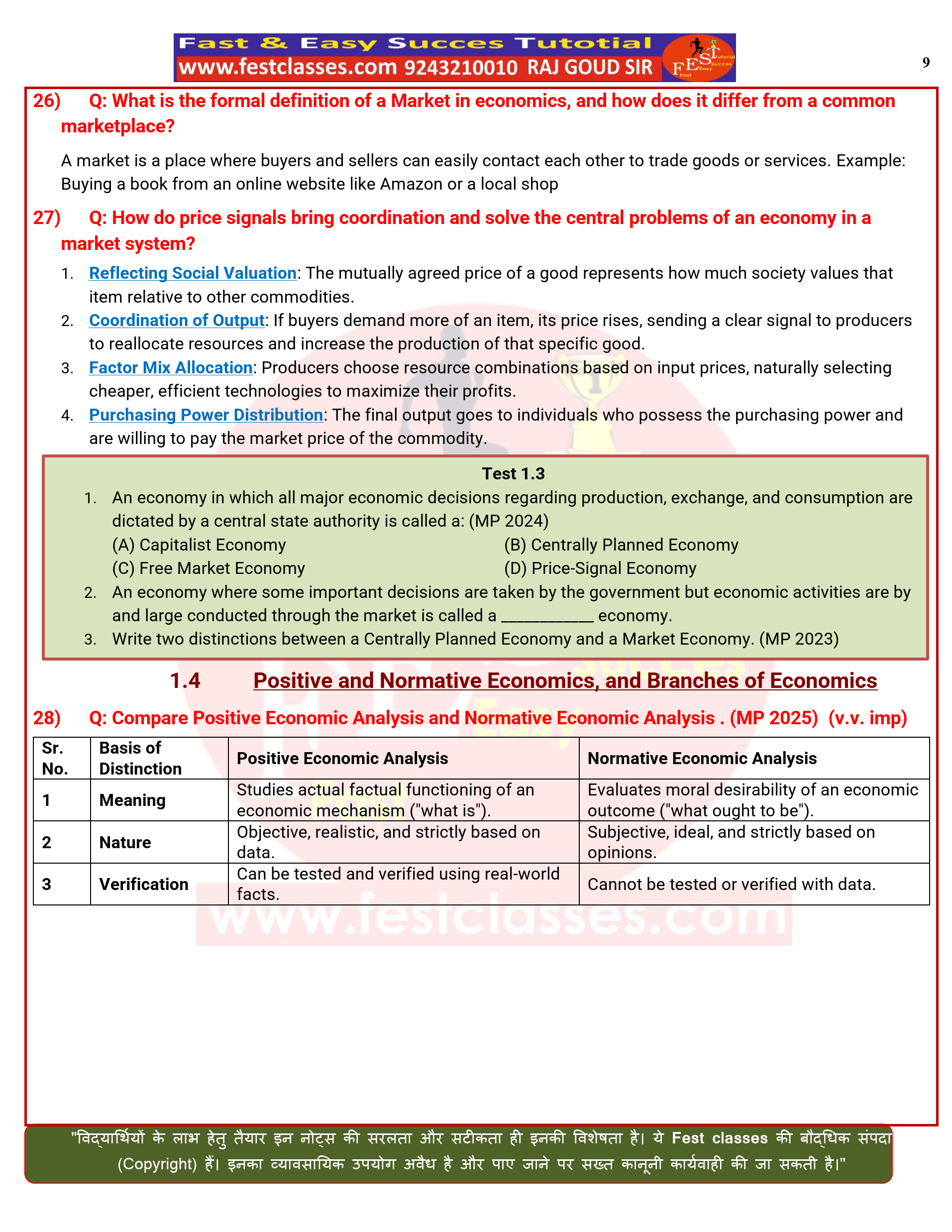
Q: Compare Positive Economic Analysis and
Normative Economic Analysis . (MP 2025)
(v.v. imp)
|
Sr. No. |
Basis of Distinction |
Positive Economic Analysis |
Normative Economic
Analysis |
|
1 |
Meaning |
Studies actual factual
functioning of an economic mechanism (“what is”). |
Evaluates moral
desirability of an economic outcome (“what ought to be”). |
|
2 |
Nature |
Objective, realistic, and
strictly based on data. |
Subjective, ideal, and
strictly based on opinions. |
|
3 |
Verification |
Can be tested and verified
using real-world facts. |
Cannot be tested or
verified with data. |
47)
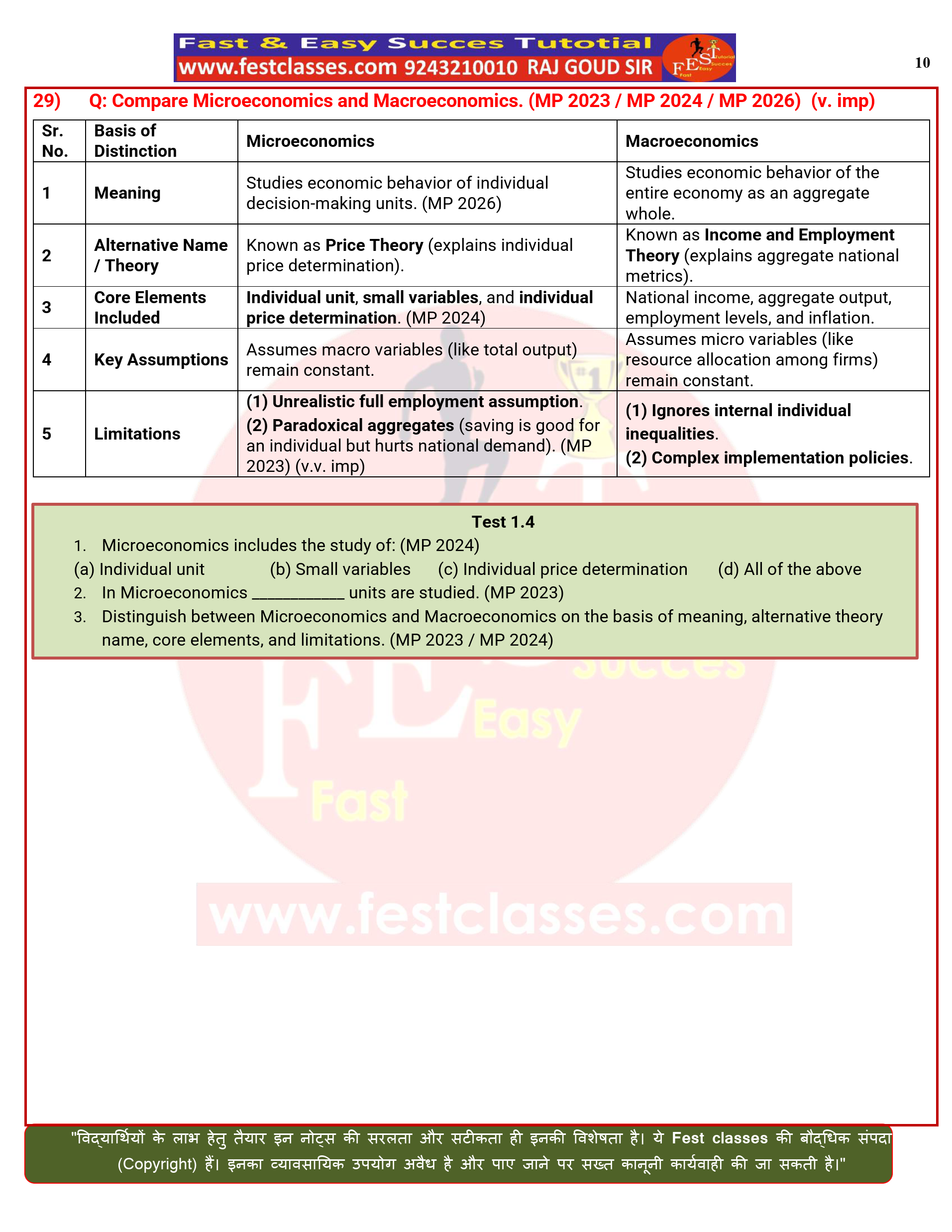
Q: Compare Microeconomics and Macroeconomics.
(MP 2023 / MP 2024 / MP 2026) (v. imp)
|
Sr. No. |
Basis of Distinction |
Microeconomics |
Macroeconomics |
|
1 |
Meaning |
Studies economic behavior
of individual decision-making units. (MP 2026) |
Studies economic behavior
of the entire economy as an aggregate whole. |
|
2 |
Alternative Name / Theory |
Known as Price Theory
(explains individual price determination). |
Known as Income and
Employment Theory (explains aggregate national metrics). |
|
3 |
Core Elements Included |
Individual unit, small variables,
and individual price determination. (MP 2024) |
National income, aggregate
output, employment levels, and inflation. |
|
4 |
Key Assumptions |
Assumes macro variables
(like total output) remain constant. |
Assumes micro variables
(like resource allocation among firms) remain constant. |
|
5 |
Limitations |
(1) Unrealistic full
employment assumption. (2) Paradoxical aggregates (saving is good for an
individual but hurts national demand). (MP 2023) (v.v. imp) |
(1) Ignores internal
individual inequalities. (2) Complex implementation
policies. |
|
Test 1.4 1.
Microeconomics includes the study of: (MP 2024) (a) Individual unit (b) Small variables (c) Individual price determination (d) All of the above 2.
In Microeconomics ____________ units are studied. (MP 2023) 3.
Distinguish between Microeconomics and Macroeconomics on the basis
of meaning, alternative theory name, core elements, and limitations. (MP
2023 / MP 2024)
|