


Chapter 1: Accounting for Partnership – Basic Concepts



Chapter – 1.
Accounting
for Partnership – Basic Concepts
1.1
Nature and Essential Features of Partnership
1) Q.
Define Partnership according to Section 4 of the Indian Partnership Act, 1932.
Also, explain the terms ‘Partners’, ‘Firm’, and ‘Firm Name’. (MP 2024, NCERT)
Definition of Partnership: According to Section 4 of
the Indian Partnership Act, 1932: “Partnership is the relation between
persons who have agreed to share the profits of a business carried on by all or
any of them acting for all.”
- Partners: The persons who have
entered into a partnership with one another individually are called
‘Partners’.
- Firm: Collectively, all the
partners who run the business together are called a ‘Firm’.
- Firm Name: The specific name
under which the partnership business is conducted and managed is called
the ‘Firm Name’.
2) Q.
Explain the separate legal entity status of a partnership firm. Discuss it from
both an accounting and a legal viewpoint. (MP 2023, NCERT)
A
partnership firm has a unique status regarding its identity, which must be
understood through two distinct viewpoints:
1.
From an Accounting Viewpoint: (separate business entity) From
the accounting perspective All transactions, capital accounts, drawings, and
profits are recorded in the books of accounts purely from the firm’s
perspective.
2.
From a Legal Viewpoint: (not separate legal entity) under
the Indian Partnership Act, 1932, The firm and the partners are one and the
same in the eyes of the law. This implies that if the firm’s assets are
insufficient to pay off its debts, the private or personal assets of the
partners can be legally used to clear the firm’s liabilities.
3) Q3.
Explain the essential features or characteristics of a partnership firm. (MP
2025, MP 2023, NCERT)
To form a valid partnership, the following essential
features must be present:
- Two or More Persons: Minimum 2 persons &
maximum partners are 50.
- Agreement: A partnership is born
out of an agreement. This agreement can be either oral (spoken) or
written.
- Lawful Business: The partners must
carry out a legal or lawful business. Co-ownership of a property without a
regular business does not create a partnership.
- Profit Sharing: The main objective of
the agreement must be to share the profits of the business.
If an association is formed purely for charity work, it cannot be called a
partnership.
- Mutual Agency: The business must be
carried on by all the partners or by any one of them acting for all. This
means every partner is both a principal (can bind other
partners) and an agent (is bound by other partners).
- Restriction on Transfer
of Share: No partner can
transfer or sell their ownership share in the firm to an outsider or
family member without obtaining the unanimous (100%) consent of all other
existing partners.
- Unlimited Liability: The liability of all
partners is joint, several, and unlimited. If the business assets are not
enough to pay off the debts, the personal properties of the partners can
be used to pay the creditors.
- Only Individuals Can Be
Partners: Only natural human
persons who are legally competent to enter into a contract can become
partners. An artificial legal entity, an association of persons, or
another firm cannot become a partner. Minors and persons of unsound mind
are excluded from signing a regular partnership contract.
|
Quick Assessment 1.1
(a) Indian Partnership Act, 1930 (b)
Indian Partnership Act, 1932 (c) Company Act, 1956 (d)
Indian Partnership Act, 1931
|
1.2
Partnership Deed (Meaning, Importance, and Rules
in Absence)
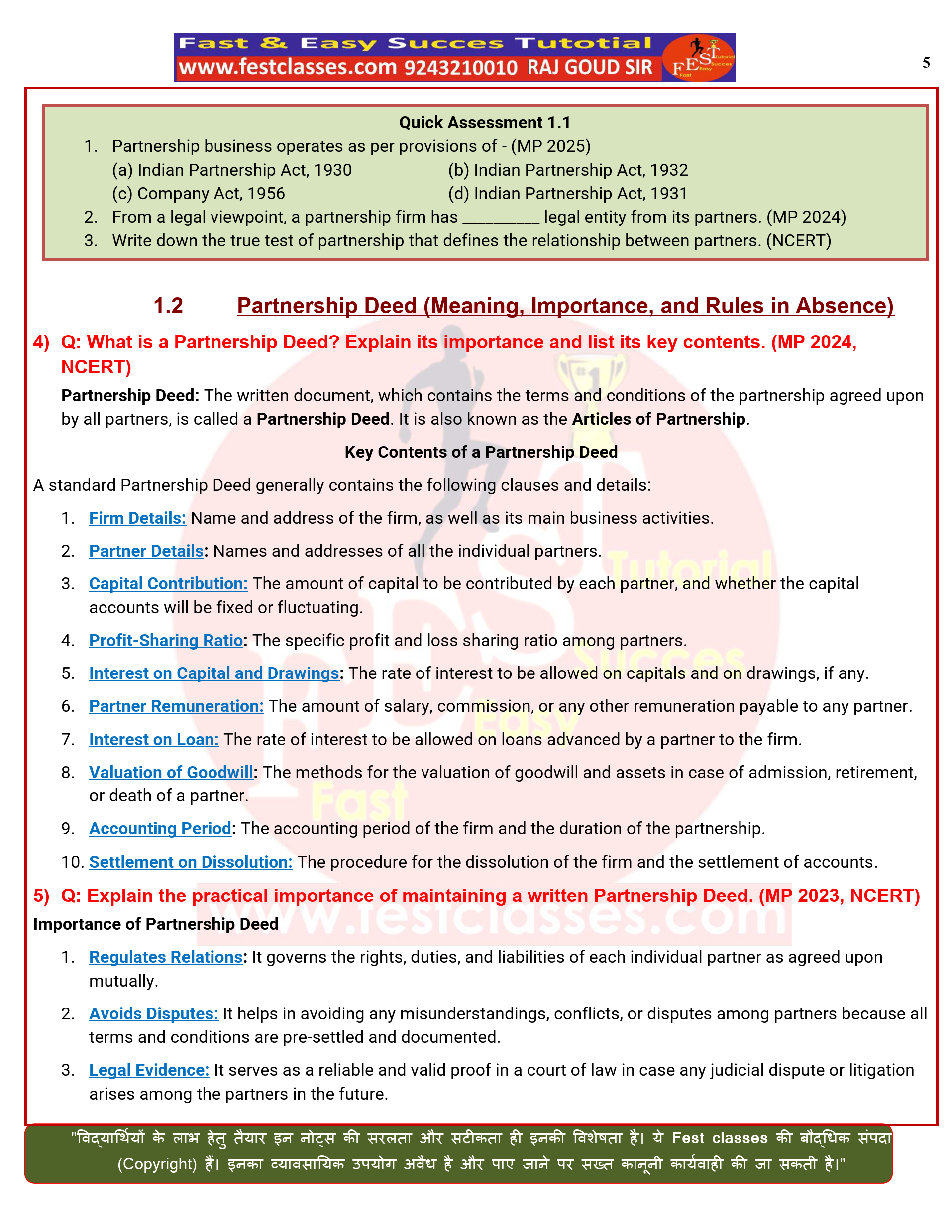
4) Q:
What is a Partnership Deed? Explain its importance and list its key contents.
(MP 2024, NCERT)
Partnership Deed: The written document, which
contains the terms and conditions of the partnership agreed upon by all
partners, is called a Partnership Deed. It is also known as the Articles
of Partnership.
Key Contents of a
Partnership Deed
A
standard Partnership Deed generally contains the following clauses and details:
- Firm Details: Name and address of the firm, as well as its
main business activities.
- Partner Details: Names and addresses of all the individual
partners.
- Capital Contribution: The amount of capital to be contributed
by each partner, and whether the capital accounts will be fixed or
fluctuating.
- Profit-Sharing Ratio: The specific profit and loss sharing ratio among
partners.
- Interest on Capital and Drawings: The rate of interest
to be allowed on capitals and on drawings, if any.
- Partner Remuneration: The amount of salary, commission, or any
other remuneration payable to any partner.
- Interest on Loan: The rate of interest to be allowed on
loans advanced by a partner to the firm.
- Valuation of Goodwill: The methods for the
valuation of goodwill and assets in case of admission, retirement, or
death of a partner.
- Accounting Period: The accounting period of the firm and the
duration of the partnership.
- Settlement on Dissolution: The procedure for the
dissolution of the firm and the settlement of accounts.
5) Q:
Explain the practical importance of maintaining a written Partnership Deed. (MP
2023, NCERT)
Importance
of Partnership Deed
- Regulates Relations: It governs the rights, duties, and liabilities
of each individual partner as agreed upon mutually.
- Avoids Disputes: It helps in avoiding any misunderstandings,
conflicts, or disputes among partners because all terms and conditions are
pre-settled and documented.
- Legal Evidence: It serves as a reliable and valid proof in a
court of law in case any judicial dispute or litigation arises among the
partners in the future.
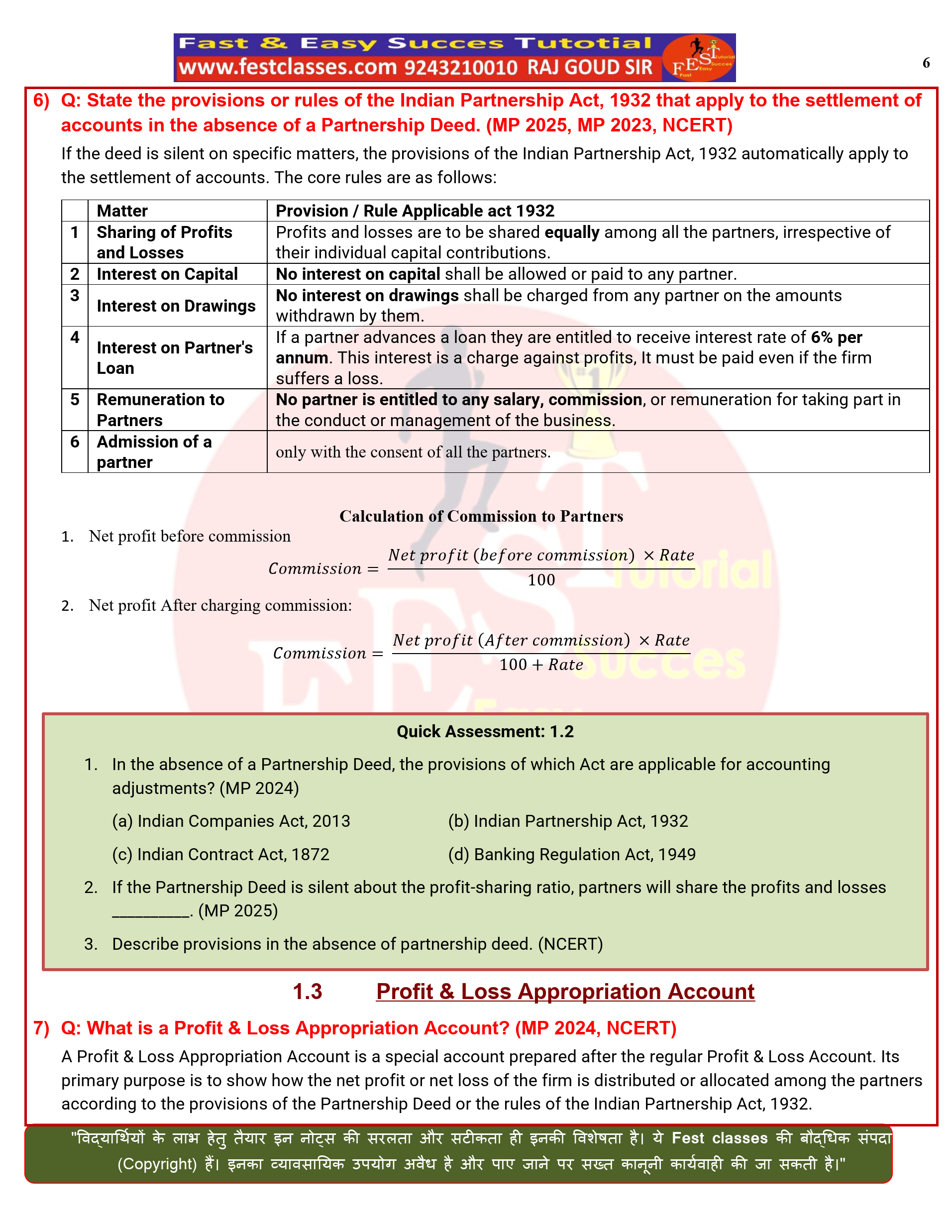
6) Q:
State the provisions or rules of the Indian Partnership Act, 1932 that apply to
the settlement of accounts in the absence of a Partnership Deed. (MP 2025, MP
2023, NCERT)
If the deed is silent on specific matters, the
provisions of the Indian Partnership Act, 1932 automatically apply to the
settlement of accounts. The core rules are as follows:
|
|
Matter |
Provision / Rule
Applicable act 1932 |
|
1 |
Sharing of Profits and
Losses |
Profits and losses are to
be shared equally among all the partners, irrespective of their
individual capital contributions. |
|
2 |
Interest on Capital |
No interest on capital shall be allowed or paid
to any partner. |
|
3 |
Interest on Drawings |
No interest on drawings shall be charged from any
partner on the amounts withdrawn by them. |
|
4 |
Interest on Partner’s Loan |
If a partner advances a
loan they are entitled to receive interest rate of 6% per annum. This
interest is a charge against profits, It must be paid even if the firm
suffers a loss. |
|
5 |
Remuneration to Partners |
No partner is entitled to
any salary, commission, or remuneration for taking part in the conduct or management of the
business. |
|
6 |
Admission of a partner |
only
with the consent of all the partners. |
Calculation of Commission
to Partners
1.
Net profit before
commission
2.
Net profit After
charging commission:
|
Quick Assessment: 1.2
(a) Indian Companies Act, 2013 (b) Indian Partnership
Act, 1932 (c) Indian Contract Act, 1872 (d) Banking
Regulation Act, 1949
|
1.3
Profit & Loss Appropriation Account
7) Q:
What is a Profit & Loss Appropriation Account? (MP 2024, NCERT)
A Profit & Loss
Appropriation Account is a special account prepared after the regular Profit
& Loss Account. Its primary purpose is to show how the net profit or net
loss of the firm is distributed or allocated among the partners according to
the provisions of the Partnership Deed or the rules of the Indian Partnership
Act, 1932.
8) Q:
Explain features/ characteristics of a Profit & Loss Appropriation Account.
(MP 2025, NCERT)
- Extension of P&L Account: It is prepared after
the finalization of the Profit & Loss Account and starts with the net
profit or net loss transferred from it.
- Nominal Account: It follows the rule of debiting all
appropriations that increase a partner’s claim (like interest on capital,
partner’s salary, or commission) and crediting items that decrease it
(like interest on drawings).
- Partnership Agreement Base: The entries passed in
this account are strictly guided by the clauses mentioned in the written
Partnership Deed or the legal rules applicable in its absence.
- Firm-Specific Preparation: It is prepared
specifically by partnership business entities to show allocation among
multiple owners, unlike sole proprietorship businesses where profits
belong to a single person.
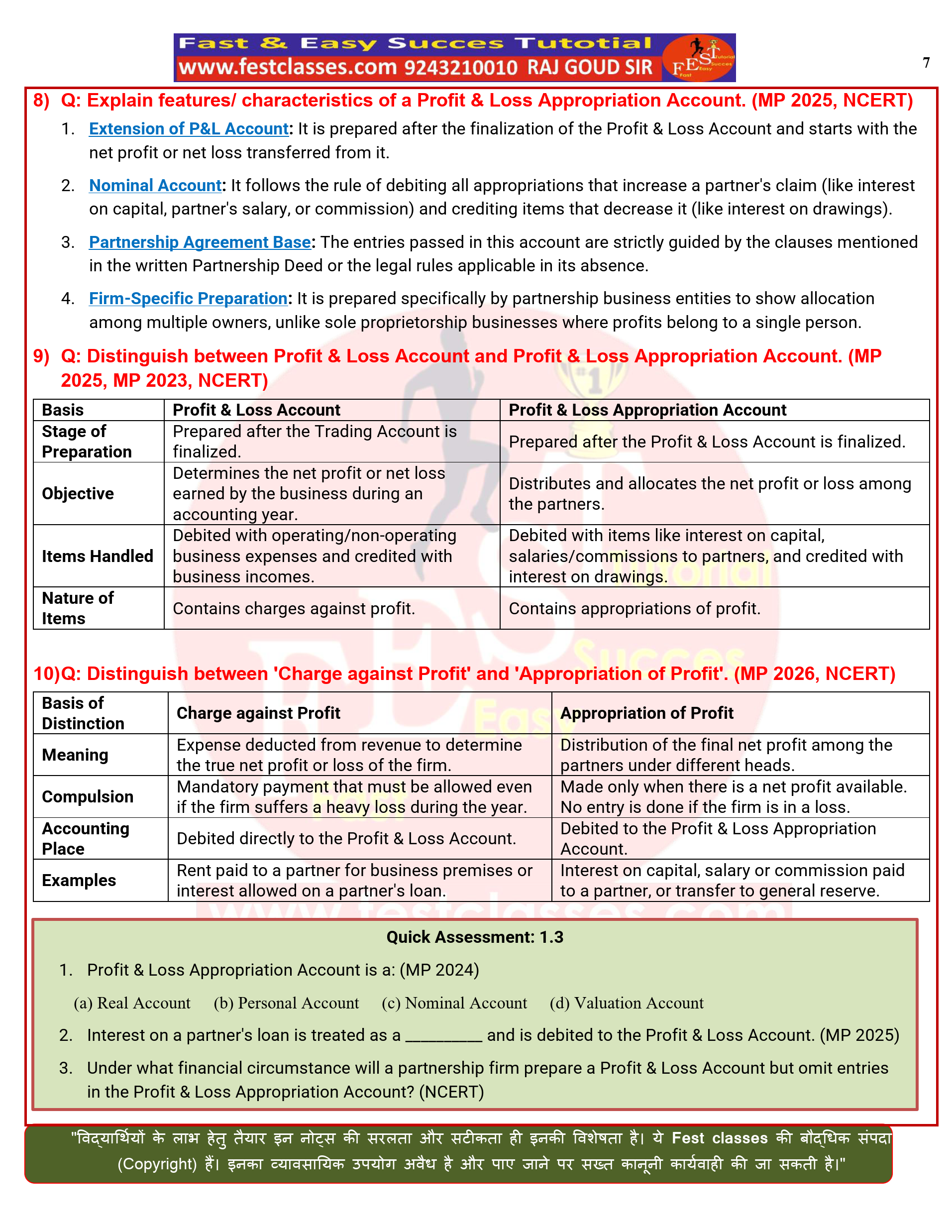
9) Q:
Distinguish between Profit & Loss Account and Profit & Loss
Appropriation Account. (MP 2025, MP 2023, NCERT)
|
Basis |
Profit
& Loss Account |
Profit
& Loss Appropriation Account |
|
Stage
of Preparation |
Prepared
after the Trading Account is finalized. |
Prepared
after the Profit & Loss Account is finalized. |
|
Objective |
Determines
the net profit or net loss earned by the business during an accounting year. |
Distributes
and allocates the net profit or loss among the partners. |
|
Items
Handled |
Debited
with operating/non-operating business expenses and credited with business
incomes. |
Debited
with items like interest on capital, salaries/commissions to partners, and
credited with interest on drawings. |
|
Nature
of Items |
Contains
charges against profit. |
Contains
appropriations of profit. |
10)
|
Quick Assessment: 1.3 1.
Profit & Loss Appropriation Account is a: (MP 2024) (a) Real Account (b)
Personal Account (c) Nominal
Account (d) Valuation Account 2.
Interest on a partner’s loan is treated as a __________ and is
debited to the Profit & Loss Account. (MP 2025) 3.
Under what financial circumstance will a partnership firm prepare a
Profit & Loss Account but omit entries in the Profit & Loss
Appropriation Account? (NCERT)
|
|
Basis
of Distinction |
Charge
against Profit |
Appropriation
of Profit |
|
Meaning |
Expense
deducted from revenue to determine the true net profit or loss of the firm. |
Distribution
of the final net profit among the partners under different heads. |
|
Compulsion |
Mandatory
payment that must be allowed even if the firm suffers a heavy loss during the
year. |
Made only
when there is a net profit available. No entry is done if the firm is in a loss. |
|
Accounting
Place |
Debited
directly to the Profit & Loss Account. |
Debited to
the Profit & Loss Appropriation Account. |
|
Examples |
Rent paid
to a partner for business premises or interest allowed on a partner’s loan. |
Interest
on capital, salary or commission paid to a partner, or transfer to general
reserve. |
1.4
Capital Accounts of Partners
11)
Q: Distinguish between Fixed Capital Account and Fluctuating Capital
Account. (MP 2026, MP 2024, NCERT)
|
|
Basis
of Distinction |
Fixed
Capital Method |
Fluctuating
Capital Method |
|
1 |
Number
of Accounts |
Two
separate accounts are maintained for each partner (Capital Account and
Current Account). |
Only one
single account is maintained for each partner (Capital Account). |
|
2 |
Adjustment
Items |
Routine
items like drawings, salary, and interest are adjusted in the Current
Account. |
All
adjustments for drawings, salary, and interest are made directly in the
Capital Account. |
|
3 |
Balance
Consistency |
Capital
Account balance remains unchanged unless fresh capital is added or withdrawn
permanently. |
Capital
Account balance changes continuously from year to year. |
|
4 |
Nature
of Balance |
Capital
Account always shows a credit balance. |
Capital
Account can show either a credit balance or a debit balance. |
|
Quick Assessment 1.4
(a) Partners’ Capital Account (b) Partners’
Current Account (c) Profit & Loss Account (d) Interest Account
|
1.5
Interest on Capital
12) Q: Explain
the rules and statutory provisions regarding the allowance of Interest on
Capital. (MP 2024, NCERT)
- Deed is Silent: No interest on capital is allowed or paid to any
partner if the Partnership Deed does not explicitly contain a provision
for it.
- Deed Provides Interest but Firm Incurs a Loss: No interest on capital
is allowed if the firm suffers a net loss during the financial year, as
interest on capital is an appropriation of profit.
- Deed Provides Interest and Firm Has Sufficient
Profit:
Full interest on capital is allowed at the rate agreed upon in the deed
out of the available net profits.
- Deed Provides Interest but Profits are Insufficient: When the net profit
before interest is less than the total interest on capital to be allowed,
the available profit is distributed among the partners in the ratio of
their respective interest claims.
- Deed Treats Interest as a Charge: Full interest on
capital is allowed to the partners even if the firm incurs a loss, and it
is debited to the Profit & Loss Account.
Opening
capital =
closing capital + drawing – old profit – additional capital
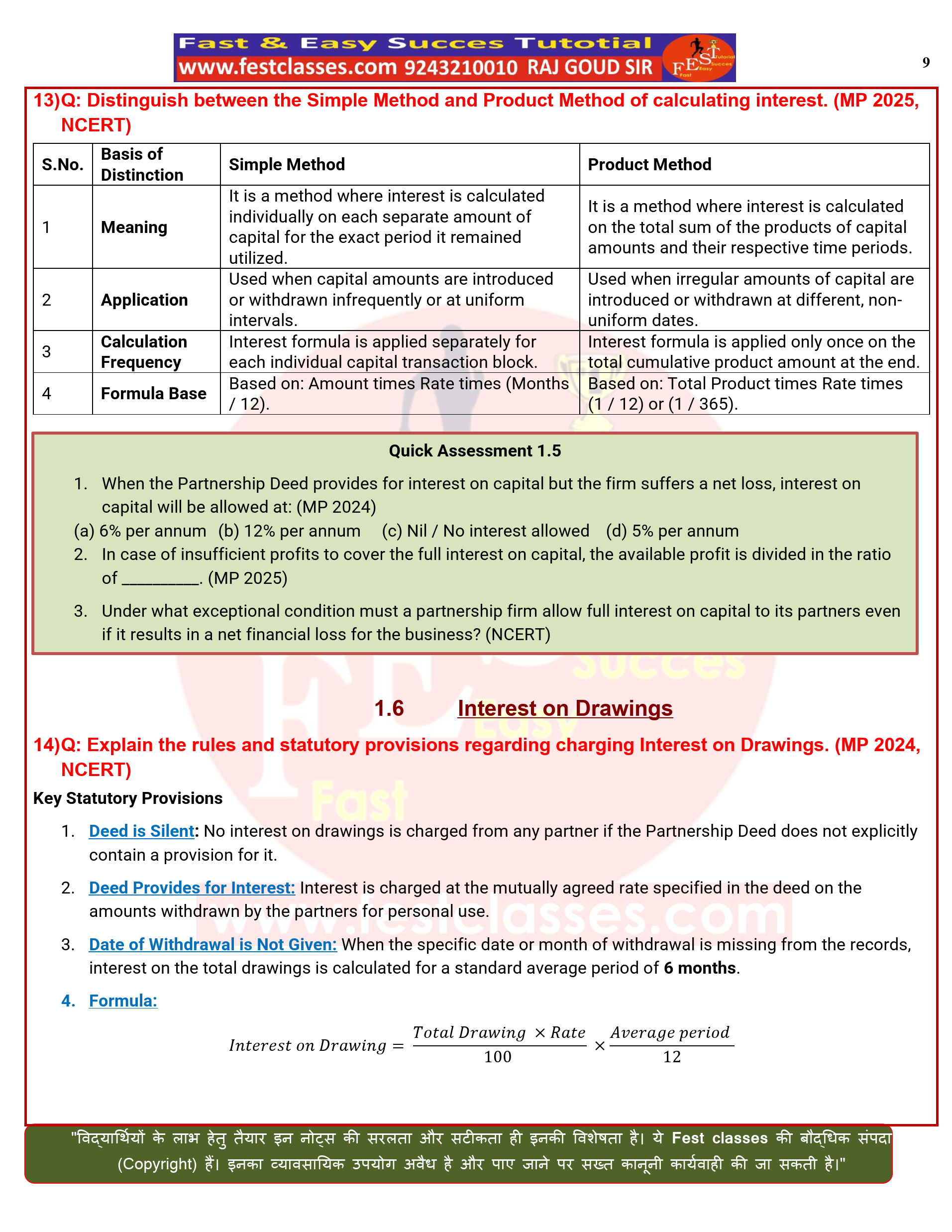
13)
|
Quick Assessment 1.5
(a) 6% per annum (b) 12% per annum (c) Nil / No interest allowed (d) 5% per annum
|
|
S.No. |
Basis of Distinction |
Simple Method |
Product Method |
|
1 |
Meaning |
It is a method where
interest is calculated individually on each separate amount of capital for
the exact period it remained utilized. |
It is a method where
interest is calculated on the total sum of the products of capital amounts
and their respective time periods. |
|
2 |
Application |
Used when capital amounts
are introduced or withdrawn infrequently or at uniform intervals. |
Used when irregular
amounts of capital are introduced or withdrawn at different, non-uniform
dates. |
|
3 |
Calculation Frequency |
Interest formula is
applied separately for each individual capital transaction block. |
Interest formula is
applied only once on the total cumulative product amount at the end. |
|
4 |
Formula Base |
Based on: Amount times Rate
times (Months / 12). |
Based on: Total Product
times Rate times (1 / 12) or (1 / 365). |
1.6
Interest on Drawings
14) Q: Explain
the rules and statutory provisions regarding charging Interest on Drawings. (MP
2024, NCERT)
Key
Statutory Provisions
- Deed is Silent: No interest on drawings is charged from any
partner if the Partnership Deed does not explicitly contain a provision
for it.
- Deed Provides for Interest: Interest is charged at
the mutually agreed rate specified in the deed on the amounts withdrawn by
the partners for personal use.
- Date of Withdrawal is Not Given: When the specific date
or month of withdrawal is missing from the records, interest on the total
drawings is calculated for a standard average period of 6 months.
4.
Formula:
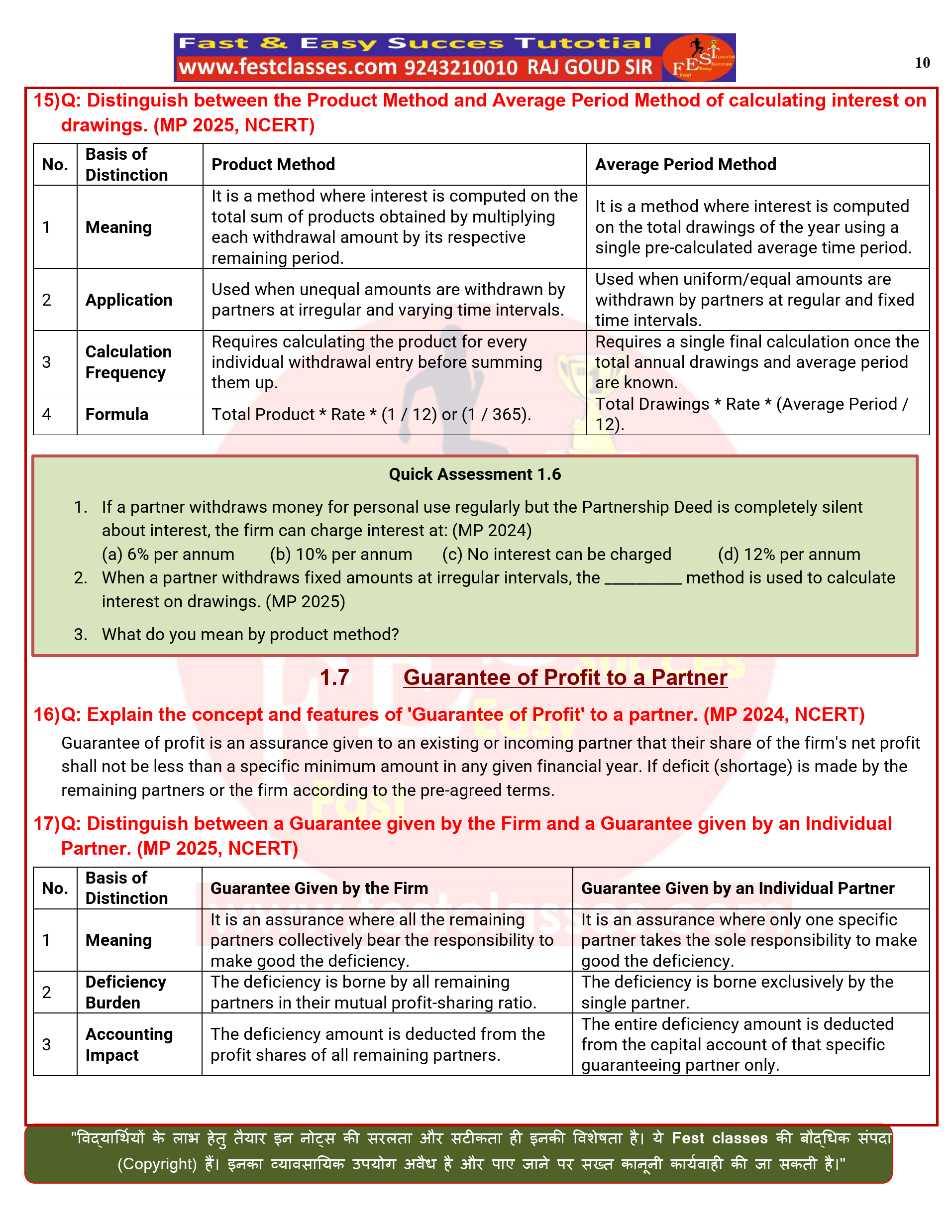
15)
|
Quick Assessment 1.6
(a) 6% per annum (b) 10% per annum (c) No interest can be charged (d) 12% per annum
|
|
No. |
Basis of Distinction |
Product Method |
Average Period Method |
|
1 |
Meaning |
It is a method where
interest is computed on the total sum of products obtained by multiplying
each withdrawal amount by its respective remaining period. |
It is a method where
interest is computed on the total drawings of the year using a single
pre-calculated average time period. |
|
2 |
Application |
Used when unequal amounts
are withdrawn by partners at irregular and varying time intervals. |
Used when uniform/equal
amounts are withdrawn by partners at regular and fixed time intervals. |
|
3 |
Calculation Frequency |
Requires calculating the
product for every individual withdrawal entry before summing them up. |
Requires a single final
calculation once the total annual drawings and average period are known. |
|
4 |
Formula |
Total Product * Rate * (1
/ 12) or (1 / 365). |
Total Drawings * Rate * (Average
Period / 12). |
1.7
Guarantee of Profit to a Partner
16) Q: Explain
the concept and features of ‘Guarantee of Profit’ to a partner. (MP 2024,
NCERT)
Guarantee of profit is an assurance given to an
existing or incoming partner that their share of the firm’s net profit shall
not be less than a specific minimum amount in any given financial year. If
deficit (shortage) is made by the remaining partners or the firm according to
the pre-agreed terms.
17) Q:
Distinguish between a Guarantee given by the Firm and a Guarantee given by an
Individual Partner. (MP 2025, NCERT)
|
No. |
Basis of Distinction |
Guarantee Given by the
Firm |
Guarantee Given by an
Individual Partner |
|
1 |
Meaning |
It is an assurance where
all the remaining partners collectively bear the responsibility to make good
the deficiency. |
It is an assurance where
only one specific partner takes the sole responsibility to make good the
deficiency. |
|
2 |
Deficiency Burden |
The deficiency is borne by
all remaining partners in their mutual profit-sharing ratio. |
The deficiency is borne
exclusively by the single partner. |
|
3 |
Accounting Impact |
The deficiency amount is
deducted from the profit shares of all remaining partners. |
The entire deficiency
amount is deducted from the capital account of that specific guaranteeing
partner only. |
|
Quick Assessment 1.7
(a) Profit & Loss Account (b) Trading Account (c) Profit & Loss Appropriation Account (d) Balance Sheet
|
1.8
Past Adjustments
18) Q: Explain
the features of Past Adjustments and list the common reasons for such errors or
omissions. (MP 2024, NCERT)
Features
- Retrospective Rectification: It involves correcting
accounting errors, omissions, or wrong distributions after the final
accounts of the firm have been closed and the balance sheet is prepared.
- Alteration Avoidance: It allows corrections without reopening
or altering the already closed final account books of previous years.
- Capital Account Routing: All necessary
adjustments to rectify previous errors are made directly through the
capital or current accounts of the affected partners.
Common
Reasons for Errors or Omissions
- Omission of Interest: Interest on capital or interest on
drawings was either totally omitted or calculated at an incorrect rate.
- Omission of Remuneration: Salaries, commissions,
or any extra remuneration payable to a partner was not recorded.
- Wrong Profit-Sharing Ratio: Profits or losses were
distributed among the partners in a ratio different from the one agreed
upon in the Partnership Deed.
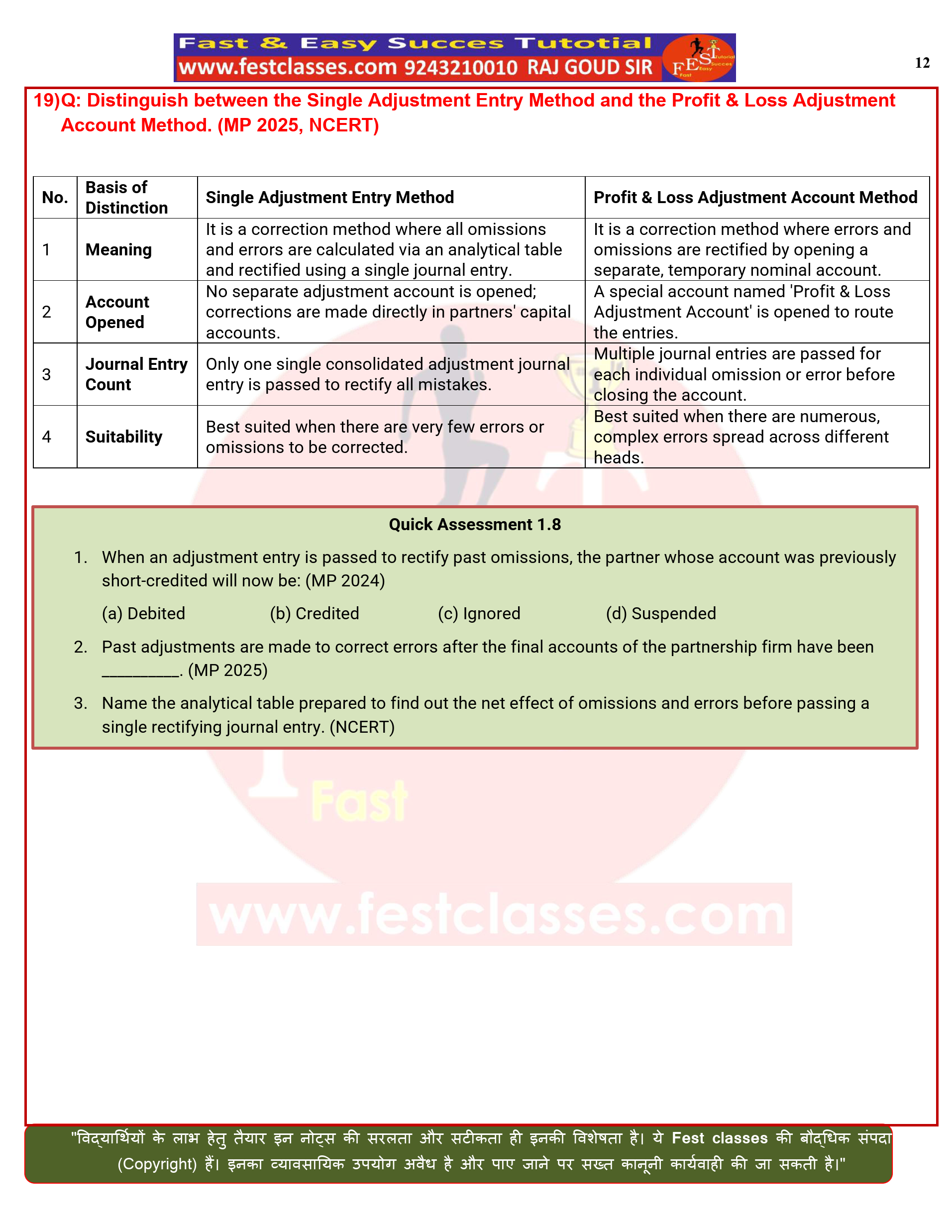
19) Q:
Distinguish between the Single Adjustment Entry Method and the Profit &
Loss Adjustment Account Method. (MP 2025, NCERT)
|
No. |
Basis of Distinction |
Single Adjustment Entry
Method |
Profit & Loss
Adjustment Account Method |
|
1 |
Meaning |
It is a correction method
where all omissions and errors are calculated via an analytical table and
rectified using a single journal entry. |
It is a correction method
where errors and omissions are rectified by opening a separate, temporary
nominal account. |
|
2 |
Account Opened |
No separate adjustment
account is opened; corrections are made directly in partners’ capital
accounts. |
A special account named
‘Profit & Loss Adjustment Account’ is opened to route the entries. |
|
3 |
Journal Entry Count |
Only one single
consolidated adjustment journal entry is passed to rectify all mistakes. |
Multiple journal entries
are passed for each individual omission or error before closing the account. |
|
4 |
Suitability |
Best suited when there are
very few errors or omissions to be corrected. |
Best suited when there are
numerous, complex errors spread across different heads. |
|
Quick Assessment 1.8
(a) Debited (b) Credited (c)
Ignored (d) Suspended
|