


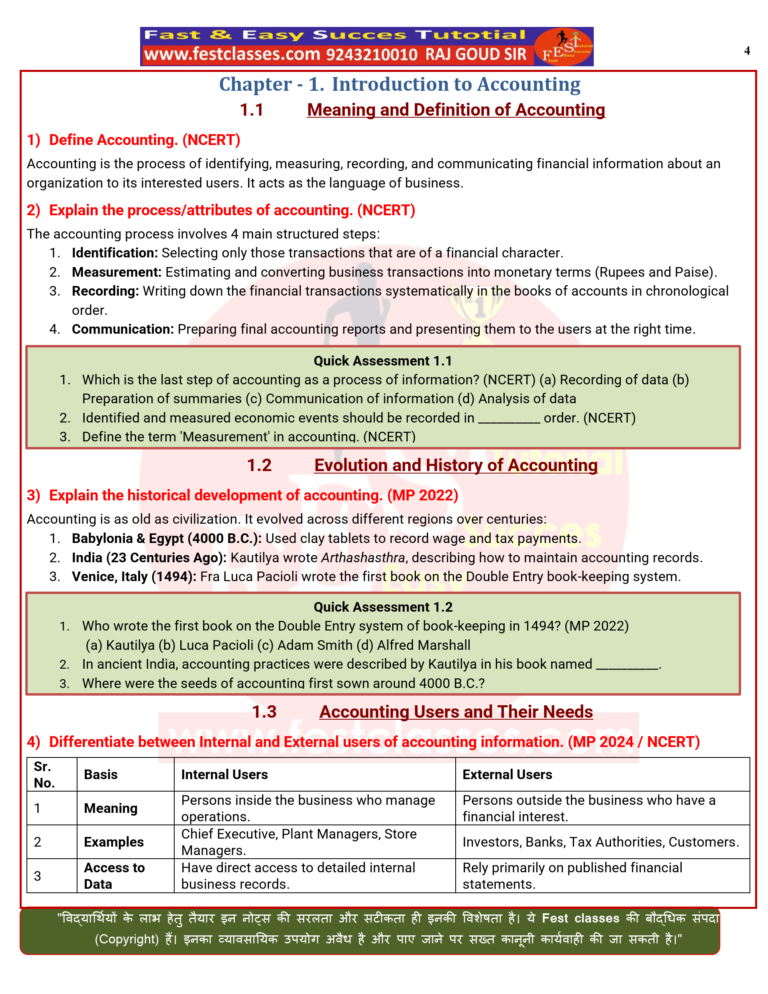
Chapter – 1.
Introduction to Accounting
1.1
Meaning and Definition of Accounting
1) Define
Accounting. (NCERT)
Accounting is the process of identifying, measuring,
recording, and communicating financial information about an organization to its
interested users. It acts as the language of business.
2) Explain
the process/attributes of accounting. (NCERT)
The accounting process involves 4 main structured
steps:
- Identification: Selecting only those transactions that are of a
financial character.
- Measurement: Estimating and converting business transactions into monetary
terms (Rupees and Paise).
- Recording: Writing down the financial transactions systematically in the
books of accounts in chronological order.
Quick Assessment 1.1
- Which is the last step of accounting as
a process of information? (NCERT) (a) Recording of data (b)
Preparation of summaries (c) Communication of information (d)
Analysis of data
- Identified and measured economic events
should be recorded in __________ order. (NCERT)
- Define the term ‘Measurement’ in
accounting. (NCERT)
- Which is the last step of accounting as
a process of information? (NCERT) (a) Recording of data (b)
Preparation of summaries (c) Communication of information (d)
Analysis of data
1.2
Evolution and History of Accounting
3) Explain
the historical development of accounting. (MP 2022)
Accounting is as old as civilization. It evolved
across different regions over centuries:
- Babylonia & Egypt (4000 B.C.): Used clay tablets to
record wage and tax payments.
- India (23 Centuries Ago): Kautilya wrote Arthashasthra, describing
how to maintain accounting records.
Quick Assessment 1.2
- Who wrote the first book on the Double
Entry system of book-keeping in 1494? (MP 2022)
(a) Kautilya (b) Luca Pacioli (c) Adam Smith (d) Alfred Marshall
- In ancient India, accounting practices
were described by Kautilya in his book named __________.
3. Where were the seeds of accounting first sown around 4000 B.C.?
- Who wrote the first book on the Double
Entry system of book-keeping in 1494? (MP 2022)
1.3
Accounting Users and Their Needs
4) Differentiate
between Internal and External users of accounting information. (MP 2024 /
NCERT)
|
Sr. No. |
Basis |
Internal Users |
External Users |
|
1 |
Meaning |
Persons inside the
business who manage operations. |
Persons outside the
business who have a financial interest. |
|
2 |
Examples |
Chief Executive, Plant
Managers, Store Managers. |
Investors, Banks, Tax
Authorities, Customers. |
|
3 |
Access to Data |
Have direct access to
detailed internal business records. |
Rely primarily on
published financial statements. |
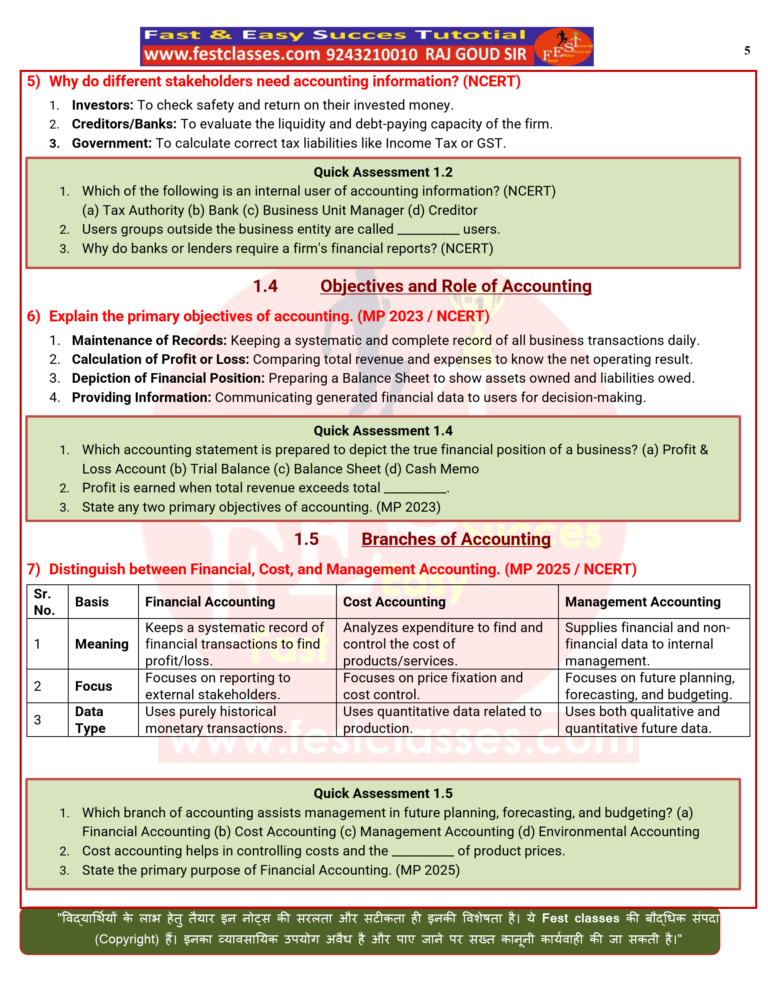
9) Why
do different stakeholders need accounting information? (NCERT)
- Investors: To check safety and return on their invested money.
- Creditors/Banks: To evaluate the liquidity and debt-paying
capacity of the firm.
- Government: To calculate correct tax liabilities like Income Tax or GST.
Quick Assessment 1.2
- Which of the following is an internal
user of accounting information? (NCERT)
(a) Tax Authority (b) Bank (c) Business Unit Manager (d) Creditor
- Users groups outside the business entity
are called __________ users.
- Why do banks or lenders require a firm’s
financial reports? (NCERT)
- Which of the following is an internal
user of accounting information? (NCERT)
1.4
Objectives and Role of Accounting
10)
Explain the primary objectives of accounting.
(MP 2023 / NCERT)
- Maintenance of Records: Keeping a systematic and complete record of all
business transactions daily.
- Calculation of Profit or Loss: Comparing total revenue and expenses to
know the net operating result.
- Depiction of Financial Position: Preparing a Balance Sheet to show assets
owned and liabilities owed.
Quick Assessment 1.4
- Which accounting statement is prepared
to depict the true financial position of a business? (a) Profit
& Loss Account (b) Trial Balance (c) Balance Sheet (d) Cash
Memo
- Profit is earned when total revenue
exceeds total __________.
- State any two primary objectives of
accounting. (MP 2023)
- Which accounting statement is prepared
to depict the true financial position of a business? (a) Profit
& Loss Account (b) Trial Balance (c) Balance Sheet (d) Cash
Memo
11)
Distinguish between Financial, Cost, and
Management Accounting. (MP 2025 / NCERT)
|
Sr. No. |
Basis |
Financial Accounting |
Cost Accounting |
Management Accounting |
|
1 |
Meaning |
Keeps a systematic record
of financial transactions to find profit/loss. |
Analyzes expenditure to
find and control the cost of products/services. |
Supplies financial and
non-financial data to internal management. |
|
2 |
Focus |
Focuses on reporting to
external stakeholders. |
Focuses on price fixation
and cost control. |
Focuses on future
planning, forecasting, and budgeting. |
|
3 |
Data Type |
Uses purely historical
monetary transactions. |
Uses quantitative data
related to production. |
Uses both qualitative and
quantitative future data. |
|
Quick Assessment 1.5
|
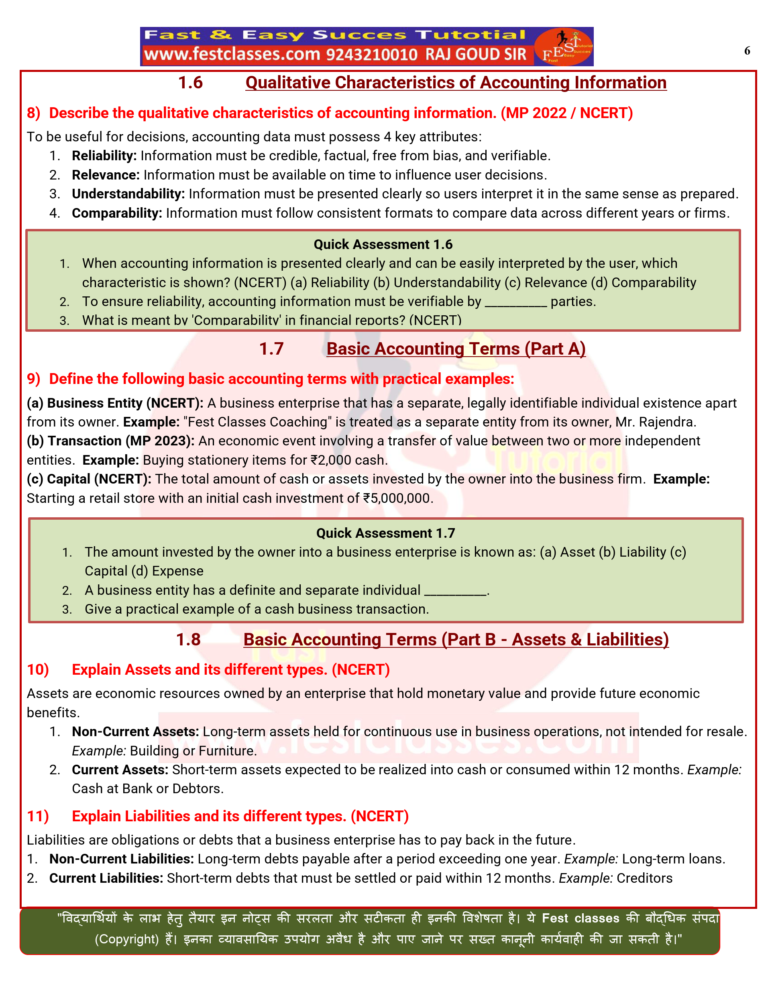
1.6
Qualitative Characteristics of Accounting
Information
17)
Describe the qualitative characteristics of
accounting information. (MP 2022 / NCERT)
To be useful for decisions, accounting data must
possess 4 key attributes:
- Reliability: Information must be credible, factual, free from bias, and
verifiable.
- Relevance: Information must be available on time to influence user decisions.
- Understandability: Information must be presented clearly so users
interpret it in the same sense as prepared.
Quick Assessment 1.6
- When accounting information is presented
clearly and can be easily interpreted by the user, which
characteristic is shown? (NCERT) (a) Reliability (b)
Understandability (c) Relevance (d) Comparability
- To ensure reliability, accounting
information must be verifiable by __________ parties.
- What is meant by ‘Comparability’ in
financial reports? (NCERT)
- When accounting information is presented
clearly and can be easily interpreted by the user, which
characteristic is shown? (NCERT) (a) Reliability (b)
Understandability (c) Relevance (d) Comparability
1.7
Basic Accounting Terms (Part A)
18)
Define the following basic accounting terms with
practical examples:
(a) Business Entity (NCERT): A business enterprise that
has a separate, legally identifiable individual existence apart from its owner.
Example: “Fest Classes Coaching” is treated as a separate
entity from its owner, Mr. Rajendra.
(b) Transaction (MP 2023): An economic event involving
a transfer of value between two or more independent entities. Example: Buying stationery items for
₹2,000 cash.
|
Quick Assessment 1.7
|
1.8
Basic Accounting Terms (Part B – Assets &
Liabilities)
19)
Explain Assets and its different types. (NCERT)
Assets are economic resources owned by an enterprise
that hold monetary value and provide future economic benefits.
- Non-Current Assets: Long-term assets held for continuous use in
business operations, not intended for resale. Example: Building or
Furniture.
- Current Assets: Short-term assets expected to be realized into
cash or consumed within 12 months. Example: Cash at Bank or
Debtors.
20)
Explain Liabilities and its different types.
(NCERT)
Liabilities are obligations or debts that a business
enterprise has to pay back in the future.
1. Non-Current Liabilities: Long-term debts payable
after a period exceeding one year. Example: Long-term loans.
2. Current Liabilities: Short-term debts that must
be settled or paid within 12 months. Example: Creditors
|
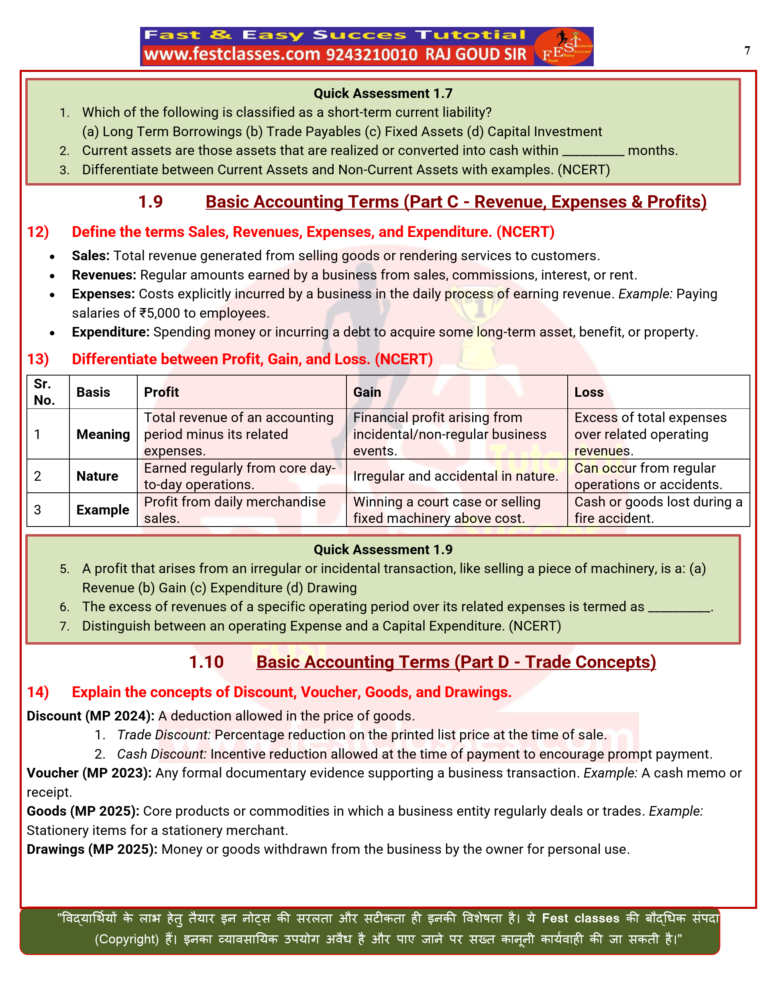
Quick Assessment 1.7
(a) Long Term Borrowings (b) Trade Payables (c) Fixed Assets (d)
Capital Investment
|
21)
Define the terms Sales, Revenues, Expenses, and
Expenditure. (NCERT)
- Sales: Total revenue generated from selling goods or rendering services
to customers.
- Revenues: Regular amounts earned by a business from sales, commissions,
interest, or rent.
- Expenses: Costs explicitly incurred by a business in the daily process of
earning revenue. Example: Paying salaries of ₹5,000 to employees.
- Expenditure: Spending money or incurring a debt to acquire some long-term
asset, benefit, or property.
22)
|
Quick Assessment 1.9
|
|
Sr. No. |
Basis |
Profit |
Gain |
Loss |
|
1 |
Meaning |
Total revenue of an
accounting period minus its related expenses. |
Financial profit arising
from incidental/non-regular business events. |
Excess of total expenses
over related operating revenues. |
|
2 |
Nature |
Earned regularly from core
day-to-day operations. |
Irregular and accidental
in nature. |
Can occur from regular
operations or accidents. |
|
3 |
Example |
Profit from daily
merchandise sales. |
Winning a court case or
selling fixed machinery above cost. |
Cash or goods lost during
a fire accident. |
1.10
Basic Accounting Terms (Part D – Trade Concepts)
28)
Explain the concepts of Discount, Voucher,
Goods, and Drawings.
Discount (MP 2024): A deduction allowed in the price of goods.
- Trade Discount: Percentage reduction on the printed list price
at the time of sale.
- Cash Discount: Incentive reduction allowed at the time of
payment to encourage prompt payment.
Voucher (MP 2023): Any formal documentary evidence supporting a
business transaction. Example: A cash memo or receipt.
Goods (MP 2025): Core products or commodities in which a
business entity regularly deals or trades. Example: Stationery items for
a stationery merchant.
Drawings (MP 2025): Money or goods withdrawn from the business by
the owner for personal use.
29)
Explain Purchases, Stock, Debtors, and
Creditors. (NCERT)
- Purchases: Total amount of merchandise procured by a firm for resale.
- Stock: Value of goods, raw materials, or unsold inventory lying on hand
on a specific date.
- Debtors: Customers or entities who owe money to the firm for buying goods
on credit.
Quick Assessment 1.10
- Withdrawal of cash or goods by the owner
from the business for personal use is called: (MP 2025) (a)
Capital investment (b) Drawings (c) Trade discount (d) Assets
- The documentary evidence used to verify
and support a financial transaction is called a __________. (MP
2023)
- Differentiate clearly between Debtors
and Creditors. (NCERT)
7.
- Withdrawal of cash or goods by the owner
from the business for personal use is called: (MP 2025) (a)
Capital investment (b) Drawings (c) Trade discount (d) Assets