


Chapter – 1.
Business, Trade and Commerce
1.1
Introduction & Role of
Business in the Development of Economy
1) Why was the Indian subcontinent referred to as ‘Swaran Bharat’ and
‘Swaran Dweep’ by ancient travellers?
Foreign travelers saw India’s massive wealth, gold, and silver earned
through heavy exports because India had a favourable balance of trade, meaning
exports were much higher than imports.
Ex: Roman empires paid India in pure gold coins to buy Indian spices.
2) What are ‘Hundi’ and ‘Chitties’, and how were they used in ancient
times?
These were ancient handwritten financial
documents used like modern cheques or notes to transfer money safely. They
involved an unconditional contract to pay money by negotiation.
Example: A merchant in
Surat used a Hundi to pay a trader in Varanasi without carrying heavy gold
coins.
3) Name any four major leading trade centres developed in ancient
India.
- Pataliputra (Patna): Major centre for
exporting stones.
- Peshawar: Famous for exporting
wool and importing horses.
- Taxila: Centre for land routes
and indigenous financial banks.
- Surat: Emporium of western
trade famous for gold-bordered textile garments (Zari).
4) List the major items of export and import in ancient India.
- Exports: Spices, wheat, sugar,
indigo, cotton, and live animals.
- Imports: Horses, gold, silver,
copper, wine, and Chinese silk.
5) How does business contribute to the economic development of a
country? (NCERT)
1.
Income Generation: Trading creates surplus
income and helps people earn livelihoods.
2.
Infrastructure Aids: Business expands essential
support systems like transport, finance, and communication networks.
Example: Setting up a textile factory generates jobs for
weavers and builds local roads for transport.
6) Discuss the development of indigenous banking system in Indian
subcontinent. (NCERT)
Wealth from trade was channelled into
investments, creating family-run indigenous banking structures. These banks
provided credit transactions, loans, and instruments like Hundis to expand
commerce.
|
Quick Assessment 1.1
(a) Share (b) Debenture (c) Hundi (d) Equity
|
1.2
Concept and Characteristics of
Business
7) State the meaning of business. (NCERT)
An economic activity involving regular
production and sale of goods or services to earn profit by satisfying social
needs. Example: A shopkeeper sells notebooks daily to students to earn a
regular livelihood.
8) Why is business considered an economic activity? (NCERT)
It is performed strictly to earn money and
livelihood, not out of love, sympathy, or emotions.
- Example: A cook prepares and
sells meals in a restaurant to run his household.
9) State the different types of economic activities. (NCERT)
- Business: Producing and selling
goods or services for profit.
- Profession: Providing specialized
expert services requiring a specific degree.
- Employment: Working under an
employer based on a service contract for wages.
10)
Define business. Describe its
important characteristics. (NCERT)
- Definition: An economic occupation
where people regularly produce, purchase, or sell goods and services to
earn profits.
- Characteristics:
- Economic Activity: Done solely to earn
money.
- Regular Dealings: One single
transaction is never business; it must happen daily.
- Profit Motive: Main goal is making
money.
- Element of Risk: Profits are never
certain, and losses can happen anytime.
Quick Assessment 1.1
- Which of the following is not a
characteristic of a business activity? (a) Profit earning (b)
Certainty of return (c) Element of risk (d) Regular dealings
- Cooking food for family members at home
is a ________ activity.
- Why is a single transaction of sale not
considering a business?
- Which of the following is not a
characteristic of a business activity? (a) Profit earning (b)
Certainty of return (c) Element of risk (d) Regular dealings
1.3
Comparison of Business, Profession,
and Employment
11)
Define the terms ‘Profession’
and ‘Employment’.
- Profession: An occupation
requiring specialized qualification, training, and membership in a
professional body to render expert services. Example: A Chartered
Accountant managing company taxes.
- Employment: An occupation where an
individual works regularly for someone else under a contract to get fixed
salary or wages. Example: A clerk working in a government bank.
12)
|
Quick Assessment 1.2
|
|
Sr. No. |
Basis |
Business |
Profession |
Employment |
|
1 |
Meaning |
Regular production/sale of goods for profit. |
Specialized expert services under a professional
body. |
Working under a service contract for an employer. |
|
2 |
Qualification |
No minimum qualification needed. |
Prescribed professional degree and training
required. |
Qualification as prescribed by the employer. |
|
3 |
Capital |
Capital needed according to the size of operations. |
Limited capital needed to set up an office. |
No capital investment required. |
|
4 |
Reward |
Profits earned. |
Professional fees. |
Salary or fixed wages. |
|
5 |
Risk |
High risk; profits are highly uncertain. |
Low risk; fees are generally regular. |
No risk; fixed regular pay. |
1.4
Classification of Business
Activities (Industry and Commerce)
18)
How would you classify business
activities? (NCERT)
- Classification: Business activities
are split into two broad categories: Industry and Commerce.
- Industry: Concerned with
production, processing, or conversion of raw resources into useful goods.
- Commerce: Includes trade and all
helper activities that make the exchange of goods easy.
19)
Define Industry and state its
various types. (NCERT)
- Definition: Economic activities
involved in turning raw resources into usable products using mechanical
skills.
- Types: Divided into Primary,
Secondary, and Tertiary industries.
- Example: Converting raw timber
wood into household wooden chairs.
Explain primary industries
along with its subdivisions.
20)
Meaning: Industries focused on extracting natural
resources or breeding living organisms.
- Subdivisions:
- Extractive Industry: Drawing raw materials
from air, water, or earth. Example: Mining iron ore or fishing.
- Genetic Industry: Breeding plants and
animals for reproduction. Example: Poultry farms or plant nurseries.
21)
Describe secondary industries
and explain the four categories of manufacturing industries.
- Meaning: Industries that use
raw materials already extracted by the primary sector to finish them into
final products.
- Manufacturing Subdivisions:
- Analytical: Separates elements
from one material. Example: Oil refinery.
- Synthetical: Combines ingredients
into a new product. Example: Cement factory.
- Processing: Involves successive
production stages. Example: Paper or sugar mills.
- Assembling: Joins different
components. Example: Car or television assembly.
22)
What are tertiary industries?
- Meaning: Service industries
that provide support to primary sectors, secondary sectors, and general
trade.
- Example: Transport companies
moving factory goods, or banks providing corporate finance.
23)
Define Industry. Explain
various types of industries giving examples. (NCERT)
- Definition: Economic block dealing
with converting resources into finished items using technical skills.
- Types Table:
|
Sr. No. |
Basis |
Primary
Industry |
Secondary
Industry |
Tertiary
Industry |
|
1 |
Meaning |
Extracts raw
materials or breeds living things. |
Processes
primary materials into final goods. |
Provides
support services to other industries. |
|
2 |
Example |
Mining iron ore
or running a poultry farm. |
Manufacturing
steel rods from raw iron. |
Banking,
transport, and insurance services. |
29)
Describe the activities
relating to commerce. (NCERT)
- Meaning: Activities that
connect the producer with the consumer by removing all exchange hurdles.
- Activities: Split into Trade
(buying/selling) and Auxiliaries to Trade (support systems like transport
and warehousing).
- Example: A wholesaler buys
goods from a factory, stores them in a warehouse, and uses trucks to send
them to shops.
30)
What is Trade? Classify its
types.
- Definition: The actual buying and
selling, or exchange, of goods and services for monetary value.
- Classification:
- Internal Trade: Buying and selling
inside national geographical boundaries. Example: Wholesale and retail
shops.
- External Trade: Trade between two or
more different countries. Example: Import, Export, and Entrepot trade.
31)
Explain any two business
activities which are auxiliaries to trade. (NCERT)
- Transport: Removes the
geographical hurdle of place by moving items from production sites to
consumption markets. Example: Carrying tea from Assam gardens to shops
in Delhi via rail.
Quick Assessment 1.3
- Which industry type is an oil refinery
classified under? (a) Genetic (b) Synthetical (c) Analytical (d)
Assembling
- The hurdle of place in moving goods from
factories to markets is removed by ________.
- Give an example of a genetic industry.
- Which industry type is an oil refinery
classified under? (a) Genetic (b) Synthetical (c) Analytical (d)
Assembling
1.5
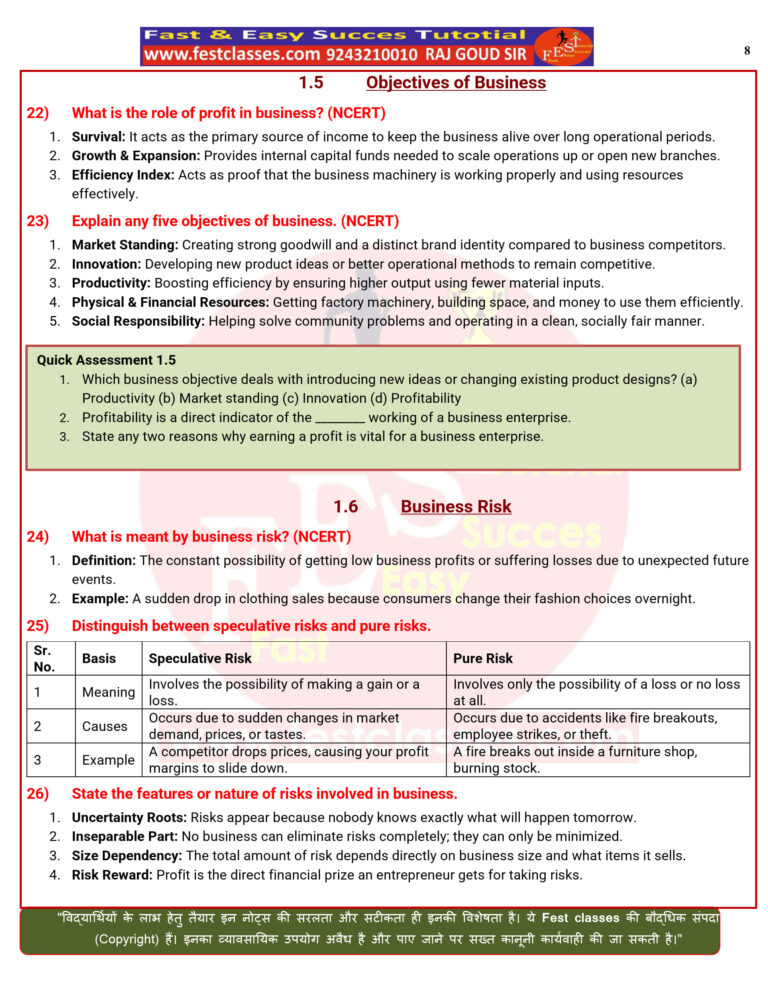
Objectives of Business
32)
What is the role of profit in
business? (NCERT)
- Survival: It acts as the primary
source of income to keep the business alive over long operational periods.
- Growth & Expansion: Provides
internal capital funds needed to scale operations up or open new branches.
- Efficiency Index: Acts as proof that the
business machinery is working properly and using resources effectively.
33)
Explain any five objectives of
business. (NCERT)
- Market Standing: Creating strong
goodwill and a distinct brand identity compared to business competitors.
- Innovation: Developing new product
ideas or better operational methods to remain competitive.
- Productivity: Boosting efficiency by
ensuring higher output using fewer material inputs.
- Physical & Financial Resources: Getting
factory machinery, building space, and money to use them efficiently.
Quick Assessment 1.5
- Which business objective deals with
introducing new ideas or changing existing product designs? (a)
Productivity (b) Market standing (c) Innovation (d) Profitability
- Profitability is a direct indicator of
the ________ working of a business enterprise.
- State any two reasons why earning a
profit is vital for a business enterprise.
- Which business objective deals with
introducing new ideas or changing existing product designs? (a)
Productivity (b) Market standing (c) Innovation (d) Profitability
1.6
Business Risk
34)
What is meant by business risk?
(NCERT)
- Definition: The constant
possibility of getting low business profits or suffering losses due to
unexpected future events.
- Example: A sudden drop in
clothing sales because consumers change their fashion choices overnight.
35)
Distinguish between speculative
risks and pure risks.
|
Sr. No. |
Basis |
Speculative
Risk |
Pure Risk |
|
1 |
Meaning |
Involves the
possibility of making a gain or a loss. |
Involves only
the possibility of a loss or no loss at all. |
|
2 |
Causes |
Occurs due to sudden
changes in market demand, prices, or tastes. |
Occurs due to
accidents like fire breakouts, employee strikes, or theft. |
|
3 |
Example |
A competitor
drops prices, causing your profit margins to slide down. |
A fire breaks
out inside a furniture shop, burning stock. |
40)
State the features or nature of
risks involved in business.
- Uncertainty Roots: Risks appear because
nobody knows exactly what will happen tomorrow.
- Inseparable Part: No business can
eliminate risks completely; they can only be minimized.
- Size Dependency: The total amount of
risk depends directly on business size and what items it sells.
- Risk Reward: Profit is the direct
financial prize an entrepreneur gets for taking risks.
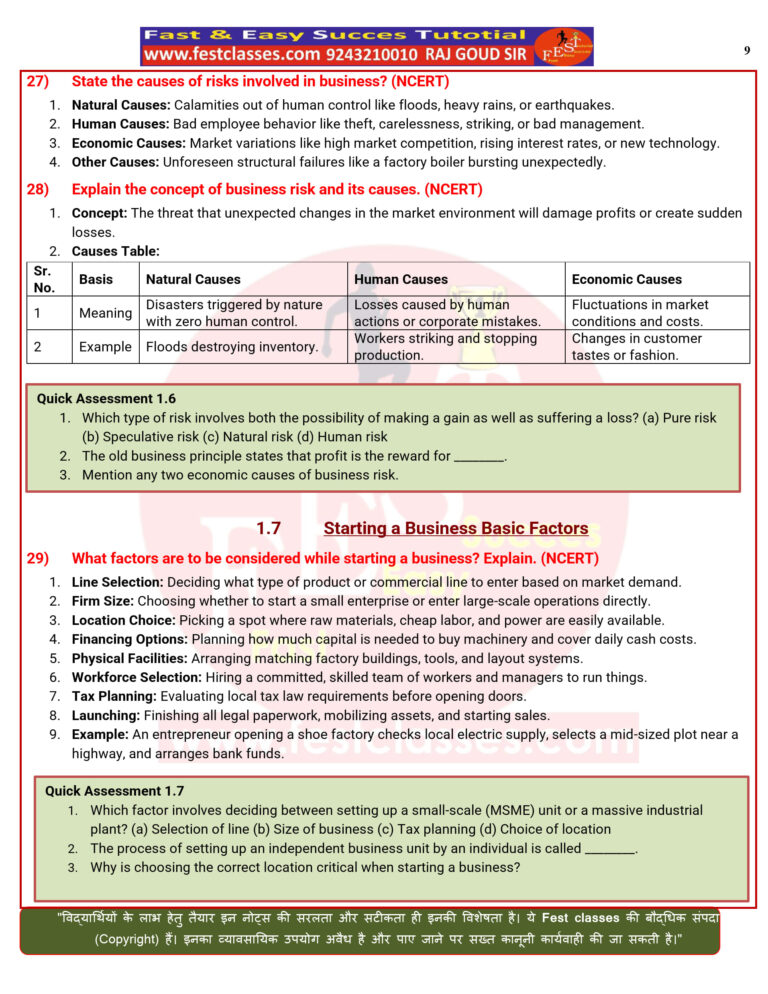
41)
State the causes of risks
involved in business? (NCERT)
- Natural Causes: Calamities out of
human control like floods, heavy rains, or earthquakes.
- Human Causes: Bad employee behavior
like theft, carelessness, striking, or bad management.
- Economic Causes: Market variations like
high market competition, rising interest rates, or new technology.
- Other Causes: Unforeseen structural
failures like a factory boiler bursting unexpectedly.
42)
Explain the concept of business
risk and its causes. (NCERT)
- Concept: The threat that
unexpected changes in the market environment will damage profits or create
sudden losses.
- Causes Table:
|
Sr. No. |
Basis |
Natural Causes |
Human Causes |
Economic Causes |
|
1 |
Meaning |
Disasters
triggered by nature with zero human control. |
Losses caused
by human actions or corporate mistakes. |
Fluctuations in
market conditions and costs. |
|
2 |
Example |
Floods
destroying inventory. |
Workers
striking and stopping production. |
Changes in
customer tastes or fashion. |
|
Quick Assessment 1.6
|
1.7
Starting a Business Basic
Factors
48)
What factors are to be
considered while starting a business? Explain. (NCERT)
- Line Selection: Deciding what type of
product or commercial line to enter based on market demand.
- Firm Size: Choosing whether to
start a small enterprise or enter large-scale operations directly.
- Location Choice: Picking a spot where
raw materials, cheap labor, and power are easily available.
- Financing Options: Planning how much
capital is needed to buy machinery and cover daily cash costs.
- Physical Facilities: Arranging matching
factory buildings, tools, and layout systems.
- Workforce Selection: Hiring a committed,
skilled team of workers and managers to run things.
- Tax Planning: Evaluating local tax
law requirements before opening doors.
- Launching: Finishing all legal
paperwork, mobilizing assets, and starting sales.
Quick Assessment 1.7
- Which factor involves deciding between
setting up a small-scale (MSME) unit or a massive industrial
plant? (a) Selection of line (b) Size of business (c) Tax
planning (d) Choice of location
- The process of setting up an independent
business unit by an individual is called ________.
- Why is choosing the correct location
critical when starting a business?
- Which factor involves deciding between
setting up a small-scale (MSME) unit or a massive industrial
plant? (a) Selection of line (b) Size of business (c) Tax
planning (d) Choice of location