


Chapter – 1. Forms of Business
Organisation
1.1
Introduction
& Sole Proprietorship
1)
What
are the major forms of business organisation available to start or expand a
business?
- Sole
Proprietorship: Owned, managed, and controlled by a single individual.
- Joint
Hindu Family Business: Business owned and run by members of a Hindu Undivided
Family (HUF).
- Partnership: Business formed by two or
more persons agreeing to share profits and risks.
- Cooperative
Society:
Voluntary association formed mainly for the mutual welfare of its members.
- Joint
Stock Company:
Entity created by law with a separate legal identity and continuous life.
2)
What
do you understand by a sole proprietorship firm? Explain its key features,
merits, and limitations. (NCERT)
Definition: A business owned, managed, and controlled by a single
individual who gets all profits and bears all risks.
Example: A neighborhood grocery shop run by a single shopkeeper.
Key Features:
1.
Easy Formation & Closure: Hardly any legal formalities are needed to start or close
the business.
2.
Unlimited Liability: Owner’s personal assets can be sold to pay off business debts if
business assets fall short.
3.
Single Risk Bearer & Profit Recipient: The owner enjoys 100% of the
profits and absorbs all losses alone.
4.
Direct Control: All operational decisions are taken strictly by the owner without
outside interference.
5.
No Separate Legal Entity: Law treats the owner and business as one single entity.
6.
Lack of Business Continuity: Owner’s death, illness, or insolvency can directly lead to
business closure.
Merits:
1.
Quick Decisions: Direct control allows instant decision-making without consulting anyone.
2.
Confidentiality: Business secrets stay completely safe as there is no legal requirement
to publish accounts.
3.
Direct Motivation: Getting all profits drives the owner to work harder.
4.
Personal Satisfaction: Running one’s own business creates confidence and
self-accomplishment.
Limitations:
1.
Limited Resources: Capital is strictly restricted to personal savings and limited borrowing
capacity.
2.
Limited Life:
Business existence ends easily if the owner dies or faces bankruptcy.
3.
Heavy Risk Burden: Fear of losing personal property due to unlimited liability restricts
expansion.
4.
Limited Managerial Skill: A single person cannot be expert in purchasing, selling,
and financial management all at once.
3)
Despite
limitations of size and resources, why do many people continue to prefer sole
proprietorship over other forms of organisation? (NCERT)
1.
Minimal Capital & Low Cost: Easy to set up with very small personal savings.
2.
Complete Freedom: Instant decisions without waiting for partners’ or board approvals.
3.
Personalized Customer Service: Direct interaction with customers builds strong loyalty,
essential for small retail stores or salons.
4.
Zero Profit Sharing: Rewards belong 100% to the owner, giving maximum incentive to put in
effort.
5.
No Complex Legal Formalities: No compulsory legal registration or mandatory filing of
public financial reports.
4)
Kiran
is a sole proprietor operating a neighborhood accessories shop that grew into a
city-wide retail chain with three branches. She is wondering whether she should
form a company to go nationwide. Explain two benefits of remaining a sole
proprietor and two benefits of converting to a joint stock company. (NCERT)
- Two
Benefits of Remaining a Sole Proprietor:
a)
Absolute Control: Kiran retains full authority over all daily decisions without
interference from shareholders or directors.
b)
Complete Confidentiality: Business operations and financial profits remain entirely
private.
- Two
Benefits of Converting to a Joint Stock Company:
a)
Massive Capital Access: Can raise huge funds nationwide by issuing shares to the
general public.
b)
Limited Liability: Kiran’s personal assets will stay completely protected from business
liabilities.
5)
The
business assets of a sole proprietorship firm amount to Rs. 50,000, but the
unpaid debts are Rs. 80,000. What course of action can the creditors take to
recover the remaining amount? (NCERT)
- Unlimited
Liability Application: Sole proprietors have unlimited personal liability by
law.
- Creditor’s
Action:
Creditors will first sell all business assets worth Rs. 50,000.
Quick Assessment
1. Which form of business organisation gives the owner absolute decision-making power and 100% right over profits?
2. A sole proprietor has __________ liability, meaning personal assets can be attached to settle business debts.
3. Sole proprietorship business can be closed instantly if the proprietor becomes insolvent. True/False
1.2
Joint Hindu Family Business
(HUF)
6) What is meant by Joint Hindu Family Business? (NCERT)
- Definition: A unique Indian form of business owned and
carried on by members of a Hindu Undivided Family (HUF), governed by Hindu
Law.
- Membership: Acquired automatically by birth in the family
across three successive generations.
- Key Roles: The head/eldest member is called Karta;
all other male/female members with equal ownership rights are called Co-parceners.
- Practical Example: A traditional family-run textile store
managed by the eldest member with all family members sharing equal
hereditary property rights.
7) State the key features of a Joint Hindu Family Business. (NCERT)
- Formation: Requires at least 2 family members and
ancestral property inherited by them; no legal agreement needed.
- Liability: Karta has unlimited liability, while
co-parceners have limited liability up to their share in ancestral
property.
- Control: Karta holds absolute decision-making power
and full management authority.
- Continuity: Business continues smoothly after Karta’s
death as the next eldest member automatically becomes Karta.
- Minor Members: Minors automatically become members right
from their birth.
8) What are the merits and limitations of a Joint Hindu Family
Business? (NCERT)
- Merits:
a)
Effective
Control: Karta takes quick,
undisputed decisions without internal interference.
b)
Business
Continuity: Karta’s death does not
end the business; the next eldest member takes over.
c)
Limited Risk
for Members: Co-parceners lose at
most their property share; personal assets remain safe.
d)
Family
Loyalty: High cooperation and
loyalty as family prestige is linked to business success.
- Limitations:
a)
Limited
Capital: Restricted purely to
inherited ancestral property, limiting expansion.
b)
Unlimited
Liability of Karta: Karta risks
losing personal property to repay business debts.
c)
Karta’s
Dominance: Unilateral decisions by
Karta can create family conflicts and splits.
d)
Limited
Managerial Skills: Karta may lack
professional expertise in all management areas.
9) Compare the status of a minor in a Joint Hindu Family business with
that in a partnership firm. (NCERT)
- Status in HUF: A minor becomes a full co-parcener
automatically by birth with full property rights.
- Status in
Partnership: A minor cannot
become a full partner because a minor cannot enter a legal contract; can
only be admitted to profit benefits with all partners’ consent.
10)
|
Quick Assessment 2.2
(a)
All co-parceners (b) Karta only (c) Minor members only (d) Female members
only
|
|
Sr. No. |
Basis |
Joint Hindu Family Business |
Partnership |
|
1 |
Meaning |
Business run by HUF members governed by Hindu Law.
|
Business carried on by two or more persons based
on a contract. |
|
2 |
Governing Law |
Hindu Succession Act, 1956 / Hindu Law. |
Indian Partnership Act, 1932. |
|
3 |
Mode of Admission |
By birth in the family. |
By written or oral legal agreement. |
|
4 |
Liability |
Karta: Unlimited; Members: Limited. |
All partners: Unlimited and joint. |
|
5 |
Control & Management |
Karta alone controls everything. |
Managed jointly by all or active partners. |
|
6 |
Minor’s Status |
Member by birth. |
Admitted only for profit benefits. |
|
7 |
Minimum Members |
Minimum 2 members. |
Minimum 2 members. |
1.3
Partnership
11)Q. Define Partnership
according to Section 4 of the Indian Partnership Act, 1932. Also, explain the
terms ‘Partners’, ‘Firm’, and ‘Firm Name’. (MP 2024, NCERT)
Definition of
Partnership: According to Section 4 of the Indian Partnership Act,
1932: “Partnership is the relation between persons who have agreed to
share the profits of a business carried on by all or any of them acting for
all.”
- Partners: The persons
who have entered into a partnership with one another individually are
called ‘Partners’.
- Firm:
Collectively, all the partners who run the business together are called a
‘Firm’.
- Firm Name: The
specific name under which the partnership business is conducted and
managed is called the ‘Firm Name’.
12)Q. Explain the separate
legal entity status of a partnership firm. Discuss it from both an accounting
and a legal viewpoint. (MP 2023, NCERT)
A partnership firm has a unique status regarding its identity, which
must be understood through two distinct viewpoints:
1. From an
Accounting Viewpoint: (separate business entity) From the accounting
perspective All transactions, capital accounts, drawings, and profits are
recorded in the books of accounts purely from the firm’s perspective.
2. From a Legal
Viewpoint: (not separate legal entity) under the Indian
Partnership Act, 1932, The firm and the partners are one and the same in the
eyes of the law. This implies that if the firm’s assets are insufficient to pay
off its debts, the private or personal assets of the partners can be legally
used to clear the firm’s liabilities.
13)Q3. Explain the essential
features or characteristics of a partnership firm. (MP 2025, MP 2023, NCERT)
To form a valid partnership, the following
essential features must be present:
- Two or
More Persons: Minimum 2 persons & maximum partners are 50.
- Agreement: A
partnership is born out of an agreement. This agreement can be either oral
(spoken) or written.
- Lawful
Business: The partners must carry out a legal or
lawful business. Co-ownership of a property without a regular business
does not create a partnership.
- Profit
Sharing: The main objective of the agreement must
be to share the profits of the business. If an association is
formed purely for charity work, it cannot be called a partnership.
- Mutual
Agency: The business must be carried on by all
the partners or by any one of them acting for all. This means every
partner is both a principal (can bind other partners) and an
agent (is bound by other partners).
- Restriction
on Transfer of Share: No partner can
transfer or sell their ownership share in the firm to an outsider or
family member without obtaining the unanimous (100%) consent of all other
existing partners.
- Unlimited
Liability: The liability of all partners is joint, several,
and unlimited. If the business assets are not enough to pay off the debts,
the personal properties of the partners can be used to pay the creditors.
Quick Assessment 1.1
- Partnership business operates as per
provisions of – (MP 2025)
(a) Indian Partnership Act, 1930 (b) Indian Partnership Act, 1932
(c) Company Act, 1956 (d) Indian Partnership Act, 1931
- From a legal viewpoint, a partnership
firm has __________ legal entity from its partners. (MP 2024)
- Write down the true test of partnership
that defines the relationship between partners. (NCERT)
- Partnership business operates as per
provisions of – (MP 2025)
1.4
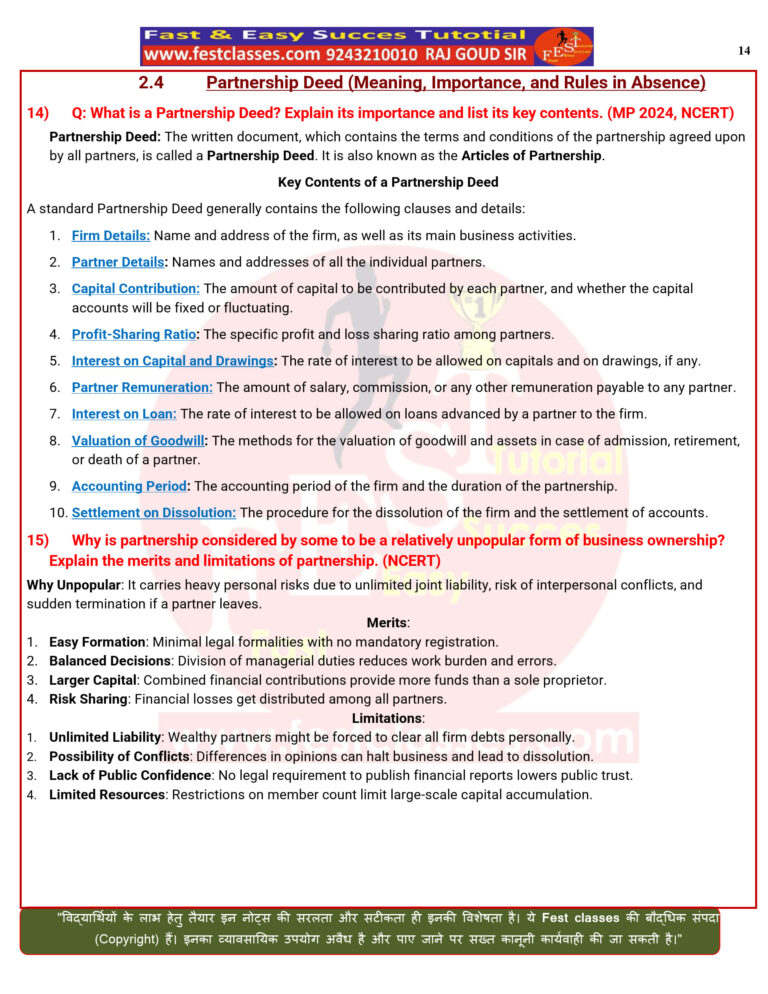
Partnership Deed (Meaning,
Importance, and Rules in Absence)
14)Q: What is a Partnership
Deed? Explain its importance and list its key contents. (MP 2024, NCERT)
Partnership Deed: The written
document, which contains the terms and conditions of the partnership agreed
upon by all partners, is called a Partnership Deed. It is also known as
the Articles of Partnership.
Key Contents of a
Partnership Deed
A standard Partnership Deed generally contains the following clauses and
details:
- Firm Details: Name and
address of the firm, as well as its main business activities.
- Partner Details: Names and
addresses of all the individual partners.
- Capital Contribution: The amount
of capital to be contributed by each partner, and whether the capital
accounts will be fixed or fluctuating.
- Profit-Sharing Ratio: The
specific profit and loss sharing ratio among partners.
- Interest on Capital and Drawings: The rate of
interest to be allowed on capitals and on drawings, if any.
- Partner Remuneration: The amount
of salary, commission, or any other remuneration payable to any partner.
- Interest on Loan: The rate of
interest to be allowed on loans advanced by a partner to the firm.
- Valuation of Goodwill: The methods
for the valuation of goodwill and assets in case of admission, retirement,
or death of a partner.
- Accounting Period: The
accounting period of the firm and the duration of the partnership.
- Settlement on Dissolution: The
procedure for the dissolution of the firm and the settlement of accounts.
15)Why is partnership
considered by some to be a relatively unpopular form of business ownership?
Explain the merits and limitations of partnership. (NCERT)
Why
Unpopular: It carries heavy
personal risks due to unlimited joint liability, risk of interpersonal
conflicts, and sudden termination if a partner leaves.
Merits:
1.
Easy
Formation: Minimal legal
formalities with no mandatory registration.
2.
Balanced
Decisions: Division of managerial
duties reduces work burden and errors.
3.
Larger
Capital: Combined financial
contributions provide more funds than a sole proprietor.
4.
Risk Sharing: Financial losses get distributed among all
partners.
Limitations:
1. Unlimited Liability: Wealthy partners might be forced to clear all firm
debts personally.
2. Possibility of Conflicts: Differences in opinions can halt business and lead
to dissolution.
3. Lack of Public Confidence: No legal requirement to publish financial reports
lowers public trust.
4. Limited Resources: Restrictions on member count limit large-scale capital accumulation.
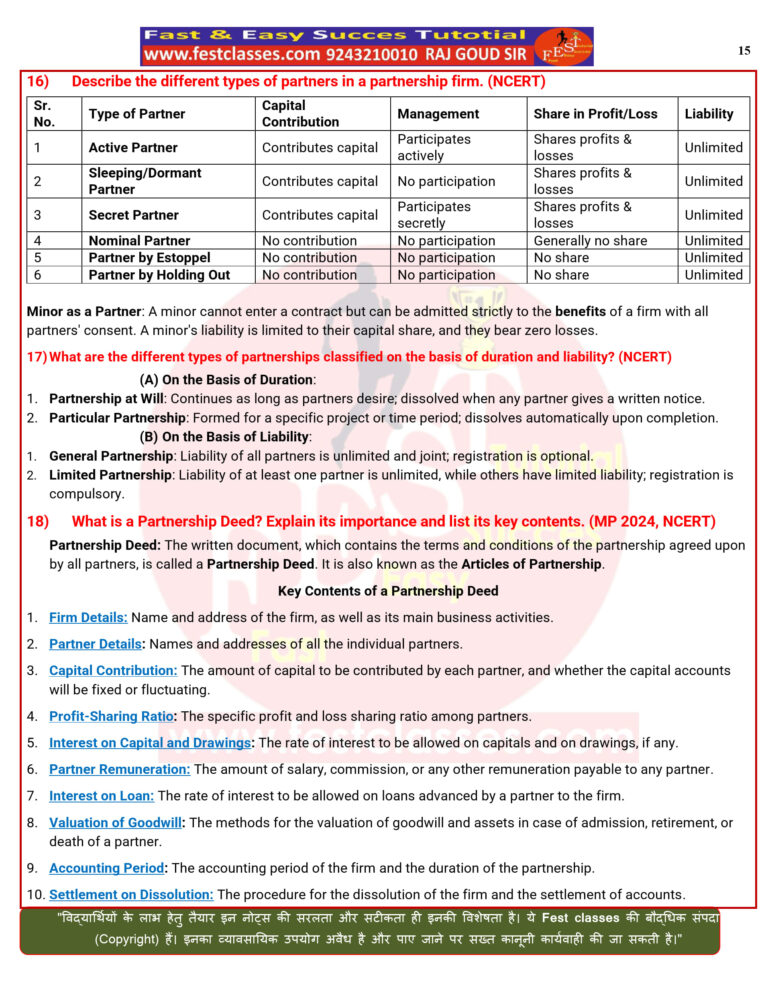
16)Describe the different
types of partners in a partnership firm. (NCERT)
|
Sr. No. |
Type of Partner |
Capital Contribution |
Management |
Share in Profit/Loss |
Liability |
|
1 |
Active Partner |
Contributes capital |
Participates actively |
Shares profits & losses |
Unlimited |
|
2 |
Sleeping/Dormant Partner |
Contributes capital |
No participation |
Shares profits & losses |
Unlimited |
|
3 |
Secret Partner |
Contributes capital |
Participates secretly |
Shares profits & losses |
Unlimited |
|
4 |
Nominal Partner |
No contribution |
No participation |
Generally no share |
Unlimited |
|
5 |
Partner by Estoppel |
No contribution |
No participation |
No share |
Unlimited |
|
6 |
Partner by Holding Out |
No contribution |
No participation |
No share |
Unlimited |
Minor
as a Partner: A minor cannot enter
a contract but can be admitted strictly to the benefits of a firm with
all partners’ consent. A minor’s liability is limited to their capital share,
and they bear zero losses.
17)
What are the different types of partnerships classified on
the basis of duration and liability? (NCERT)
(A)
On the
Basis of Duration:
1.
Partnership
at Will: Continues as long as
partners desire; dissolved when any partner gives a written notice.
2.
Particular
Partnership: Formed for a specific
project or time period; dissolves automatically upon completion.
(B)
On the
Basis of Liability:
1. General Partnership: Liability of all partners is unlimited and joint;
registration is optional.
2. Limited Partnership: Liability of at least one partner is unlimited,
while others have limited liability; registration is compulsory.
18)What is a Partnership Deed?
Explain its importance and list its key contents. (MP 2024, NCERT)
Partnership Deed: The written
document, which contains the terms and conditions of the partnership agreed
upon by all partners, is called a Partnership Deed. It is also known as
the Articles of Partnership.
Key Contents of a
Partnership Deed
1.
Firm
Details: Name and address of the firm, as well as its main business activities.
2.
Partner
Details: Names and addresses of all the individual partners.
3.
Capital
Contribution: The amount of capital to be contributed by each
partner, and whether the capital accounts will be fixed or fluctuating.
4.
Profit-Sharing
Ratio: The specific profit and loss sharing ratio among partners.
5.
Interest
on Capital and Drawings: The rate of interest to be allowed on capitals
and on drawings, if any.
6.
Partner
Remuneration: The amount of salary, commission, or any other
remuneration payable to any partner.
7.
Interest
on Loan: The rate of interest to be allowed on loans advanced by a partner to
the firm.
8.
Valuation
of Goodwill: The methods for the valuation of goodwill and assets
in case of admission, retirement, or death of a partner.
9.
Accounting
Period: The accounting period of the firm and the duration of the partnership.
10. Settlement on Dissolution: The procedure
for the dissolution of the firm and the settlement of accounts.
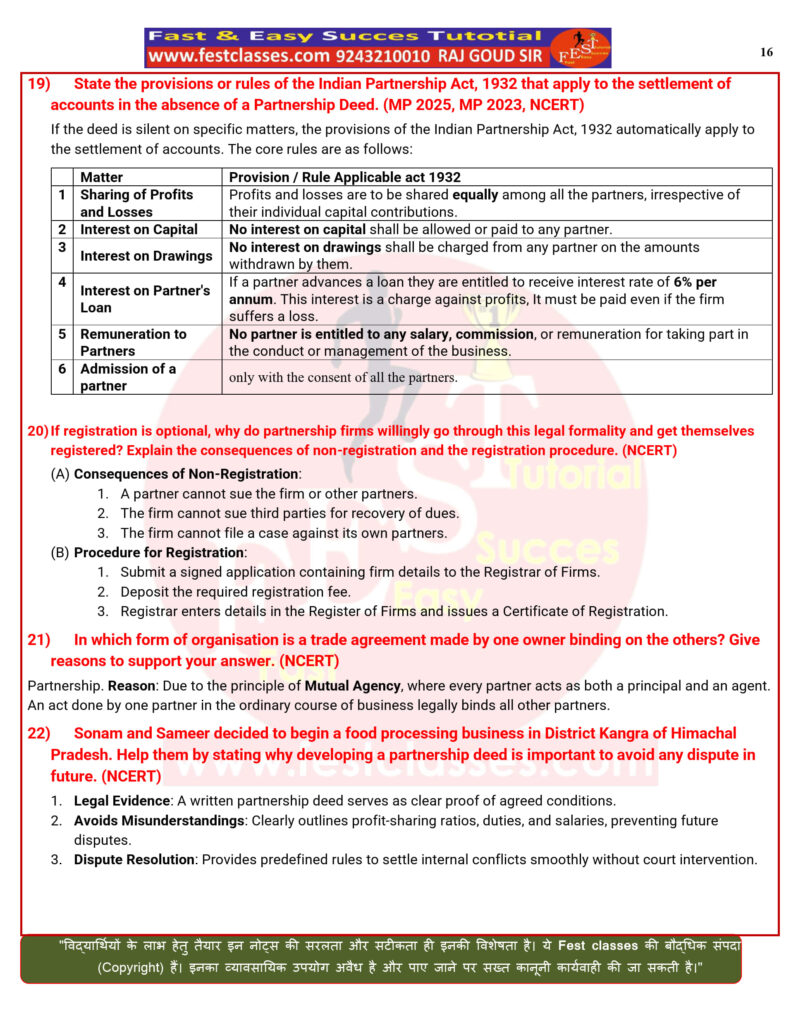
19)State the provisions or
rules of the Indian Partnership Act, 1932 that apply to the settlement of
accounts in the absence of a Partnership Deed. (MP 2025, MP 2023, NCERT)
If the deed is silent on
specific matters, the provisions of the Indian Partnership Act, 1932
automatically apply to the settlement of accounts. The core rules are as
follows:
|
|
Matter |
Provision /
Rule Applicable act 1932 |
|
1 |
Sharing of
Profits and Losses |
Profits and
losses are to be shared equally among all the partners, irrespective
of their individual capital contributions. |
|
2 |
Interest on
Capital |
No interest on
capital shall be allowed or paid to any partner. |
|
3 |
Interest on
Drawings |
No interest on
drawings shall be charged from any partner on the amounts withdrawn by them. |
|
4 |
Interest on
Partner’s Loan |
If a partner
advances a loan they are entitled to receive interest rate of 6% per annum.
This interest is a charge against profits, It must be paid even if the firm
suffers a loss. |
|
5 |
Remuneration to
Partners |
No partner is
entitled to any salary, commission, or remuneration for
taking part in the conduct or management of the business. |
|
6 |
Admission of a
partner |
only
with the consent of all the partners. |
20)
If registration is optional, why do partnership firms
willingly go through this legal formality and get themselves registered?
Explain the consequences of non-registration and the registration procedure.
(NCERT)
(A) Consequences of Non-Registration:
1.
A partner
cannot sue the firm or other partners.
2.
The firm cannot
sue third parties for recovery of dues.
3.
The firm cannot
file a case against its own partners.
(B)
Procedure
for Registration:
1.
Submit a signed
application containing firm details to the Registrar of Firms.
2.
Deposit the
required registration fee.
3.
Registrar
enters details in the Register of Firms and issues a Certificate of
Registration.
21)In which form of
organisation is a trade agreement made by one owner binding on the others? Give
reasons to support your answer. (NCERT)
Partnership.
Reason: Due to the principle of Mutual Agency, where every
partner acts as both a principal and an agent. An act done by one partner in
the ordinary course of business legally binds all other partners.
22)Sonam and Sameer decided to
begin a food processing business in District Kangra of Himachal Pradesh. Help
them by stating why developing a partnership deed is important to avoid any
dispute in future. (NCERT)
- Legal Evidence: A written partnership deed serves as clear
proof of agreed conditions.
- Avoids
Misunderstandings: Clearly
outlines profit-sharing ratios, duties, and salaries, preventing future
disputes.
- Dispute
Resolution: Provides
predefined rules to settle internal conflicts smoothly without court
intervention.
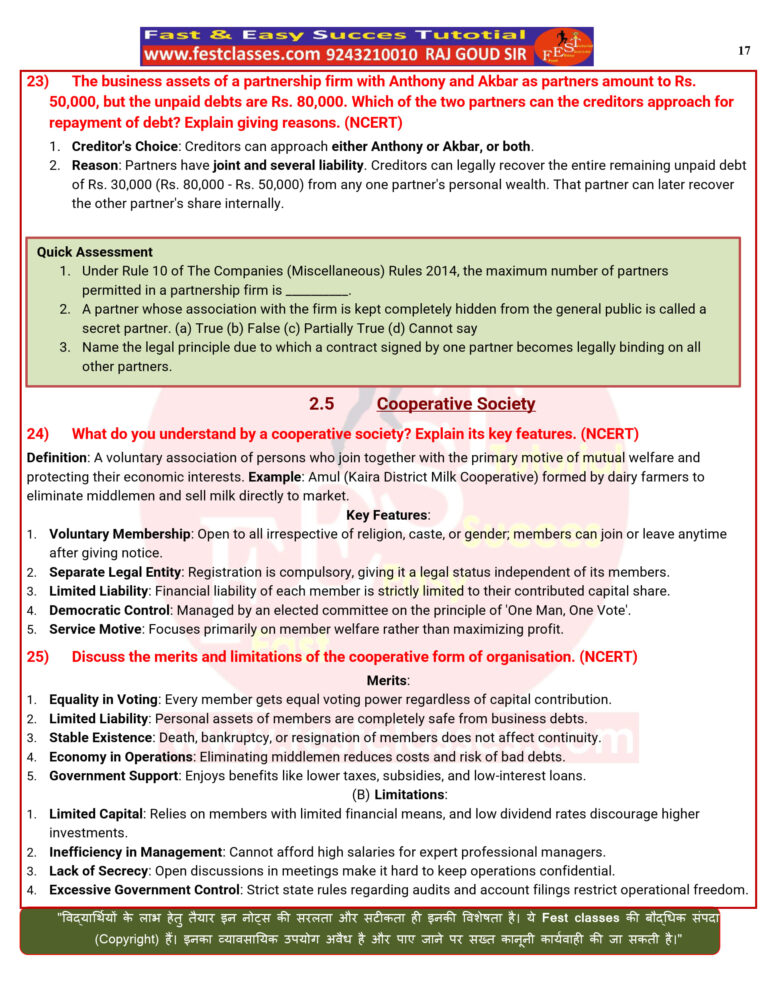
23)The business assets of a
partnership firm with Anthony and Akbar as partners amount to Rs. 50,000, but
the unpaid debts are Rs. 80,000. Which of the two partners can the creditors
approach for repayment of debt? Explain giving reasons. (NCERT)
- Creditor’s Choice: Creditors can approach either Anthony or
Akbar, or both.
- Reason: Partners have joint and several liability.
Creditors can legally recover the entire remaining unpaid debt of Rs.
30,000 (Rs. 80,000 – Rs. 50,000) from any one partner’s personal wealth.
That partner can later recover the other partner’s share internally.
|
Quick Assessment
|
1.5
Cooperative Society
24)What do you understand by a
cooperative society? Explain its key features. (NCERT)
Definition: A voluntary association of persons who join
together with the primary motive of mutual welfare and protecting their
economic interests. Example: Amul (Kaira District Milk Cooperative)
formed by dairy farmers to eliminate middlemen and sell milk directly to
market.
Key Features:
1. Voluntary Membership: Open to all irrespective of religion, caste, or
gender; members can join or leave anytime after giving notice.
2. Separate Legal Entity: Registration is compulsory, giving it a legal
status independent of its members.
3. Limited Liability: Financial liability of each member is strictly limited to their
contributed capital share.
4. Democratic Control: Managed by an elected committee on the principle of ‘One Man, One
Vote’.
5. Service Motive: Focuses primarily on member welfare rather than maximizing profit.
25)Discuss the merits and
limitations of the cooperative form of organisation. (NCERT)
Merits:
1. Equality in Voting: Every member gets equal voting power regardless of capital
contribution.
2. Limited Liability: Personal assets of members are completely safe from business debts.
3. Stable Existence: Death, bankruptcy, or resignation of members does not affect
continuity.
4. Economy in Operations: Eliminating middlemen reduces costs and risk of
bad debts.
5. Government Support: Enjoys benefits like lower taxes, subsidies, and low-interest loans.
(B)
Limitations:
1. Limited Capital: Relies on members with limited financial means, and low dividend
rates discourage higher investments.
2. Inefficiency in Management: Cannot afford high salaries for expert
professional managers.
3. Lack of Secrecy: Open discussions in meetings make it hard to keep operations
confidential.
4. Excessive Government Control: Strict state rules regarding audits and account
filings restrict operational freedom.
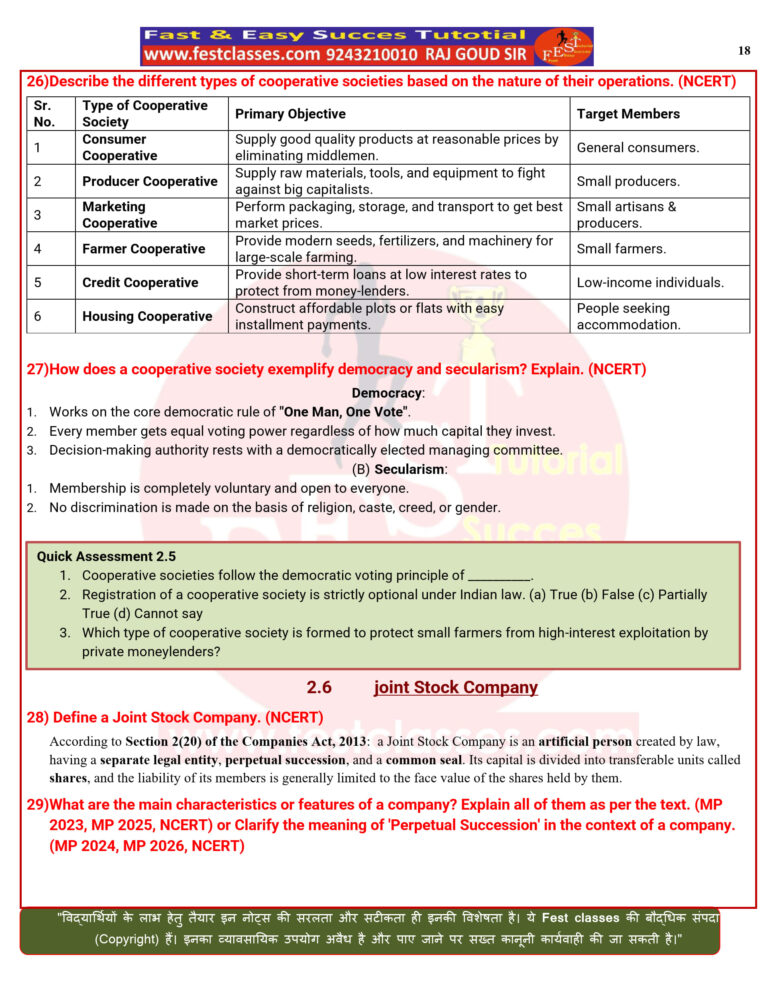
26)Describe the different
types of cooperative societies based on the nature of their operations. (NCERT)
|
Sr. No. |
Type of Cooperative Society |
Primary Objective |
Target Members |
|
1 |
Consumer Cooperative |
Supply good quality products at reasonable prices
by eliminating middlemen. |
General consumers. |
|
2 |
Producer Cooperative |
Supply raw materials, tools, and equipment to
fight against big capitalists. |
Small producers. |
|
3 |
Marketing Cooperative |
Perform packaging, storage, and transport to get
best market prices. |
Small artisans & producers. |
|
4 |
Farmer Cooperative |
Provide modern seeds, fertilizers, and machinery
for large-scale farming. |
Small farmers. |
|
5 |
Credit Cooperative |
Provide short-term loans at low interest rates to
protect from money-lenders. |
Low-income individuals. |
|
6 |
Housing Cooperative |
Construct affordable plots or flats with easy
installment payments. |
People seeking accommodation. |
27)How does a cooperative
society exemplify democracy and secularism? Explain. (NCERT)
Democracy:
1. Works on the core democratic rule of “One
Man, One Vote”.
2. Every member gets equal voting power regardless of
how much capital they invest.
3. Decision-making authority rests with a
democratically elected managing committee.
(B)
Secularism:
1. Membership is completely voluntary and open to
everyone.
2.
No
discrimination is made on the basis of religion, caste, creed, or gender.
|
Quick Assessment 2.5
|
1.6
joint Stock Company
28) Define a Joint Stock
Company. (NCERT)
According to Section 2(20) of
the Companies Act, 2013: a Joint
Stock Company is an artificial person created by law, having a separate
legal entity, perpetual succession, and a common seal. Its
capital is divided into transferable units called shares, and the
liability of its members is generally limited to the face value of the shares
held by them.
29)What are the main
characteristics or features of a company? Explain all of them as per the text.
(MP 2023, MP 2025, NCERT) or Clarify the meaning of ‘Perpetual Succession’ in the
context of a company. (MP 2024, MP 2026, NCERT)
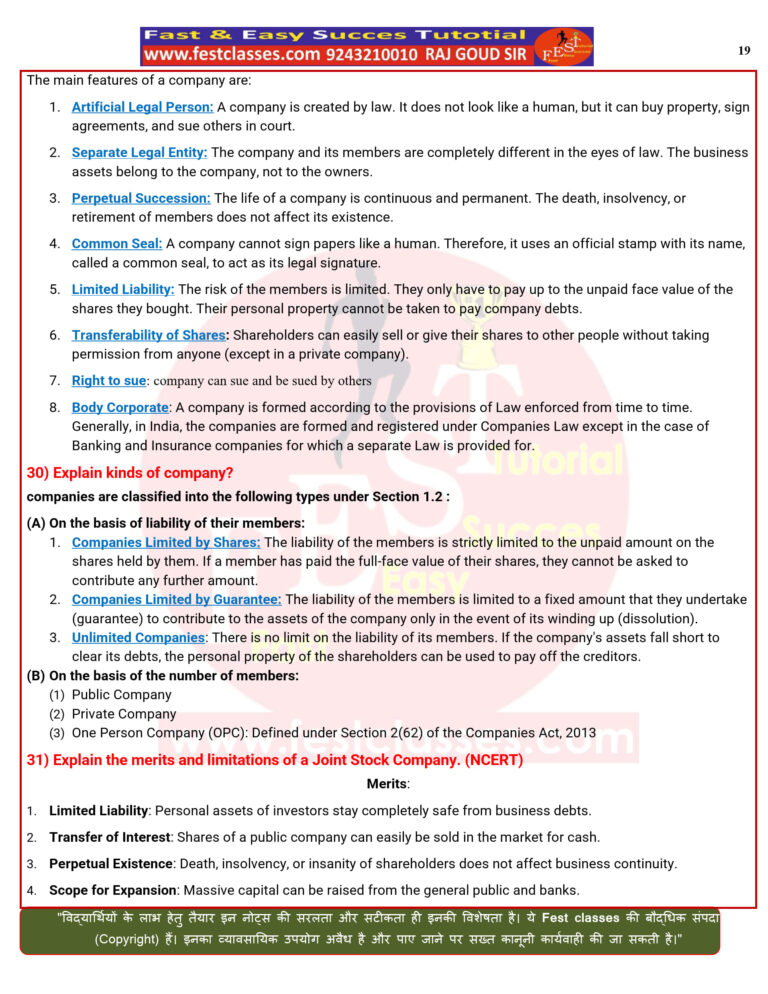
The main features of a company are:
- Artificial Legal Person: A company
is created by law. It does not look like a human, but it can buy property,
sign agreements, and sue others in court.
- Separate Legal Entity: The company
and its members are completely different in the eyes of law. The business
assets belong to the company, not to the owners.
- Perpetual Succession: The life of
a company is continuous and permanent. The death, insolvency, or
retirement of members does not affect its existence.
- Common Seal: A company
cannot sign papers like a human. Therefore, it uses an official stamp with
its name, called a common seal, to act as its legal signature.
- Limited Liability: The risk of
the members is limited. They only have to pay up to the unpaid face value
of the shares they bought. Their personal property cannot be taken to pay
company debts.
- Transferability of Shares:
Shareholders can easily sell or give their shares to other people without
taking permission from anyone (except in a private company).
- Right to sue: company can sue and be sued by
others
- Body Corporate: A company is formed according to the
provisions of Law enforced from time to time. Generally, in India, the
companies are formed and registered under Companies Law except in the case
of Banking and Insurance companies for which a separate Law is provided
for.
30) Explain kinds of company?
companies are classified into the following types under Section 1.2 :
(A)
On the basis of liability of their members:
1.
Companies
Limited by Shares: The liability of the members is strictly limited to
the unpaid amount on the shares held by them. If a member has paid the
full-face value of their shares, they cannot be asked to contribute any further
amount.
2.
Companies
Limited by Guarantee: The liability of the members is limited to a fixed
amount that they undertake (guarantee) to contribute to the assets of the
company only in the event of its winding up (dissolution).
3.
Unlimited
Companies: There is no limit on the liability of its members. If the company’s
assets fall short to clear its debts, the personal property of the shareholders
can be used to pay off the creditors.
(B)
On the basis of the number of members:
(1) Public Company
(2) Private Company
(3) One Person
Company (OPC): Defined under Section 2(62) of the Companies Act, 2013
31) Explain the merits and
limitations of a Joint Stock Company. (NCERT)
Merits:
1. Limited Liability: Personal assets of investors stay completely safe from business
debts.
2. Transfer of Interest: Shares of a public company can easily be sold in
the market for cash.
3. Perpetual Existence: Death, insolvency, or insanity of shareholders
does not affect business continuity.
4. Scope for Expansion: Massive capital can be raised from the general
public and banks.
5. Professional Management: Can afford high salaries to hire experts for
efficient operation.
(B)
Limitations:
1.
Complex
Formation: Requires extensive legal
compliance, documents, and formal procedures.
2.
Lack of
Secrecy: Required to publish and
submit detailed annual financial reports to the Registrar.
3.
Delay in
Decisions: Democratic setup with
multi-level approvals causes administrative delays.
4.
Numerous
Regulations: Strict compliance with
government norms, audits, and statutory requirements.
5.
Oligarchic
Management: In practice, control
remains concentrated in the hands of a few directors.
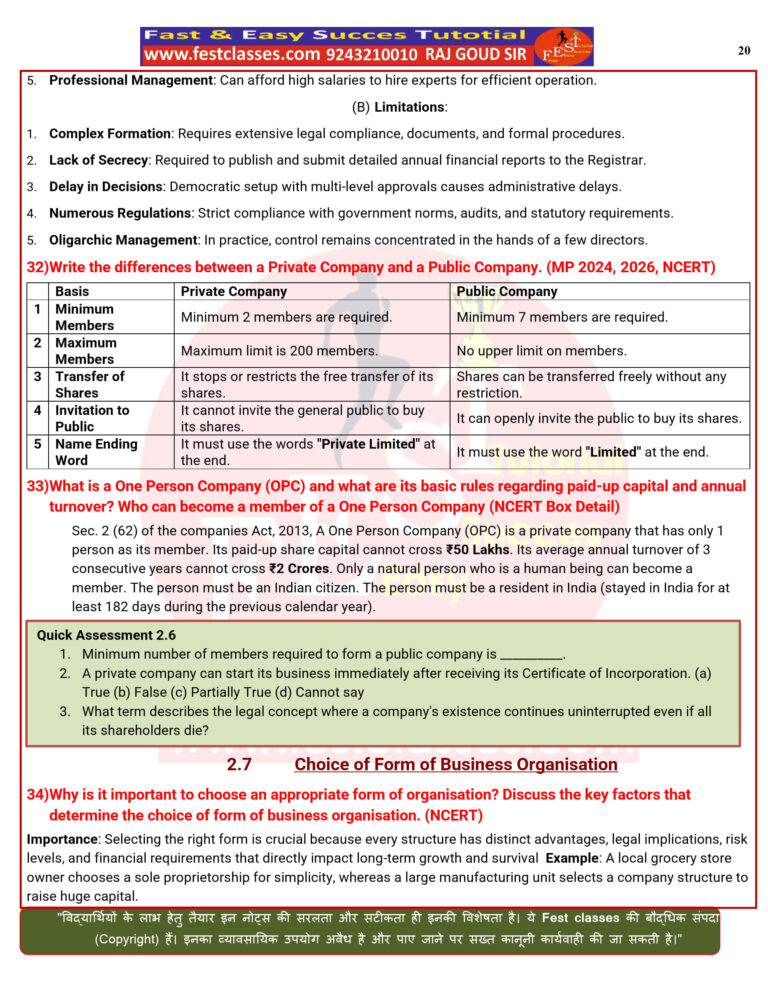
32)Write the differences
between a Private Company and a Public Company. (MP 2024, 2026, NCERT)
|
|
Basis |
Private Company |
Public Company |
|
1 |
Minimum Members |
Minimum 2
members are required. |
Minimum 7
members are required. |
|
2 |
Maximum Members |
Maximum limit
is 200 members. |
No upper limit
on members. |
|
3 |
Transfer of
Shares |
It stops or
restricts the free transfer of its shares. |
Shares can be
transferred freely without any restriction. |
|
4 |
Invitation to
Public |
It cannot
invite the general public to buy its shares. |
It can openly
invite the public to buy its shares. |
|
5 |
Name Ending
Word |
It must use the
words “Private Limited” at the end. |
It must use the
word “Limited” at the end. |
33)What is a One Person
Company (OPC) and what are its basic rules regarding paid-up capital and annual
turnover? Who can become a member of a One Person Company (NCERT
Box Detail)
|
Quick Assessment 2.6
|
1.7
Choice of Form of Business
Organisation
34)Why is it important to
choose an appropriate form of organisation? Discuss the key factors that
determine the choice of form of business organisation. (NCERT)
Importance: Selecting the right form is crucial because every
structure has distinct advantages, legal implications, risk levels, and
financial requirements that directly impact long-term growth and survival Example: A local grocery store owner
chooses a sole proprietorship for simplicity, whereas a large manufacturing
unit selects a company structure to raise huge capital.
Key Determinant Factors:
1. Cost & Ease of Formation: Sole proprietorship is easiest and cheapest to set
up, whereas a company involves lengthy legal procedures and heavy expense.
2. Liability:
Investors seeking limited personal risk prefer companies or cooperative
societies over sole proprietorships or general partnerships.
3. Continuity:
If long-term permanent operations are required, a company structure is ideal
due to its perpetual existence.
4. Management Ability: Complex operations needing professional experts benefit from a
company structure, whereas simple businesses can run as proprietorships.
5. Capital Considerations: Large-scale projects requiring huge investment
require a company to raise funds from the public.
6. Degree of Control: Owners wanting absolute personal decision-making power choose sole
proprietorship.
7. Nature of Business: Direct customer contact businesses suit proprietorship, while large
manufacturing units suit company forms.
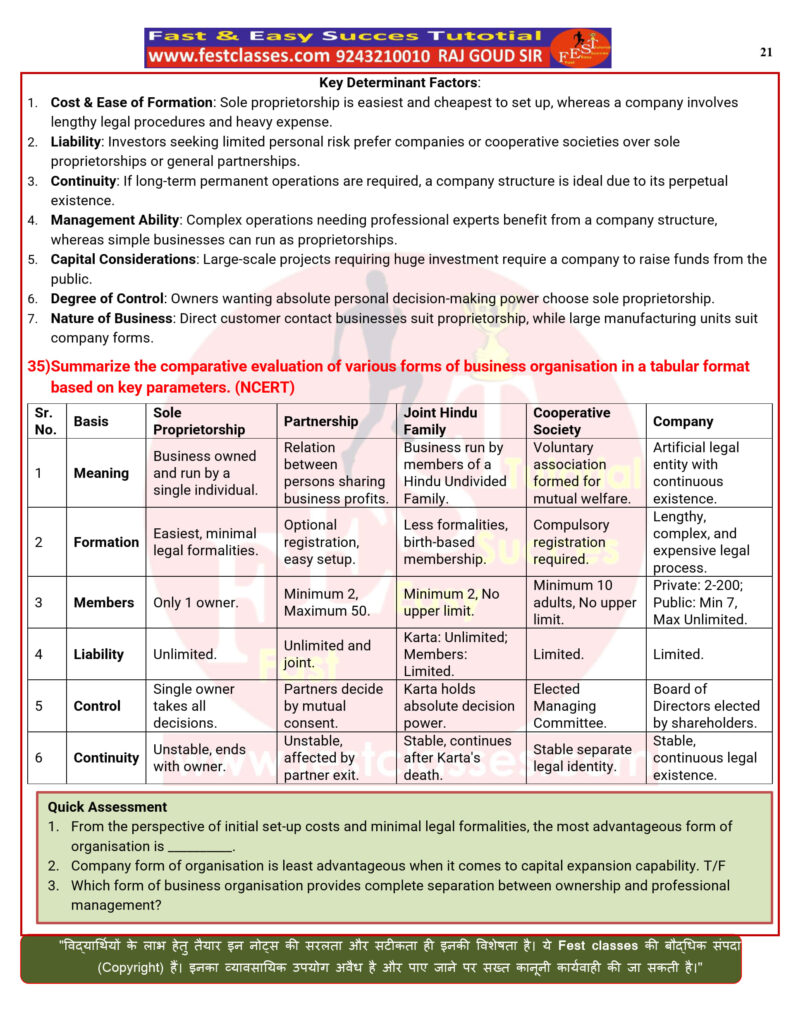
35)
|
Quick Assessment 1. From the perspective of initial set-up costs and
minimal legal formalities, the most advantageous form of organisation is
__________. 2. Company form of organisation is least
advantageous when it comes to capital expansion capability. T/F 3. Which form of business organisation provides
complete separation between ownership and professional management? |
|
Sr. No. |
Basis |
Sole Proprietorship |
Partnership |
Joint Hindu Family |
Cooperative Society |
Company |
|
1 |
Meaning |
Business owned and run by a single individual. |
Relation between persons sharing business profits.
|
Business run by members of a Hindu Undivided
Family. |
Voluntary association formed for mutual welfare. |
Artificial legal entity with continuous existence.
|
|
2 |
Formation |
Easiest, minimal legal formalities. |
Optional registration, easy setup. |
Less formalities, birth-based membership. |
Compulsory registration required. |
Lengthy, complex, and expensive legal process. |
|
3 |
Members |
Only 1 owner. |
Minimum 2, Maximum 50. |
Minimum 2, No upper limit. |
Minimum 10 adults, No upper limit. |
Private: 2-200; Public: Min 7, Max Unlimited. |
|
4 |
Liability |
Unlimited. |
Unlimited and joint. |
Karta: Unlimited; Members: Limited. |
Limited. |
Limited. |
|
5 |
Control |
Single owner takes all decisions. |
Partners decide by mutual consent. |
Karta holds absolute decision power. |
Elected Managing Committee. |
Board of Directors elected by shareholders. |
|
6 |
Continuity |
Unstable, ends with owner. |
Unstable, affected by partner exit. |
Stable, continues after Karta’s death. |
Stable separate legal identity. |
Stable, continuous legal existence. |