


Chapter – 1.
Planning
1.1
Concept and Meaning of Planning
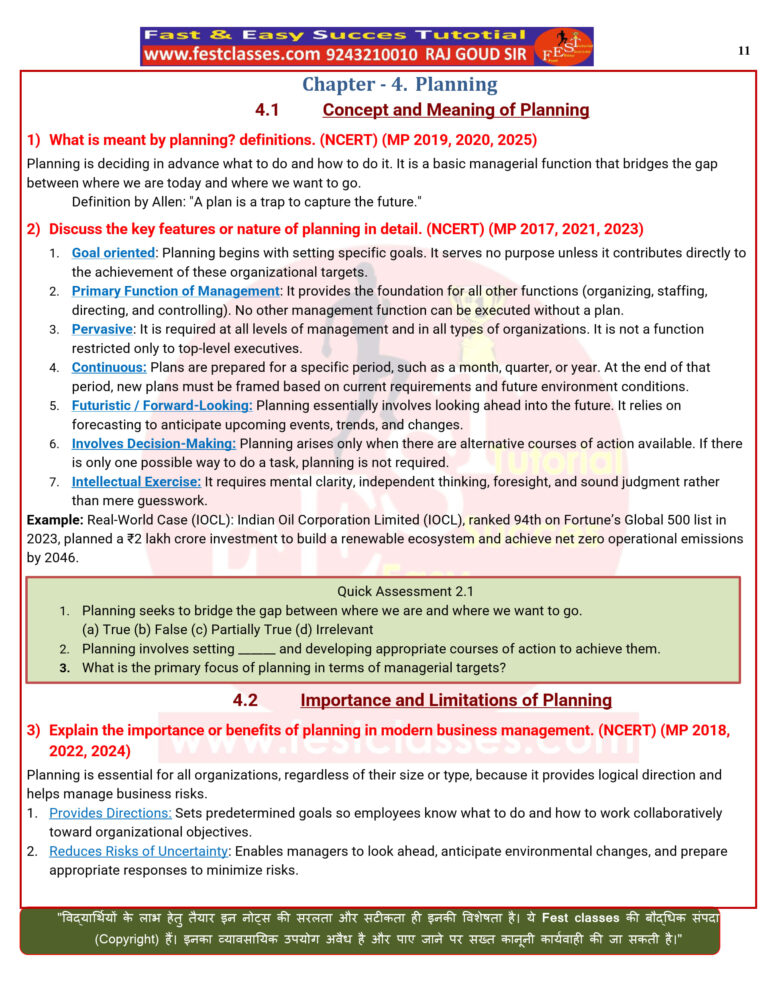
1) What is meant by planning? definitions. (NCERT) (MP 2019, 2020,
2025)
Planning is
deciding in advance what to do and how to do it. It is a basic managerial
function that bridges the gap between where we are today and where we want to
go.
Definition by Allen: “A plan is a trap to capture the
future.”
2) Discuss the key features or nature of planning in detail. (NCERT)
(MP 2017, 2021, 2023)
1.
Goal oriented: Planning begins with setting specific goals. It
serves no purpose unless it contributes directly to the achievement of these
organizational targets.
2.
Primary Function of Management: It provides the foundation for all
other functions (organizing, staffing, directing, and controlling). No other
management function can be executed without a plan.
3.
Pervasive: It is required at all levels of management and in
all types of organizations. It is not a function restricted only to top-level
executives.
4.
Continuous: Plans are prepared for a specific period, such as a
month, quarter, or year. At the end of that period, new plans must be framed
based on current requirements and future environment conditions.
5.
Futuristic / Forward-Looking: Planning essentially involves looking
ahead into the future. It relies on forecasting to anticipate upcoming events,
trends, and changes.
6.
Involves Decision-Making: Planning arises only when there are
alternative courses of action available. If there is only one possible way to
do a task, planning is not required.
7.
Intellectual Exercise: It requires mental clarity, independent
thinking, foresight, and sound judgment rather than mere guesswork.
|
Quick Assessment 2.1 1. Planning seeks to bridge the gap
between where we are and where we want to go. (a) True (b) False (c) Partially True (d)
Irrelevant 2. Planning involves setting ______ and
developing appropriate courses of action to achieve them. 3.
What
is the primary focus of planning in terms of managerial targets? |
1.2
Importance and Limitations of
Planning
3) Explain the importance or benefits of planning in modern business
management. (NCERT) (MP 2018, 2022, 2024)
Planning is essential for all organizations, regardless of their size or
type, because it provides logical direction and helps manage business risks.
1. Provides
Directions: Sets predetermined goals so employees know what to do and how to work
collaboratively toward organizational objectives.
2. Reduces Risks
of Uncertainty: Enables managers to look ahead, anticipate
environmental changes, and prepare appropriate responses to minimize risks.
3. Reduces
Overlapping and Wasteful Activities: Coordinates efforts
across departments, eliminating useless, duplicate, or inefficient actions.
4. Promotes
Innovative Ideas: Encourages creative thinking and intellectual
analysis to discover better ways of performing tasks.
5. Facilitates
Decision-Making: Helps managers evaluate multiple alternatives and
choose the most suitable course of action.
6. Establishes
Standards for Controlling: Provides baseline targets against which
actual performance is measured to identify and correct deviations.
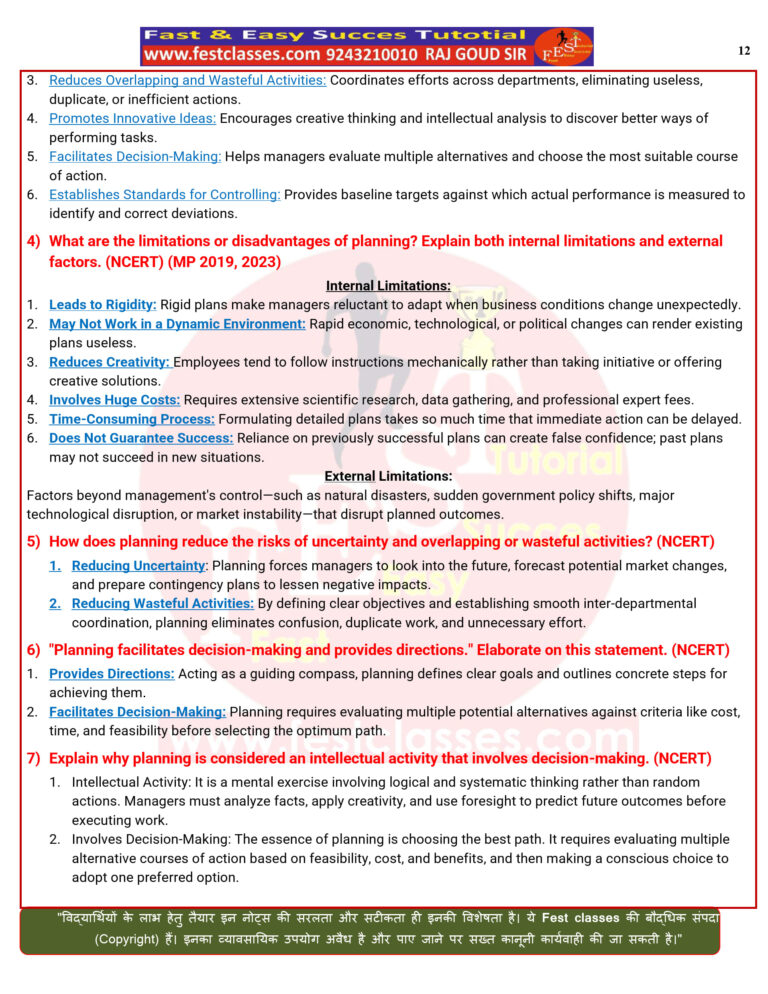
4) What are the limitations or disadvantages of planning? Explain both
internal limitations and external factors. (NCERT) (MP 2019, 2023)
Internal
Limitations:
1. Leads
to Rigidity: Rigid plans make managers reluctant to adapt when
business conditions change unexpectedly.
2. May Not
Work in a Dynamic Environment: Rapid economic, technological, or political
changes can render existing plans useless.
3. Reduces
Creativity: Employees tend to follow instructions mechanically
rather than taking initiative or offering creative solutions.
4. Involves
Huge Costs: Requires extensive scientific research, data gathering, and professional
expert fees.
5. Time-Consuming
Process: Formulating detailed plans takes so much time that immediate action can
be delayed.
6. Does
Not Guarantee Success: Reliance on previously successful plans can create
false confidence; past plans may not succeed in new situations.
External
Limitations:
Factors beyond management’s control—such as natural disasters, sudden
government policy shifts, major technological disruption, or market
instability—that disrupt planned outcomes.
5) How does planning reduce the risks of uncertainty and overlapping or
wasteful activities? (NCERT)
1. Reducing
Uncertainty: Planning forces managers to look into the future, forecast potential
market changes, and prepare contingency plans to lessen negative impacts.
2. Reducing
Wasteful Activities: By defining clear objectives and establishing
smooth inter-departmental coordination, planning eliminates confusion,
duplicate work, and unnecessary effort.
6) “Planning facilitates decision-making and provides
directions.” Elaborate on this statement. (NCERT)
1. Provides
Directions: Acting as a guiding compass, planning defines clear goals and outlines
concrete steps for achieving them.
2. Facilitates
Decision-Making: Planning requires evaluating multiple potential
alternatives against criteria like cost, time, and feasibility before selecting
the optimum path.
7) Explain why planning is considered an intellectual activity that
involves decision-making. (NCERT)
1. Intellectual Activity: It is a mental
exercise involving logical and systematic thinking rather than random actions.
Managers must analyze facts, apply creativity, and use foresight to predict
future outcomes before executing work.
2. Involves Decision-Making: The essence of
planning is choosing the best path. It requires evaluating multiple alternative
courses of action based on feasibility, cost, and benefits, and then making a
conscious choice to adopt one preferred option.
1.3
|
Quick
Assessment 2.2 1. Which
function of management establishes standards against which actual
performance is evaluated? (a) Organizing (b)
Planning (c) Directing (d) Staffing 2. Planning
completely guarantees success if a previously tested plan is used again. (a) True (b) False (c)
Partially True (d) Irrelevant 3. State any
two internal limitations of planning. |
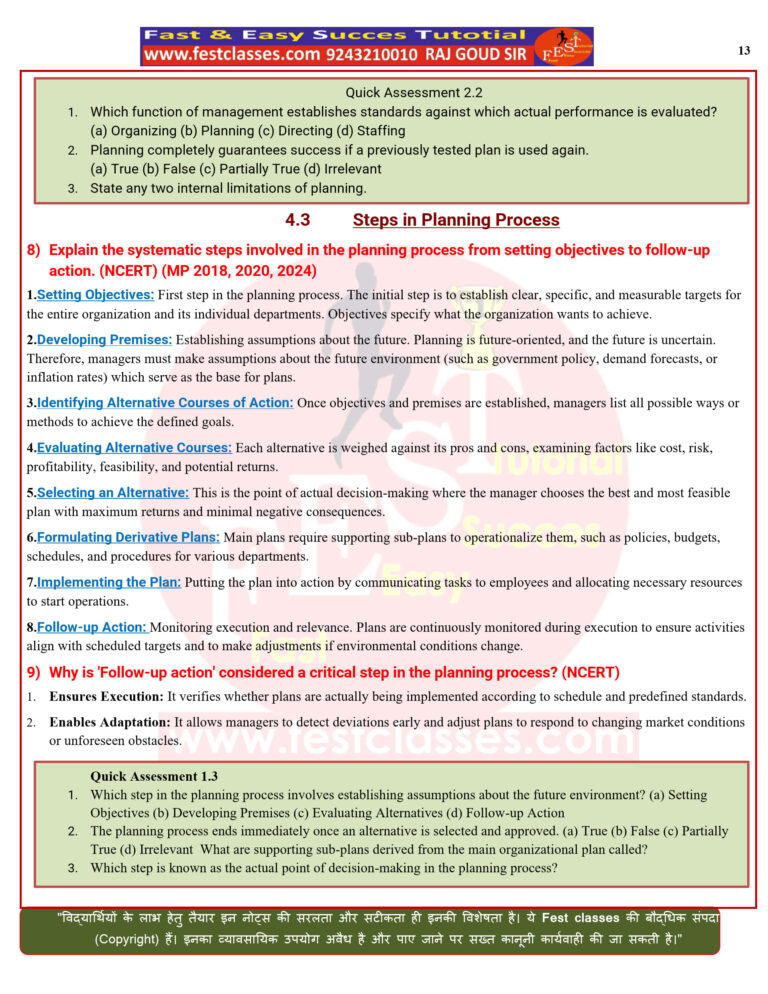
8) Explain the systematic steps involved in the planning process from
setting objectives to follow-up action. (NCERT) (MP 2018, 2020, 2024)
1.Setting
Objectives: First step in the
planning process. The initial step is to establish clear, specific, and
measurable targets for the entire organization and its individual departments.
Objectives specify what the organization wants to achieve.
2.Developing
Premises: Establishing assumptions
about the future. Planning is future-oriented, and the future is uncertain.
Therefore, managers must make assumptions about the future environment (such as
government policy, demand forecasts, or inflation rates) which serve as the
base for plans.
3.Identifying
Alternative Courses of Action: Once
objectives and premises are established, managers list all possible ways or
methods to achieve the defined goals.
4.Evaluating
Alternative Courses: Each alternative is
weighed against its pros and cons, examining factors like cost, risk,
profitability, feasibility, and potential returns.
5.Selecting
an Alternative: This is the point of
actual decision-making where the manager chooses the best and most feasible
plan with maximum returns and minimal negative consequences.
6.Formulating
Derivative Plans: Main plans require
supporting sub-plans to operationalize them, such as policies, budgets,
schedules, and procedures for various departments.
7.Implementing
the Plan: Putting the plan into action by
communicating tasks to employees and allocating necessary resources to start
operations.
8.Follow-up
Action: Monitoring execution and relevance. Plans are
continuously monitored during execution to ensure activities align with
scheduled targets and to make adjustments if environmental conditions change.
9) Why is ‘Follow-up action’ considered a critical step in the planning
process? (NCERT)
1. Ensures
Execution: It verifies whether plans are actually being implemented
according to schedule and predefined standards.
2.
|
Quick Assessment 1.3 1.
Which step in the planning process involves
establishing assumptions about the future environment? (a) Setting
Objectives (b) Developing Premises (c) Evaluating Alternatives (d)
Follow-up Action 2.
The planning process ends immediately once
an alternative is selected and approved. (a) True (b) False (c) Partially
True (d) Irrelevant What are
supporting sub-plans derived from the main organizational plan called? 3.
Which step is known as the actual point of
decision-making in the planning process? 4. |
1.4
Types of Plans
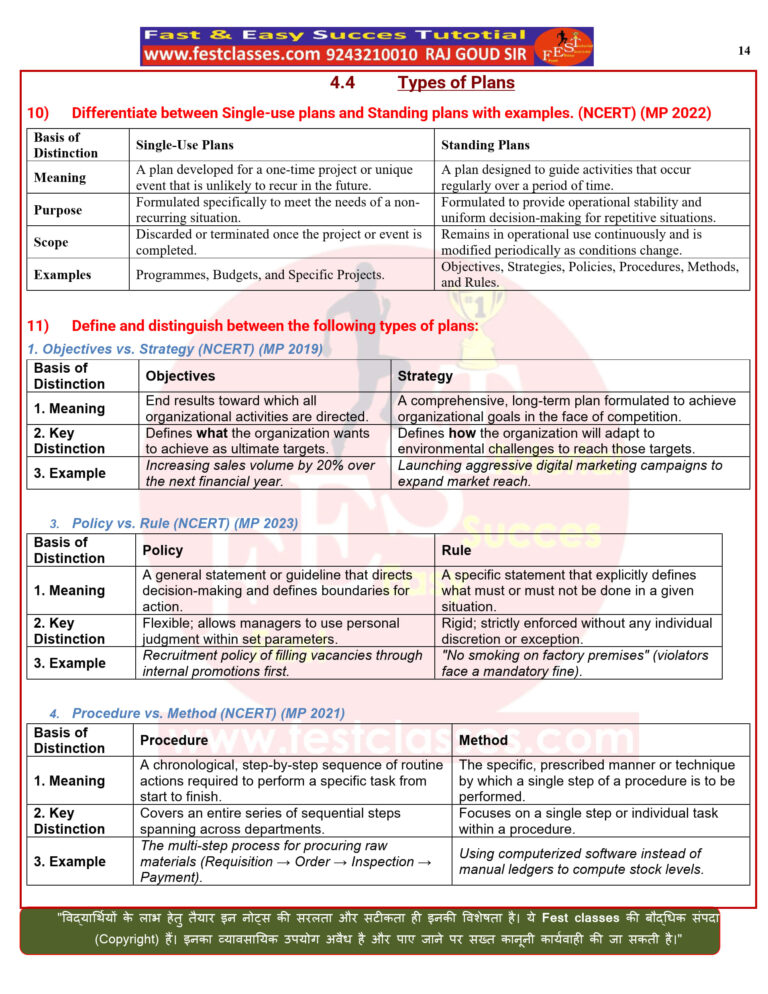
10)
Differentiate between
Single-use plans and Standing plans with examples. (NCERT) (MP 2022)
|
Basis of
Distinction |
Single-Use
Plans |
Standing
Plans |
|
Meaning |
A plan
developed for a one-time project or unique event that is unlikely to recur in
the future. |
A plan
designed to guide activities that occur regularly over a period of time. |
|
Purpose |
Formulated
specifically to meet the needs of a non-recurring situation. |
Formulated to
provide operational stability and uniform decision-making for repetitive
situations. |
|
Scope |
Discarded or
terminated once the project or event is completed. |
Remains in
operational use continuously and is modified periodically as conditions
change. |
|
Examples |
Programmes,
Budgets, and Specific Projects. |
Objectives,
Strategies, Policies, Procedures, Methods, and Rules. |
11)
Define and distinguish between
the following types of plans:
1. Objectives
vs. Strategy (NCERT) (MP 2019)
|
Basis of Distinction |
Objectives |
Strategy |
|
1. Meaning |
End results toward which all
organizational activities are directed. |
A comprehensive, long-term plan
formulated to achieve organizational goals in the face of competition. |
|
2. Key Distinction |
Defines what the organization wants to achieve as ultimate
targets. |
Defines how the organization will adapt to environmental
challenges to reach those targets. |
|
3. Example |
Increasing sales volume by 20% over
the next financial year. |
Launching aggressive digital marketing
campaigns to expand market reach. |
3.
Policy
vs. Rule (NCERT) (MP 2023)
|
Basis of Distinction |
Policy |
Rule |
|
1. Meaning |
A general statement or guideline that
directs decision-making and defines boundaries for action. |
A specific statement that explicitly
defines what must or must not be done in a given situation. |
|
2. Key Distinction |
Flexible; allows managers to use
personal judgment within set parameters. |
Rigid; strictly enforced without any
individual discretion or exception. |
|
3. Example |
Recruitment policy of filling
vacancies through internal promotions first. |
“No smoking on factory
premises” (violators face a mandatory fine). |
4.
Procedure
vs. Method (NCERT) (MP 2021)
|
Basis of Distinction |
Procedure |
Method |
|
1. Meaning |
A chronological, step-by-step sequence
of routine actions required to perform a specific task from start to finish. |
The specific, prescribed manner or
technique by which a single step of a procedure is to be performed. |
|
2. Key Distinction |
Covers an entire series of sequential
steps spanning across departments. |
Focuses on a single step or individual
task within a procedure. |
|
3. Example |
The multi-step process for procuring
raw materials (Requisition → Order → Inspection → Payment). |
Using computerized software instead of
manual ledgers to compute stock levels. |
5.
Quick Assessment 1.4
1.
Which type of plan is designed to handle
non-recurring, one-time projects or events? (a) Standing Plan (b)
Single-use Plan (c) Policy (d) Procedure
2.
Rules allow managers full flexibility and
personal discretion during execution. (a) True (b) False (c) Partially True
(d) Irrelevant
3.
Identify the type of plan: “No employee
is permitted to accept personal gifts from suppliers.”
4.
Which plan specifies the exact step-by-step
chronological sequence for performing a task?
5.
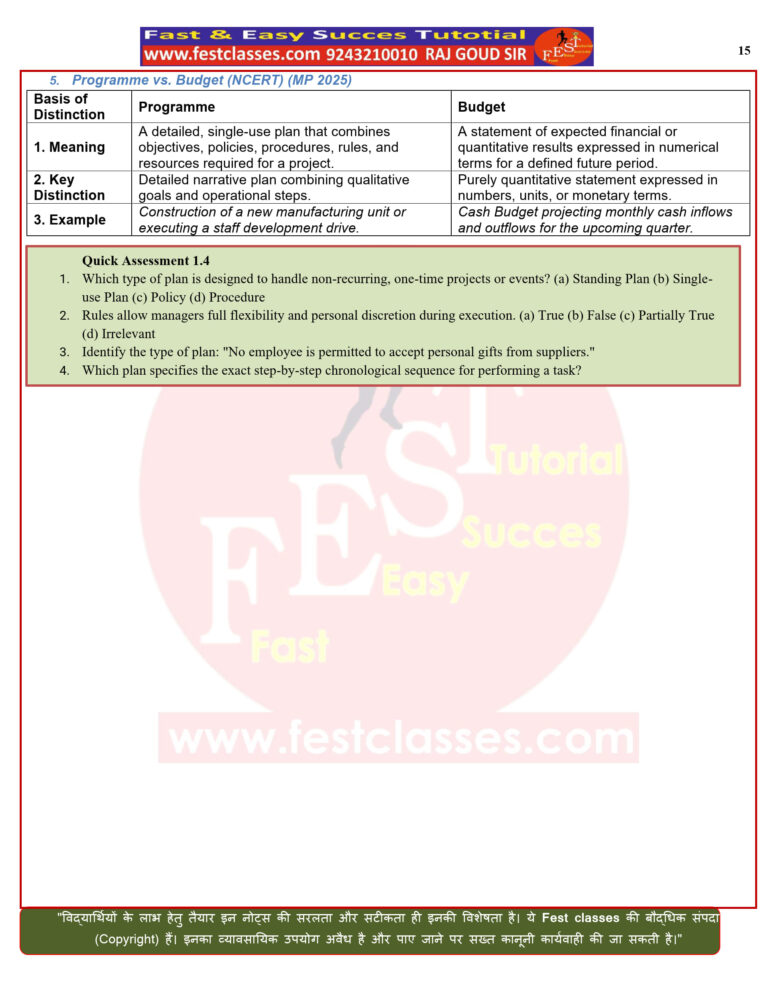
Programme vs. Budget
(NCERT) (MP 2025)
|
Quick Assessment 1.4 1.
Which type of plan is designed to handle
non-recurring, one-time projects or events? (a) Standing Plan (b)
Single-use Plan (c) Policy (d) Procedure 2.
Rules allow managers full flexibility and
personal discretion during execution. (a) True (b) False (c) Partially True
(d) Irrelevant 3.
Identify the type of plan: “No employee
is permitted to accept personal gifts from suppliers.” 4.
Which plan specifies the exact step-by-step
chronological sequence for performing a task? 5. |
|
Basis of Distinction |
Programme |
Budget |
|
1. Meaning |
A detailed, single-use plan that
combines objectives, policies, procedures, rules, and resources required for
a project. |
A statement of expected financial or
quantitative results expressed in numerical terms for a defined future period. |
|
2. Key Distinction |
Detailed narrative plan combining
qualitative goals and operational steps. |
Purely quantitative statement
expressed in numbers, units, or monetary terms. |
|
3. Example |
Construction of a new manufacturing
unit or executing a staff development drive. |
Cash Budget projecting monthly cash
inflows and outflows for the upcoming quarter. |