


Chapter – 1.
Chapter 7:
Financial Statements of a Company
1.1
Meaning and Nature
1)
What are financial statements? Define their
basic purpose and main components for a company. (MP Board 2023) (NCERT)
Financial statements are
end-of-year reports prepared by a business to show its financial health.To give
a true picture of business profit or loss and show what the company owns and
owes.
Main Components:
1. Balance Sheet: Shows assets,
liabilities, and owner’s capital on a specific date.
2.
Statement of Profit and Loss: Shows total income, expenses, and net
profit or loss made during the year.
3.
Cash Flow Statement: Shows how much cash came into and went out of the
company.
4.
Notes to Accounts: Gives extra details and explanations about the
numerical data.
2) Explain
the essential features and characteristics that define the nature of financial
statements. (MP Board 2022) (NCERT)
1.
Recorded Facts: They are based on actual transactions recorded at
historical cost (purchase price), not market estimates.
2.
Accounting Conventions: They follow standard accounting rules like
consistency, conservatism, and full disclosure.
3.
Personal Judgment: Numbers can be affected by personal choices (e.g.,
choosing a depreciation method or estimating bad debt).
4.
Postmortem Report: They show past financial performance after the period
is already over.
3) Differentiate
between financial statements prepared under Schedule III of the Companies Act,
2013, and those prepared for sole proprietorships or partnership firms. (MP
Board 2024) (NCERT)
|
Feature |
Companies
(Schedule III) |
Sole
Proprietorship / Partnership |
|
Prescribed
Format |
Must
follow strict Vertical Format as per Schedule III. |
Uses
standard Horizontal (T-shape) Format. |
|
Legal
Mandate |
Compulsory
under Companies Act, 2013. |
Optional;
governed by basic accounting rules. |
|
Terminology |
Uses Statement
of Profit & Loss. |
Uses Trading
and Profit & Loss Account. |
|
Public
Filing |
Must
submit reports to government (ROC) and shareholders. |
Kept
private for owners and tax authorities only. |
1.2
Objectives of Financial Statements
4) Explain
the primary objectives of preparing financial statements for a joint stock
company. (MP Board 2023) (NCERT)
- Show True Profit or Loss: To report exact profit earned or loss
suffered during the year.
- Show Financial Health: To display the exact assets owned and
liabilities owed on a given date.
- Provide Data for Decision Making: To supply reliable financial data to
management, investors, and banks.
- Legal Compliance: To fulfill mandatory government rules
under the Companies Act, 2013.
5) How
do financial statements help in assessing the true earning capacity and
financial position of a business enterprise? (MP Board 2022) (NCERT)
- Earning Capacity: The Statement of Profit and Loss compares
revenue with expenses to show whether sales are growing and profits are
stable over time.
- Financial Position: The Balance Sheet reveals solvency by
comparing short-term assets with short-term liabilities (liquidity) and
long-term assets with borrowings (stability).
6) Discuss
how financial statements provide relevant information to different stakeholders
like investors, creditors, and tax authorities. (MP Board 2024) (NCERT)
- Investors: Help them decide whether to buy, hold, or
sell shares based on dividend prospects and growth.
- Creditors & Banks: Help them check if the company can pay
back loans and interest on time.
- Tax Authorities: Provide accurate figures to calculate
Income Tax, GST, and corporate tax correctly.
1.3
Types and Form of Financial Statements (Balance
Sheet)
7) Explain
the major heads under the “Equity and Liabilities” section of a
company’s Balance Sheet as per Schedule III Part I of the Companies Act, 2013.
(MP Board 2023) (NCERT)
The “Equity and
Liabilities” side shows where the company got its money from. It has 4
main heads:
- Shareholders’ Funds: Money belonging to the
owners/shareholders.
Ø Includes: Share Capital, Reserves and Surplus, and Money received against share
warrants.
- Share Application Money Pending Allotment: Money received from applicants for shares
that have not been allotted yet.
- Non-Current Liabilities: Long-term loans and debts payable after
12 months.
Ø Includes: Long-term borrowings (like debentures and bank loans) and long-term
provisions.
- Current Liabilities: Short-term debts payable within 12
months.
Ø Includes: Short-term borrowings, Trade Payables (Creditors/Bills Payable), and
Short-term provisions.
8) Discuss
the major categories and sub-heads under the “Assets” side of a
company’s Balance Sheet under Schedule III. (MP Board 2022) (NCERT)
The “Assets”
side shows how the company has used its money. It has 2 main heads:
1.
Non-Current
Assets: Long-term assets kept
for business use, not for immediate resale.
o
Property,
Plant and Equipment and Intangible Assets: Land, buildings, machinery (tangible) and patents, trademarks
(intangible).
o
Non-Current
Investments: Investments made
for more than 1 year.
o
Long-Term
Loans and Advances: Loans
given to others for more than 12 months.
2. Current Assets: Short-term assets expected to convert into
cash within 12 months.
Ø Inventories: Raw materials, work-in-progress, and finished goods.
Ø Trade Receivables: Debtors and Bills Receivable.
Ø Cash and Cash Equivalents: Cash in hand and bank balance.
9) State
the key differences between the traditional horizontal form of a Balance Sheet
and the vertical form prescribed by the Companies Act, 2013. (MP Board 2024)
(NCERT)
|
Basis |
Horizontal Form (Traditional) |
Vertical Form (Schedule III) |
|
Layout |
Prepared side-by-side in a ‘T’ shape
(Liabilities on left, Assets on right). |
Prepared top-to-bottom in a continuous
vertical format. |
|
Applicability |
Used by Sole Proprietorships and
Partnerships. |
Mandatory for Joint Stock Companies. |
|
Order |
No strict rule, usually shown in liquidity or
permanence order. |
Strictly follows the order given in Schedule
III of the Companies Act. |
1.4
Form and Content of Statement of Profit and Loss
10)
Explain the prescribed vertical format and main
components of the Statement of Profit and Loss under Schedule III Part II of
the Companies Act, 2013. (MP Board 2023) (NCERT)
The Statement of
Profit and Loss shows income earned and expenses made over the financial year
in a top-to-bottom layout:
1.
Revenue
Section:
Ø Revenue from Operations (sales/core income) + Other Income = Total
Revenue.
2.
Expense
Section:
Ø Total expenses (material costs, employee costs,
finance costs, depreciation, etc.).
3.
Net
Result:
Ø Total Revenue minus Total Expenses gives Profit
Before Tax. Subtract tax to get Profit After Tax (Net Profit).
11)
Distinguish between Revenue from Operations and
Other Income with appropriate examples for both financial and non-financial
companies. (MP Board 2022) (NCERT)
|
Sr. No. |
Basis |
Revenue from Operations |
Other Income |
|
1 |
Meaning |
Revenue generated from core business
activities like selling goods or rendering services. |
Income earned from non-operating or secondary
activities. |
|
2 |
Examples |
Net sale of products, service fees, trading
inventory sales. |
Dividend received, interest income, gain on
sale of fixed assets. |
|
3 |
Finance Company Exception |
Includes sales revenue and main operating
receipts. |
Interest and dividend earned are treated as
Revenue from Operations for finance firms. |
12)
Detail the breakdown of main line-item expenses
in the Statement of Profit and Loss. (MP Board 2024) (NCERT)
- Cost of Materials Consumed: Direct raw materials used to make goods.
- Purchases of Stock-in-Trade: Ready goods bought directly for resale.
- Changes in Inventories: Opening stock minus closing stock of
finished goods and work-in-progress.
- Employee Benefit Expenses: Salaries, wages, bonus, and staff welfare
expenses.
- Finance Costs: Interest paid on loans, debentures, or
bank overdrafts.
- Depreciation and Amortisation: Wear and tear loss on physical assets
(depreciation) or writing off non-physical assets like patents
(amortisation).
- Other Expenses: Overhead costs like rent, electricity,
insurance, and audit fees.
1.5
Uses and Importance of Financial Statements
13)
Discuss the significance and importance of
financial statements to management, shareholders, and potential investors. (MP
Board 2023) (NCERT)
Financial statements
provide clear information to help key decision-makers take the right actions:
- To Management: Helps them judge business performance,
check operational efficiency, control expenses, and plan future
strategies.
- To Shareholders: Shows whether their invested money is
safe, how much profit the company earned, and the likelihood of receiving
dividends.
- To Potential Investors: Helps them evaluate the company’s
stability and earning potential before deciding to buy shares or invest
capital.
14)
How do financial statements assist creditors,
financial institutions, and suppliers in evaluating the liquidity and
creditworthiness of a company? (MP Board 2022) (NCERT)
Lenders and suppliers
use financial statements to check if the business can clear its debts on time:
- Trade Creditors & Suppliers: Examine short-term assets and short-term
liabilities (liquidity) to ensure the company can pay for goods supplied
on credit within a few months.
- Banks & Financial Institutions: Analyze long-term debt, total assets, and
ongoing profits to check if the company can pay regular loan interest and
return the principal amount over many years.
15)
Explain the utility of financial statements for
government agencies, tax authorities, employees, and researchers. (MP Board
2024) (NCERT)
Different external
groups rely on these reports for compliance, safety, and analysis:
1.
Tax
Authorities & Government:
Use reported revenues and profits to calculate correct GST, Corporate Income
Tax, and assess compliance with economic policies.
2.
Employees
& Trade Unions: Check
company profits to negotiate for fair salary raises, annual bonuses, job
security, and better working conditions.
3.
Researchers
& Analysts: Analyze
financial trends, industry performance, and corporate growth patterns to
publish reports and market studies.
1.6
Limitations of Financial Statements
16)
Explain the major inherent limitations of
financial statements of a company. (MP Board 2023) (NCERT)
Even though financial
statements provide essential information, they have certain natural drawbacks:
1.
Based
on Past Records: They reflect
historical data (past performance), which may not accurately predict future
market conditions.
2.
Ignores
Price Level Changes: Figures
are recorded at historical cost, completely ignoring the impact of inflation
over time.
3.
Excludes
Non-Monetary Factors:
Important qualitative aspects—like management skill, employee efficiency, labor
relations, or brand reputation—are left out because they cannot be measured in
money.
4.
Influenced
by Personal Estimates:
Numerical entries rely on subjective accounting estimates, such as deciding an
asset’s useful life or estimating bad debt reserves.
5.
Possibility
of Window Dressing: Management
can manipulate accounting entries near year-end to make the financial position
look better than it actually is.
17)
How do historical costs and price level changes
limit the relevance and utility of financial statements during inflationary
periods? (MP Board 2022) (NCERT)
- Outdated Asset Values (Historical Cost): Assets are recorded at their original
purchase price minus depreciation. During periods of rising prices, these
figures fail to show the true current replacement value or market worth of
the assets.
- Distorted Profit Figures (Inflation): Since revenues are measured in current
high-priced currency while expenses (like depreciation) are based on past
lower costs, net profit gets artificially overstated. This misleads owners
into paying out dividends from capital rather than real earnings.
18)
Discuss how qualitative non-monetary factors,
personal estimates, and window dressing impact the reliability of financial
reporting. (MP Board 2024) (NCERT)
1.
Qualitative
Non-Monetary Factors: A
company’s success depends heavily on workforce dedication, customer loyalty,
and management expertise. Because financial statements only record monetary
items, these critical success drivers are omitted entirely.
2.
Personal
Estimates and Choices:
Accountants choose between different accounting methods (e.g., straight-line
vs. written-down value method for depreciation). This element of personal
judgment makes it difficult to compare reports across different companies.
3.
Window
Dressing: By deliberately
delaying expense bookings or accelerating revenue recognition before closing
the books, management creates a false impression of strong liquidity and
profitability, reducing overall report reliability.
19)
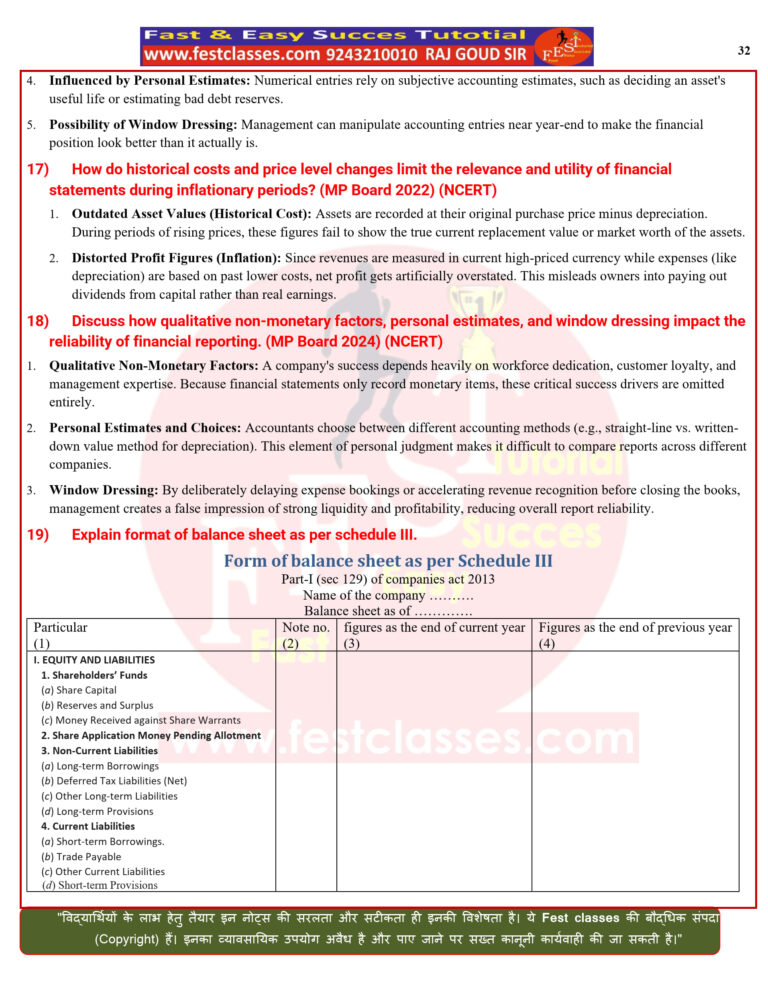
Explain format of balance sheet as per schedule
III.
Form of balance sheet as per Schedule III
Part-I (sec 129) of
companies act 2013
Name of the company
……….
Balance sheet as of
………….
|
Particular (1) |
Note
no. (2) |
figures
as the end of current year (3) |
Figures
as the end of previous year (4) |
|
I. EQUITY AND
LIABILITIES 1. Shareholders’ Funds (a) Share Capital (b) Reserves and Surplus (c) Money Received against Share Warrants 2. Share Application Money Pending Allotment 3. Non-Current Liabilities (a) Long-term Borrowings (b) Deferred Tax Liabilities (Net) (c) Other Long-term Liabilities (d) Long-term Provisions 4. Current Liabilities (a) Short-term Borrowings. (b) Trade Payable (c) Other Current Liabilities (d) Short-term Provisions |
|
|
|
|
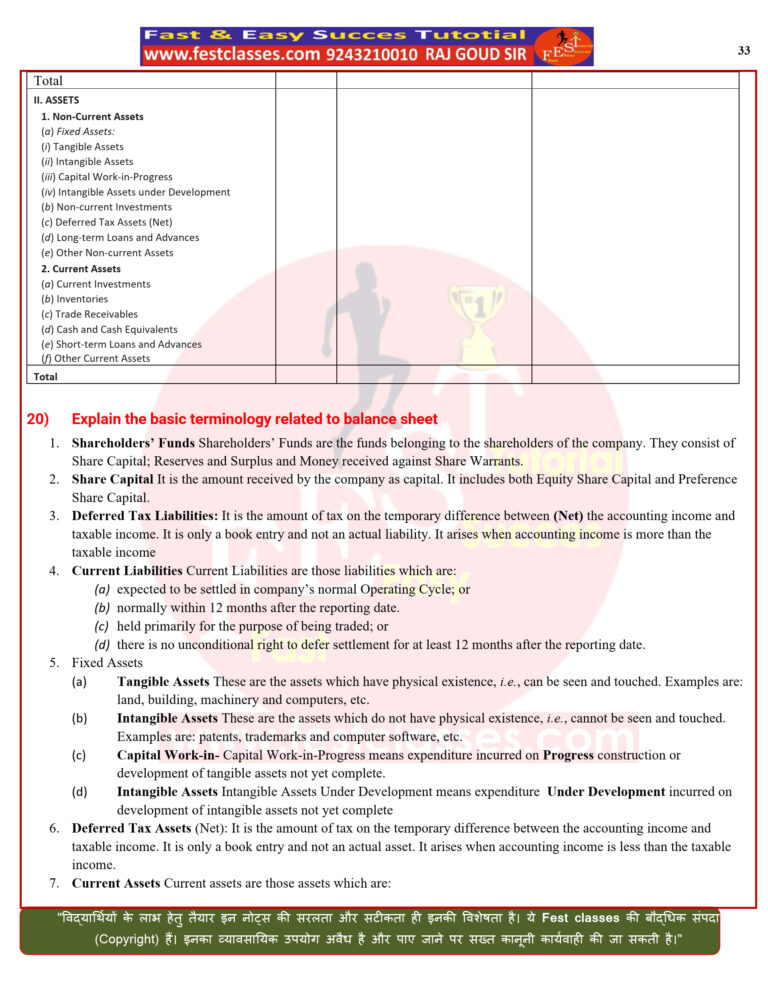
Total |
|
|
|
|
II.
ASSETS 1.
Non-Current Assets (a)
Fixed Assets: (i)
Tangible Assets (ii)
Intangible Assets (iii)
Capital Work-in-Progress (iv)
Intangible Assets under Development (b)
Non-current Investments (c)
Deferred Tax Assets (Net) (d)
Long-term Loans and Advances (e)
Other Non-current Assets 2.
Current Assets (a)
Current Investments (b)
Inventories (c)
Trade Receivables (d)
Cash and Cash Equivalents (e)
Short-term Loans and Advances (f) Other Current Assets |
|
|
|
|
Total
|
|
|
|
20)
Explain the basic terminology related to balance
sheet
1.
Shareholders’ Funds Shareholders’ Funds are the
funds belonging to the shareholders of the company. They consist of Share
Capital; Reserves and Surplus and Money received against Share Warrants.
2.
Share Capital It is the amount received by the company as capital. It
includes both Equity Share Capital and Preference Share Capital.
3. Deferred
Tax Liabilities: It is the amount of tax on the temporary difference
between (Net) the accounting income and taxable income. It is only a
book entry and not an actual liability. It arises when accounting income is
more than the taxable income
4.
Current Liabilities Current Liabilities are those
liabilities which are:
(a)
expected to be settled in company’s normal Operating Cycle;
or
(b)
normally within 12 months after the reporting date.
(c)
held primarily for the purpose of being traded; or
(d)
there is no unconditional right to defer settlement for at
least 12 months after the reporting date.
5.
Fixed Assets
(a)
Tangible Assets These are the assets which have
physical existence, i.e., can be seen and touched. Examples are: land,
building, machinery and computers, etc.
(b)
Intangible Assets These are the assets which do
not have physical existence, i.e., cannot be seen and touched. Examples
are: patents, trademarks and computer software, etc.
(c)
Capital Work-in- Capital Work-in-Progress means
expenditure incurred on Progress construction or development of tangible
assets not yet complete.
(d)
Intangible Assets Intangible Assets Under
Development means expenditure Under
Development incurred on development of intangible assets not yet complete
6.
Deferred Tax Assets (Net): It is the amount of tax
on the temporary difference between the accounting income and taxable income.
It is only a book entry and not an actual asset. It arises when accounting
income is less than the taxable income.
7.
Current Assets Current assets are those assets which are:
(a) expected to be
realised in or intended for sale or consumption in normal Operating Cycle of
the company; or
(b) held primarily for
the purposes of trading; or
(c) expected to be
realised within 12 months from the reporting date or closing date.
(d) Cash and Cash
Equivalent unless it is restricted from being exchanged or used to settle a
liability for at least 12 months after the reporting date.
8.
Inventories (stock): It is a tangible asset held:
(i)
for the purpose of sale in the normal course of business; or
(ii)
for the purpose of using it in the production of goods meant
for sale or service to be rendered. In case of trading company,
(iii)
Inventories are valued at lower of cost or net realisable
value, i.e., market price.
9.
Trade Receivables Trade receivables are the
amounts receivable within 12 months from the reporting date or within the
period of Operating Cycle for sale of goods or services rendered in the normal
course of business. It includes Bills Receivable and Sundry Debtors.
10.
Revenue from Operations It is the revenue earned by the
company from its operating activities, i.e., business activities carried
on by the company to earn profit.
11.
Employees Benefit Expenses These are the expenses incurred
for the benefit of employees. Examples are: wages, salaries, bonus, staff
welfare and medical reimbursement, etc.
12.
Appropriation of Profit: Profit
is appropriated out of ‘Surplus, i.e., Balance in Statement of Profit
and Loss’ under Reserves and Surplus.
21)
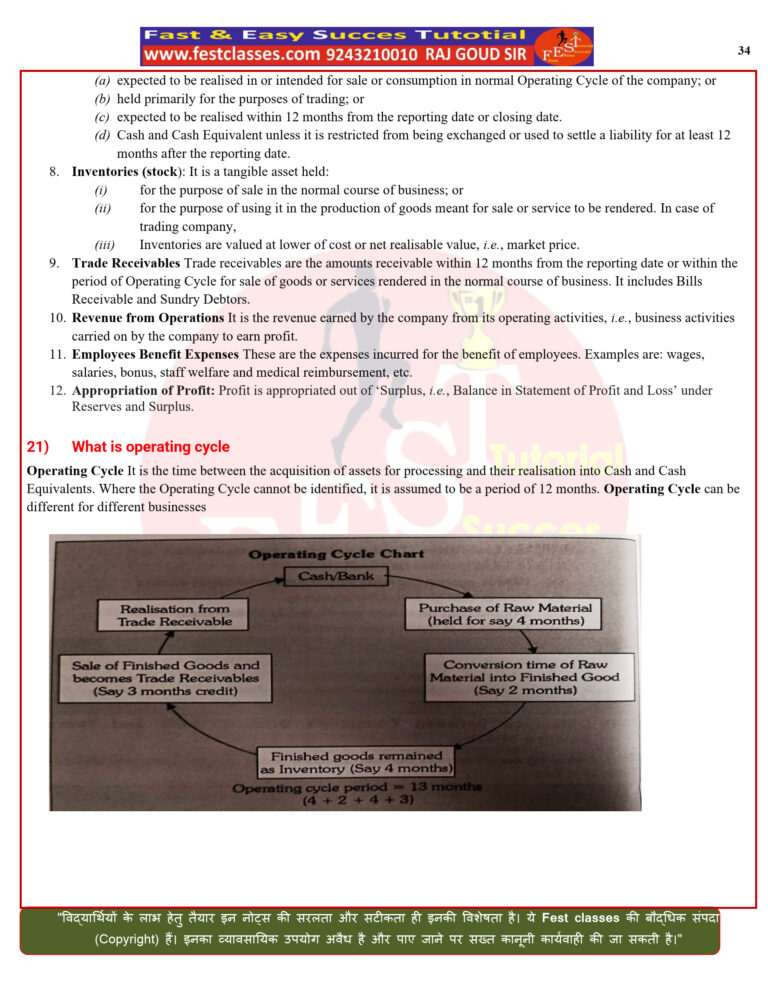
What is operating cycle
Operating Cycle It is the time
between the acquisition of assets for processing and their realisation into
Cash and Cash Equivalents. Where the Operating Cycle cannot be identified, it
is assumed to be a period of 12 months. Operating Cycle can be different
for different businesses
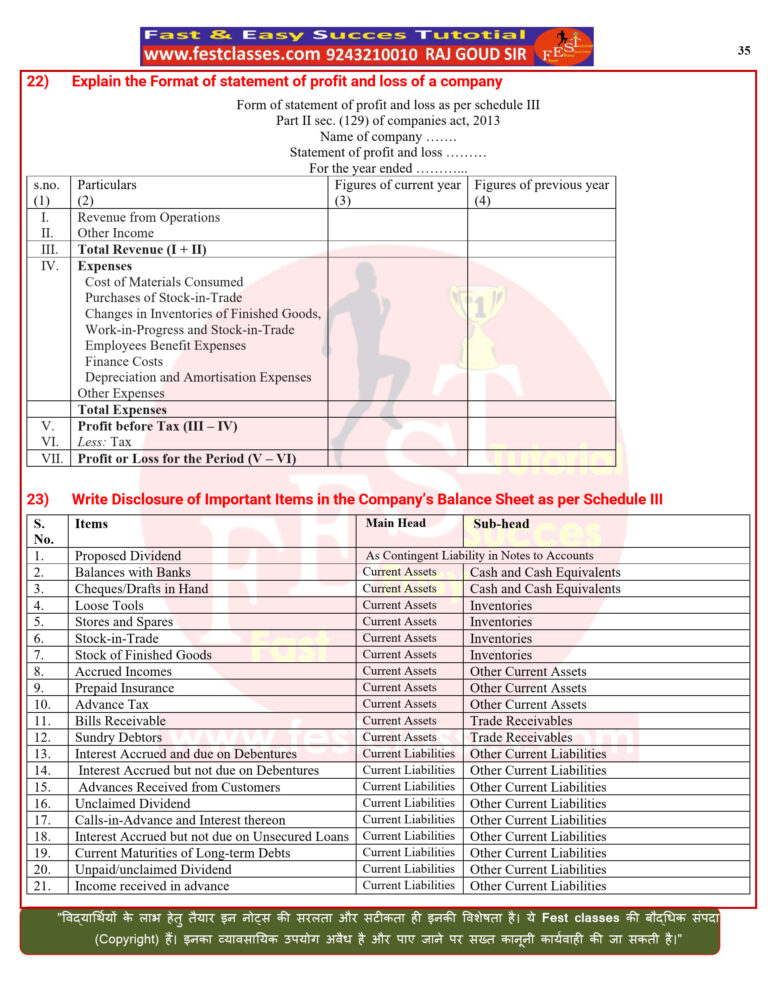
22)
Explain the Format of statement of profit and
loss of a company
Form of statement of
profit and loss as per schedule III
Part II sec. (129) of
companies act, 2013
Name of company …….
Statement of profit
and loss ………
For the year ended …………
|
s.no. (1) |
Particulars
(2) |
Figures
of current year (3) |
Figures
of previous year (4) |
|
I. II. |
Revenue from Operations Other Income |
|
|
|
III. |
Total Revenue (I + II) |
|
|
|
IV. |
Expenses Cost of Materials Consumed Purchases of Stock-in-Trade Changes in Inventories of Finished
Goods, Work-in-Progress and Stock-in-Trade Employees Benefit Expenses Finance Costs Depreciation and Amortisation Expenses Other Expenses |
|
|
|
|
Total Expenses |
|
|
|
V. VI. |
Profit before Tax (III – IV) Less: Tax |
|
|
|
VII. |
Profit or Loss for the Period (V – VI) |
|
|
23)
Write Disclosure
of Important Items in the Company’s Balance Sheet as per Schedule III
|
S. No.
|
Items |
Main Head |
Sub-head |
|
1. |
Proposed Dividend |
As Contingent
Liability in Notes to Accounts |
|
|
2. |
Balances with Banks |
Current Assets |
Cash and Cash
Equivalents |
|
3. |
Cheques/Drafts in
Hand |
Current Assets |
Cash and Cash
Equivalents |
|
4. |
Loose
Tools |
Current Assets |
Inventories
|
|
5. |
Stores and Spares |
Current Assets |
Inventories |
|
6. |
Stock-in-Trade |
Current Assets |
Inventories |
|
7. |
Stock of Finished
Goods |
Current Assets |
Inventories |
|
8. |
Accrued Incomes |
Current Assets |
Other Current
Assets |
|
9. |
Prepaid Insurance |
Current Assets |
Other Current
Assets |
|
10. |
Advance Tax |
Current Assets |
Other Current
Assets |
|
11. |
Bills
Receivable |
Current Assets |
Trade
Receivables |
|
12. |
Sundry Debtors |
Current Assets |
Trade Receivables |
|
13. |
Interest
Accrued and due on Debentures |
Current Liabilities |
Other
Current Liabilities |
|
14. |
Interest Accrued but not due on Debentures |
Current Liabilities |
Other
Current Liabilities |
|
15. |
Advances Received from Customers |
Current Liabilities |
Other
Current Liabilities |
|
16. |
Unclaimed
Dividend |
Current Liabilities |
Other
Current Liabilities |
|
17. |
Calls-in-Advance
and Interest thereon |
Current Liabilities |
Other
Current Liabilities |
|
18. |
Interest
Accrued but not due on Unsecured Loans |
Current Liabilities |
Other
Current Liabilities |
|
19. |
Current
Maturities of Long-term Debts |
Current Liabilities |
Other
Current Liabilities |
|
20. |
Unpaid/unclaimed
Dividend |
Current Liabilities |
Other Current
Liabilities |
|
21. |
Income received in
advance |
Current Liabilities |
Other Current
Liabilities |
|
22. |
Short-term Loans |
Current Liabilities |
Short-term
Borrowings |
|
23. |
Loans repayable on
demand |
Current Liabilities |
Short-term
Borrowings |
|
24. |
Bank Overdraft |
Current Liabilities |
Short-term
Borrowings |
|
25. |
Provision
for Tax |
Current Liabilities |
Short-term
Provisions |
|
26. |
Provision for
Expenses |
Current Liabilities |
Short-term
Provisions |
|
27. |
Bills Payable |
Current Liabilities |
Trade
Payables |
|
28. |
Sundry
Creditors |
Current Liabilities |
Trade
Payables |
|
29. |
Trade
Payables |
Current Liabilities |
Trade
Payables |
|
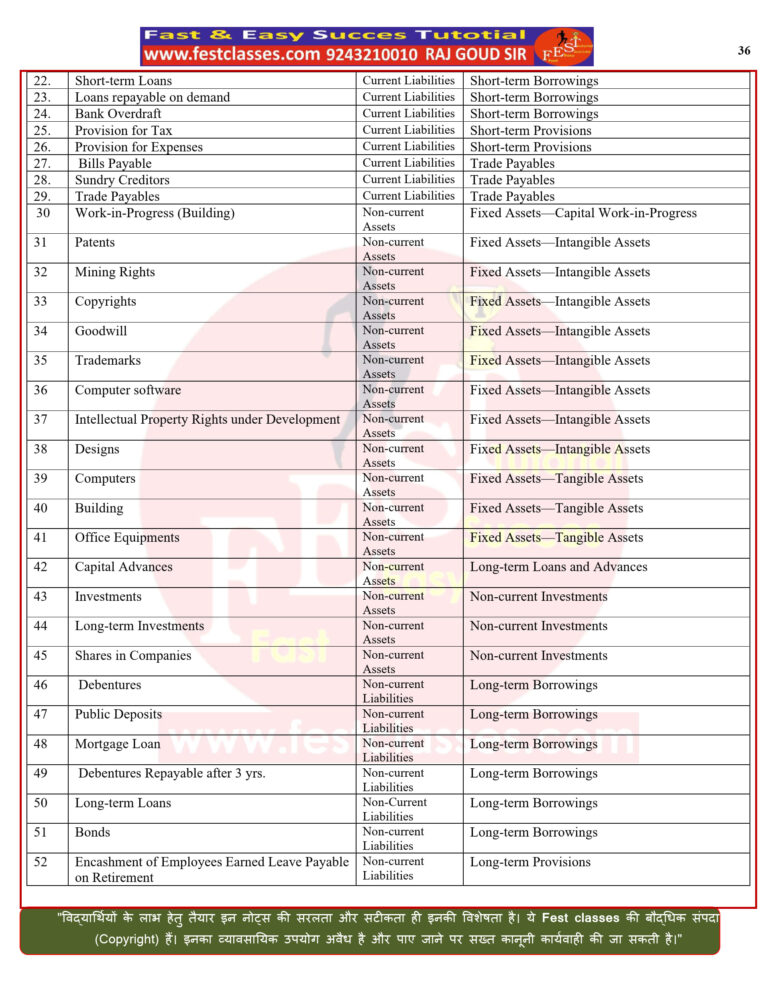
30 |
Work-in-Progress
(Building) |
Non-current Assets |
Fixed
Assets—Capital Work-in-Progress |
|
31 |
Patents
|
Non-current Assets |
Fixed
Assets—Intangible Assets |
|
32 |
Mining Rights |
Non-current Assets |
Fixed
Assets—Intangible Assets |
|
33 |
Copyrights |
Non-current Assets |
Fixed
Assets—Intangible Assets |
|
34 |
Goodwill |
Non-current Assets |
Fixed
Assets—Intangible Assets |
|
35 |
Trademarks |
Non-current Assets |
Fixed
Assets—Intangible Assets |
|
36 |
Computer software |
Non-current Assets |
Fixed
Assets—Intangible Assets |
|
37 |
Intellectual
Property Rights under Development |
Non-current Assets |
Fixed
Assets—Intangible Assets |
|
38 |
Designs |
Non-current Assets |
Fixed
Assets—Intangible Assets |
|
39 |
Computers |
Non-current Assets |
Fixed
Assets—Tangible Assets |
|
40 |
Building |
Non-current Assets |
Fixed
Assets—Tangible Assets |
|
41 |
Office Equipments |
Non-current Assets |
Fixed
Assets—Tangible Assets |
|
42 |
Capital Advances |
Non-current Assets |
Long-term Loans and
Advances |
|
43 |
Investments
|
Non-current Assets |
Non-current
Investments |
|
44 |
Long-term
Investments |
Non-current Assets |
Non-current
Investments |
|
45 |
Shares in Companies |
Non-current Assets |
Non-current
Investments |
|
46 |
Debentures |
Non-current Liabilities |
Long-term
Borrowings |
|
47 |
Public
Deposits |
Non-current Liabilities |
Long-term
Borrowings |
|
48 |
Mortgage
Loan |
Non-current Liabilities |
Long-term
Borrowings |
|
49 |
Debentures Repayable after 3 yrs. |
Non-current Liabilities |
Long-term
Borrowings |
|
50 |
Long-term Loans |
Non-Current Liabilities |
Long-term
Borrowings |
|
51 |
Bonds |
Non-current Liabilities |
Long-term
Borrowings |
|
52 |
Encashment of
Employees Earned Leave Payable on Retirement |
Non-current Liabilities |
Long-term
Provisions |
|
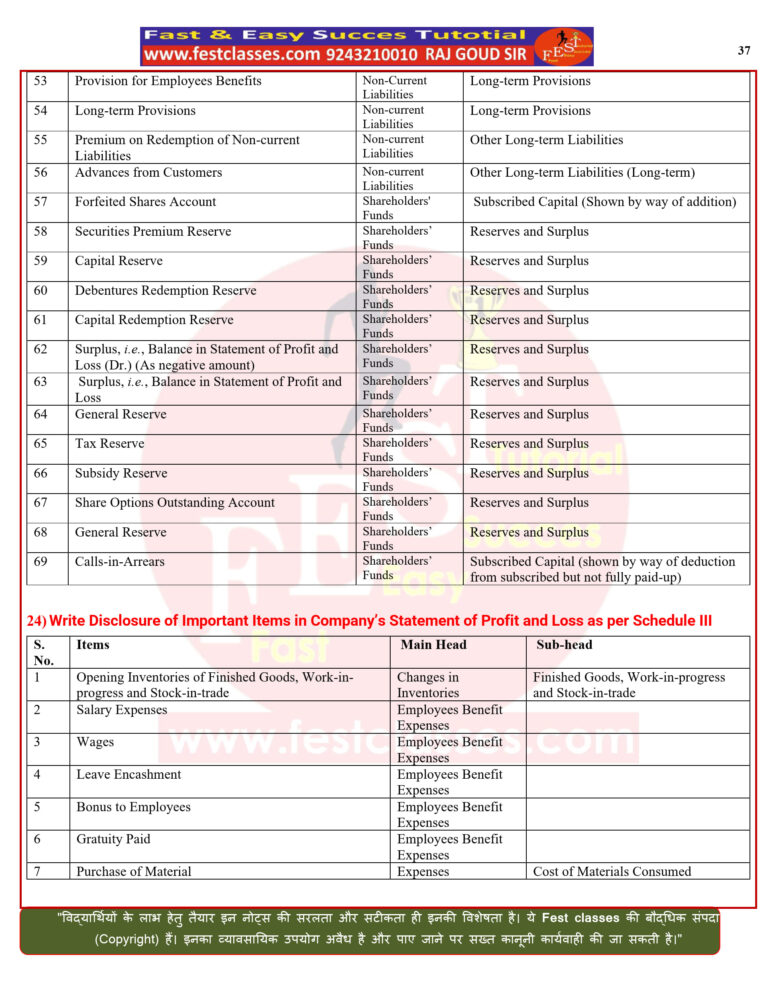
53 |
Provision for
Employees Benefits |
Non-Current Liabilities |
Long-term
Provisions |
|
54 |
Long-term
Provisions |
Non-current Liabilities |
Long-term
Provisions |
|
55 |
Premium on
Redemption of Non-current Liabilities |
Non-current Liabilities |
Other Long-term
Liabilities |
|
56 |
Advances
from Customers |
Non-current Liabilities |
Other
Long-term Liabilities (Long-term) |
|
57 |
Forfeited
Shares Account |
Shareholders’ Funds |
Subscribed Capital (Shown by way of
addition) |
|
58 |
Securities
Premium Reserve |
Shareholders’ Funds |
Reserves
and Surplus |
|
59 |
Capital
Reserve |
Shareholders’ Funds |
Reserves
and Surplus |
|
60 |
Debentures
Redemption Reserve |
Shareholders’ Funds |
Reserves
and Surplus |
|
61 |
Capital
Redemption Reserve |
Shareholders’ Funds |
Reserves
and Surplus |
|
62 |
Surplus,
i.e., Balance in Statement of Profit and Loss (Dr.) (As negative
amount) |
Shareholders’ Funds |
Reserves
and Surplus |
|
63 |
Surplus, i.e., Balance in Statement
of Profit and Loss |
Shareholders’ Funds |
Reserves
and Surplus |
|
64 |
General
Reserve |
Shareholders’ Funds |
Reserves
and Surplus |
|
65 |
Tax Reserve |
Shareholders’ Funds |
Reserves and
Surplus |
|
66 |
Subsidy Reserve |
Shareholders’ Funds |
Reserves and
Surplus |
|
67 |
Share Options
Outstanding Account |
Shareholders’ Funds |
Reserves and
Surplus |
|
68 |
General Reserve |
Shareholders’ Funds |
Reserves and
Surplus |
|
69 |
Calls-in-Arrears
|
Shareholders’ Funds |
Subscribed
Capital (shown by way of deduction from subscribed but not fully paid-up) |
24) Write
Disclosure of Important Items in Company’s Statement of Profit and Loss as per
Schedule III
|
S. No.
|
Items |
Main Head |
Sub-head |
|
1 |
Opening Inventories
of Finished Goods, Work-in-progress and Stock-in-trade |
Changes in
Inventories |
Finished Goods,
Work-in-progress and Stock-in-trade |
|
2 |
Salary Expenses |
Employees Benefit
Expenses |
|
|
3 |
Wages |
Employees Benefit
Expenses |
|
|
4 |
Leave Encashment |
Employees Benefit
Expenses |
|
|
5 |
Bonus to Employees |
Employees Benefit
Expenses |
|
|
6 |
Gratuity Paid |
Employees Benefit
Expenses |
|
|
7 |
Purchase of
Material |
Expenses |
Cost of Materials
Consumed |
|
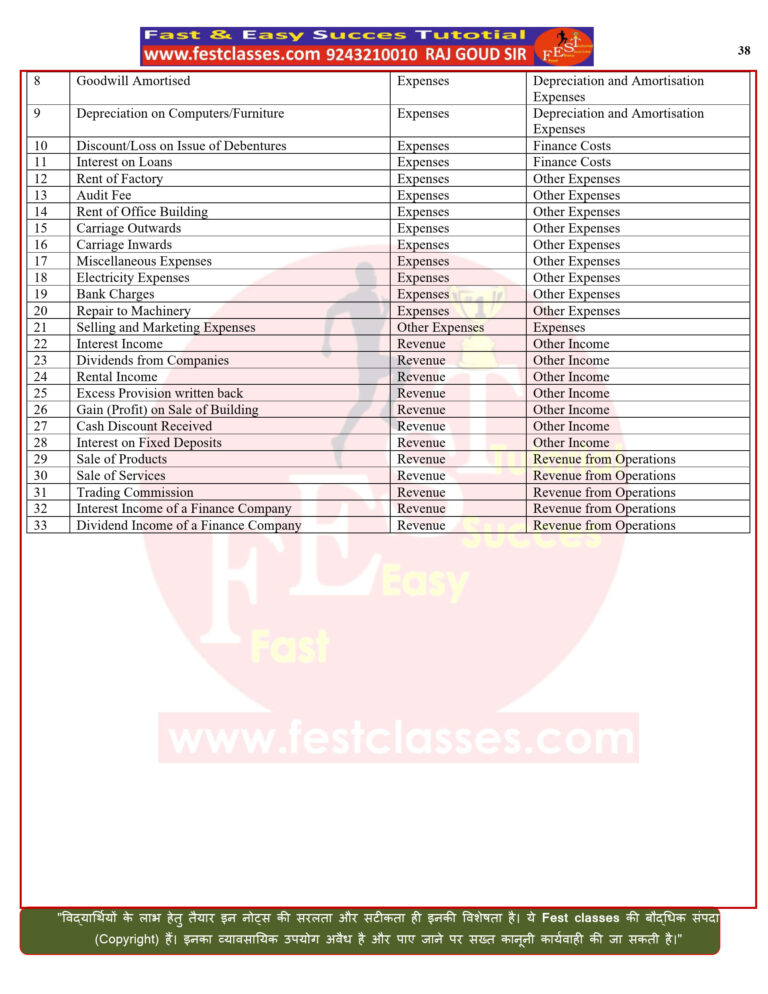
8 |
Goodwill Amortised |
Expenses |
Depreciation and
Amortisation Expenses |
|
9 |
Depreciation on
Computers/Furniture |
Expenses |
Depreciation and
Amortisation Expenses |
|
10 |
Discount/Loss on
Issue of Debentures |
Expenses |
Finance Costs |
|
11 |
Interest on Loans |
Expenses |
Finance Costs |
|
12 |
Rent of Factory |
Expenses |
Other Expenses |
|
13 |
Audit Fee |
Expenses |
Other Expenses |
|
14 |
Rent of Office
Building |
Expenses |
Other Expenses |
|
15 |
Carriage Outwards |
Expenses |
Other Expenses |
|
16 |
Carriage Inwards |
Expenses |
Other Expenses |
|
17 |
Miscellaneous
Expenses |
Expenses |
Other Expenses |
|
18 |
Electricity
Expenses |
Expenses |
Other Expenses |
|
19 |
Bank Charges |
Expenses |
Other Expenses |
|
20 |
Repair to Machinery |
Expenses |
Other Expenses |
|
21 |
Selling and
Marketing Expenses |
Other Expenses |
Expenses |
|
22 |
Interest Income |
Revenue |
Other Income |
|
23 |
Dividends from
Companies |
Revenue |
Other Income |
|
24 |
Rental Income |
Revenue |
Other Income |
|
25 |
Excess Provision
written back |
Revenue |
Other Income |
|
26 |
Gain (Profit) on
Sale of Building |
Revenue |
Other Income |
|
27 |
Cash Discount
Received |
Revenue |
Other Income |
|
28 |
Interest on Fixed
Deposits |
Revenue |
Other Income |
|
29 |
Sale of Products |
Revenue |
Revenue from
Operations |
|
30 |
Sale of Services |
Revenue |
Revenue from
Operations |
|
31 |
Trading Commission |
Revenue |
Revenue from
Operations |
|
32 |
Interest Income of
a Finance Company |
Revenue |
Revenue from
Operations |
|
33 |
Dividend Income of
a Finance Company |
Revenue |
Revenue from
Operations |