


Chapter – 1.
Issue and
Redemption of Debentures
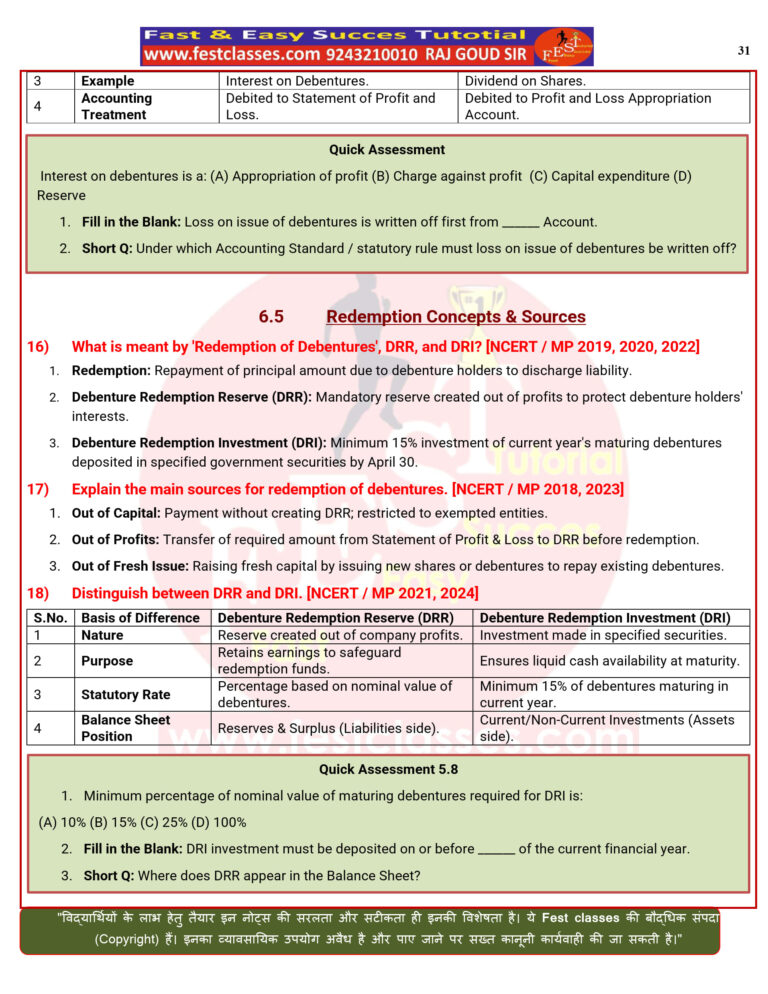
1.1
Introduction & Types of Debentures)
1)
Define a ‘Debenture’ and state its main
features. [NCERT]
Ans: The word ‘Debenture’ has been derived from a
Latin word ‘Debere’ which means to borrow. A written instrument issued under company seal
acknowledging debt, specifying principal repayment terms and fixed interest
rate.
Main Features:
1.
Certificate of debt issued by company.
2.
Carries fixed rate of interest payable periodically.
3.
Commitment to repay principal after specified period.
2) Under
which main head and sub-head are debentures shown in the Balance Sheet of a
company? [MP 2020, 2023]
Ans: Main Head: Non-Current Liabilities, Sub-head:
Long-term Borrowings
(If maturing within 12 months: Current Liabilities
-> Current Maturities of Long-Term Debt)
3) Distinguish
between Shares and Debentures. [NCERT / MP 2018, 2022]
|
S.No. |
Basis
of Difference |
Shares |
Debentures |
|
1 |
Status
of Holders |
Owners of
company. |
Creditors
of company. |
|
2 |
Return
/ Reward |
Variable
dividend. |
Fixed rate
of interest. |
|
3 |
Voting
Rights |
Full
voting rights in general meetings. |
No voting
rights. |
|
4 |
Priority
of Repayment |
Repaid
after all external liabilities are settled. |
Repaid
prior to shareholders. |
|
5 |
Charge
on Profits |
Appropriation
of profit (paid only on profit). |
Charge
against profit (mandatory payment). |
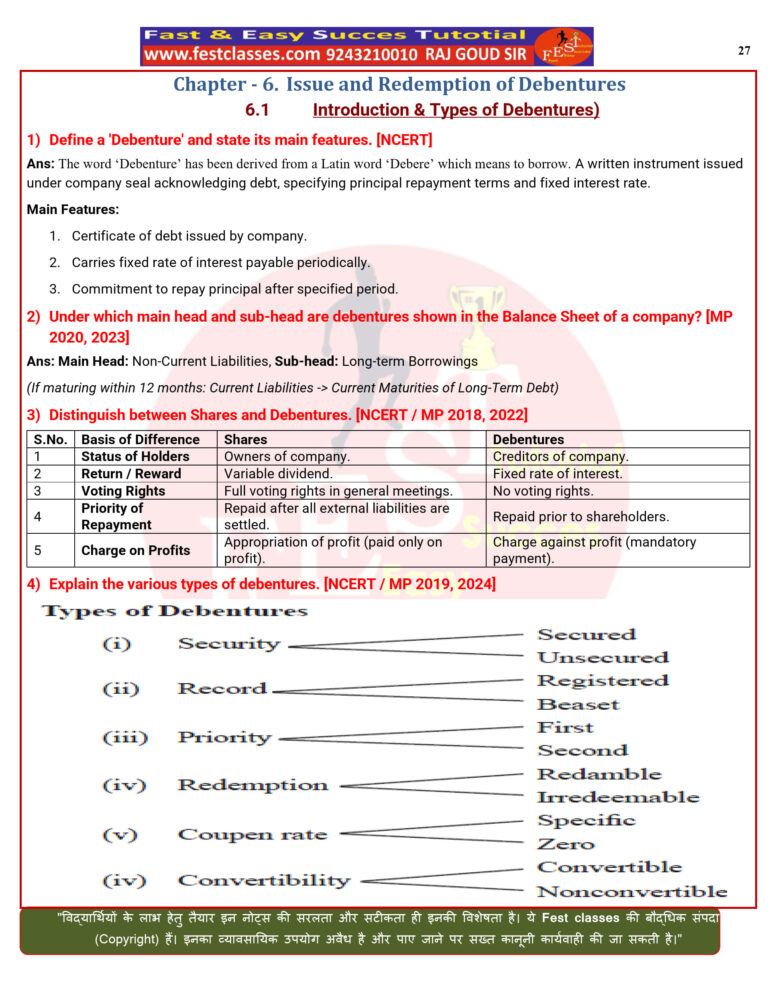
4) Explain
the various types of debentures. [NCERT / MP 2019, 2024]
(i) From
Security Point of View:
(a) Naked or Simple Debentures:
which do not carry any security in respect of repayment of interest or the
principal. The general solvency of the company is the only security for the
holders of simple debentures.
(b) Mortgaged/secured Debentures: which are secured by a charge on
the asset or properties of the company. The debenture holders have the right to
recover their principal amount as well as unpaid interest out of the assets
mortgaged by the company.
(ii) From
Permanence Point of View
(a) Redeemable Debentures Redeemable debentures provide for
the payment of principal amount on the expiry of certain period. Redeemable
debentures can be reissued even after they have been redeemed until they have
been cancelled.
(b) Irredeemable Debentures Irredeemable Debentures are
retained as a part of the permanent capital structure during the life time of
the company. Such debt becomes due for payment only when the company goes into
liquidation or when the payment of interest is not made regularly. The company
has the option of cancelling its liability to the debenture holders at any time
by giving due notice to them.
(iii) From Priority
Point of View :
(a) First
Debentures: First Debentures are those debentures which are paid first
before any payment is made to another type of debentures.
(b) Second Debentures: Second Debentures are those debentures which
are paid after making the payment of first debentures.
(iv) From Recording Point of
View :
(a) Bearer Debentures: Bearer
Debentures are transferable per bearer without endorsement and they are just
like bearer cheques or government currency notes. They are treated as
negotiable instrument and transferable by mere delivery..
(b) Registered Debentures: Registered debentures are made out in
the name of a particular person who is registered by the company as a holder
and are transferable in the same way as shares.
The payment of interest and repayment of capital is made to those whose name
are registered
(v) From Conversion
Point of View:
|
Quick assessment 1.
Debenture holders are the ______ of a company. (A) Owners (B)
Creditors (C) Customers (D) Directors 2.
Fill in the Blank: Debentures transferable
by mere delivery are called ______ debentures 3.
Short Q: Under which main head are debentures disclosed in
the Balance Sheet?
|
(b) Non-Convertible Debentures: Non-convertible debentures are not
convertible into equity or preference shares afterwards.
1.2
Issue of Debentures & Terms – Merged Version
5) What
is meant by Issue of Debentures at Premium and at Discount? [NCERT / MP 2019,
2022]
Ø
Issue at Premium: Issue price higher than nominal value; excess amount credited to
Securities Premium Account.
Ø
Issue at Discount: Issue price lower than nominal value; shortfall debited to Discount on
Issue of Debentures Account as capital loss.
6) Define
Over-subscription of debentures. [NCERT]
Ans: Applications received exceeding total debentures
offered to public.
7) Explain
the difference between ‘Issue of Debentures at Par’ and ‘Issue of Debentures at
Premium’. [NCERT / MP 2020, 2023]
|
S.No. |
Basis
of Difference |
Issue
at Par |
Issue
at Premium |
|
1 |
Meaning |
Issue
price equal to face value. |
Issue
price higher than face value. |
|
2 |
Issue
Price vs. Nominal Value |
Issue
Price = Nominal Value. |
Issue
Price > Nominal Value. |
|
3 |
Extra
Amount Received |
No extra
amount received. |
Extra
amount received represents capital gain. |
|
4 |
Accounting
Reserve |
No reserve
created. |
Premium
credited to Securities Premium Account. |
8) Explain
accounting conditions for issue relative to redemption terms. [NCERT / MP 2018,
2024]
1. Issued at Par, Redeemable at
Par: No
loss or gain; repayment equal to face value.
2. Issued at Discount,
Redeemable at Par: Discount treated as capital loss at issue.
3. Issued at Premium,
Redeemable at Par: Premium credited as Securities Premium.
4. Issued at Par, Redeemable at
Premium:
Redemption premium debited to Loss on Issue of Debentures Account and credited
to Premium on Redemption Account.
5.
|
Quick assessment 1.
Discount on issue of debentures is a: (A) Revenue loss (B) Capital
loss (C) Capital gain (D) Current liability 2.
Excess amount received over the nominal value on issue of debentures
is credited to ______ Account. 3.
What is meant by over-subscription of debentures?
|
1.3
Special Modes of Issue
9) What
is meant by issue of debentures for consideration other than cash and as
collateral security? [NCERT / MP 2019, 2021]
Ø Consideration Other Than
Cash:
Debentures issued to vendors against purchase of assets or business without
cash payout.
Ø
Collateral Security: Secondary security pledged with lender in addition to
primary security against loan.
10)
Explain the disclosure methods of debentures
issued as collateral security in Balance Sheet. [NCERT / MP 2018, 2023]
1. Method 1 (No Entry): Note appended under
Long-term Borrowings; no accounting entry passed.
2. Method 2 (With Entry): Entry passed by debiting
Debenture Suspense Account and crediting Debentures Account. Debenture Suspense
deducted from Debentures under Long-term Borrowings.
11)
|
Quick assessment
(A) Bank Account (B)
Debenture Account (C) Debenture Suspense Account (D) Loan Account 2.
Debentures issued to vendors against purchase of machinery are
issued for consideration other than ______.
|
|
S.No. |
Basis
of Difference |
Primary
Security |
Collateral
Security |
|
1 |
Meaning |
Main asset
pledged against loan. |
Subsidiary
security offered over primary security. |
|
2 |
Order
of Claim |
Realized
first by lender to recover debt. |
Realized
only if primary security fails to cover debt. |
|
3 |
Ownership |
Direct
asset mortgage. |
Issued as
debentures to creditor. |
|
4 |
Right
to Interest |
No
interest concept applicable. |
Interest
payable only upon enforcement after default. |
1.4
Interest & Writing Off Loss
12)
What is meant by ‘Interest on Debentures’ and
TDS? [NCERT / MP 2020, 2023]
1. Debenture Interest: Fixed periodic return paid
to debenture holders; mandatory charge against profit regardless of profit or
loss.
2. Tax Deducted at Source
(TDS):
Statutory deduction of income tax by company at prescribed rate before paying
net interest to debenture holders.
13)
Where is ‘Discount or Loss on Issue of
Debentures’ disclosed before writing off? [NCERT]
Answer:
1. After 12 months: Non-Current Assets
2. Within 12 months: Current Assets
14)
Explain rules for writing off Discount or Loss
on Issue of Debentures. [NCERT / MP 2018, 2022, 2024]
Answer:
1.
Timing: Written off in year of allotment/issue.
2.
Priority: First written off from Securities Premium Account; remaining balance
from Statement of Profit and Loss.
15)
Distinguish between Charge against Profit and
Appropriation of Profit. [NCERT / MP 2019, 2021]
|
S.No. |
Basis
of Difference |
Charge
Against Profit |
Appropriation
of Profit |
|
1 |
Obligation |
Mandatory
payment required by law. |
Voluntary
distribution based on profit availability. |
|
2 |
Effect
of Loss |
Payable
even if company suffers loss. |
Paid only
out of available net profits. |
|
3 |
Example |
Interest
on Debentures. |
Dividend
on Shares. |
|
4 |
Accounting
Treatment |
Debited to
Statement of Profit and Loss. |
Debited to
Profit and Loss Appropriation Account. |
|
Quick Assessment Interest on debentures is a: (A)
Appropriation of profit (B) Charge against profit (C) Capital expenditure (D) Reserve
|
1.5
Redemption Concepts & Sources
16)
What is meant by ‘Redemption of Debentures’,
DRR, and DRI? [NCERT / MP 2019, 2020, 2022]
1. Redemption: Repayment of principal
amount due to debenture holders to discharge liability.
2. Debenture Redemption Reserve
(DRR):
Mandatory reserve created out of profits to protect debenture holders’
interests.
3. Debenture Redemption
Investment (DRI): Minimum 15% investment of current year’s maturing debentures deposited
in specified government securities by April 30.
17)
Explain the main sources for redemption of
debentures. [NCERT / MP 2018, 2023]
1.
Out of Capital: Payment without creating DRR; restricted to exempted entities.
2.
Out of Profits: Transfer of required amount from Statement of Profit & Loss to DRR
before redemption.
3.
Out of Fresh Issue: Raising fresh capital by issuing new shares or
debentures to repay existing debentures.
18)
|
Quick Assessment 5.8
(A) 10% (B) 15% (C) 25% (D) 100%
|
|
S.No. |
Basis
of Difference |
Debenture
Redemption Reserve (DRR) |
Debenture
Redemption Investment (DRI) |
|
1 |
Nature |
Reserve
created out of company profits. |
Investment
made in specified securities. |
|
2 |
Purpose |
Retains
earnings to safeguard redemption funds. |
Ensures
liquid cash availability at maturity. |
|
3 |
Statutory
Rate |
Percentage
based on nominal value of debentures. |
Minimum
15% of debentures maturing in current year. |
|
4 |
Balance
Sheet Position |
Reserves
& Surplus (Liabilities side). |
Current/Non-Current
Investments (Assets side). |
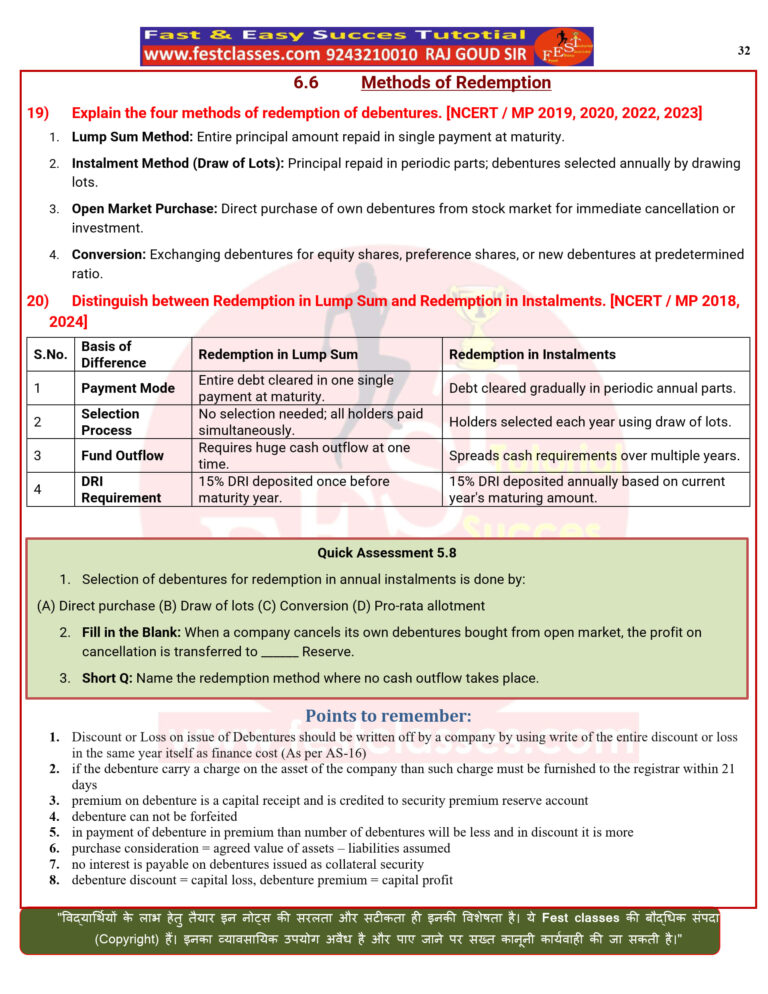
1.6
Methods of Redemption
19)
Explain the four methods of redemption of
debentures. [NCERT / MP 2019, 2020, 2022, 2023]
1. Lump Sum Method: Entire principal amount
repaid in single payment at maturity.
2. Instalment Method (Draw of
Lots):
Principal repaid in periodic parts; debentures selected annually by drawing
lots.
3. Open Market Purchase: Direct purchase of own
debentures from stock market for immediate cancellation or investment.
4. Conversion: Exchanging debentures for
equity shares, preference shares, or new debentures at predetermined ratio.
20)
Distinguish between Redemption in Lump Sum and
Redemption in Instalments. [NCERT / MP 2018, 2024]
|
S.No. |
Basis
of Difference |
Redemption
in Lump Sum |
Redemption
in Instalments |
|
1 |
Payment
Mode |
Entire
debt cleared in one single payment at maturity. |
Debt
cleared gradually in periodic annual parts. |
|
2 |
Selection
Process |
No
selection needed; all holders paid simultaneously. |
Holders
selected each year using draw of lots. |
|
3 |
Fund
Outflow |
Requires
huge cash outflow at one time. |
Spreads
cash requirements over multiple years. |
|
4 |
DRI
Requirement |
15% DRI
deposited once before maturity year. |
15% DRI
deposited annually based on current year’s maturing amount. |
|
Quick Assessment 5.8
(A) Direct purchase (B) Draw of lots (C)
Conversion (D) Pro-rata allotment
|
Points to remember:
1.
Discount
or Loss on issue of Debentures should be written off by a company by using
write of the entire discount or loss in the same year itself as finance cost
(As per AS-16)
2.
if the debenture carry a charge on the asset of the company
than such charge must be furnished to the registrar within 21 days
3.
premium on debenture is a capital receipt and is credited to
security premium reserve account
4.
debenture can not be forfeited
5.
in payment of debenture in premium than number of debentures
will be less and in discount it is more
6.
purchase consideration = agreed value of assets –
liabilities assumed
7.
no interest is payable on debentures issued as collateral
security
8.
debenture discount = capital loss, debenture premium =
capital profit