


THE RISE OF NATIONALISM IN EUROPE
The French Revolution and the Idea of the Nation
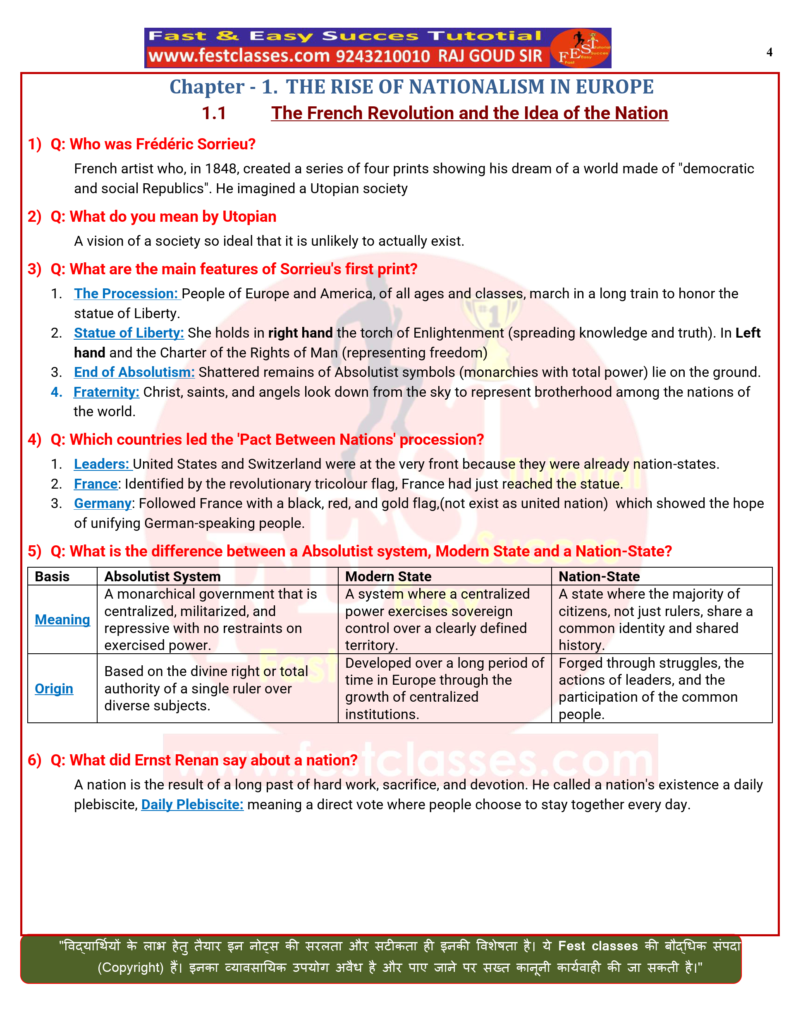
Q: Who was Frédéric Sorrieu?
French artist who, in 1848, created a series of four prints showing his dream of a world made of “democratic and social Republics”. He imagined a Utopian society
Q: What do you mean by Utopian
A vision of a society so ideal that it is unlikely to actually exist.
Q: What are the main features of Sorrieu’s first print?
The Procession: People of Europe and America, of all ages and classes, march in a long train to honor the statue of Liberty.
Statue of Liberty: She holds in right hand the torch of Enlightenment (spreading knowledge and truth). In Left hand and the Charter of the Rights of Man (representing freedom)
End of Absolutism: Shattered remains of Absolutist symbols (monarchies with total power) lie on the ground.
Fraternity: Christ, saints, and angels look down from the sky to represent brotherhood among the nations of the world.
Q: Which countries led the ‘Pact Between Nations’ procession?
Leaders: United States and Switzerland were at the very front because they were already nation-states.
France: Identified by the revolutionary tricolour flag, France had just reached the statue.
Germany: Followed France with a black, red, and gold flag,(not exist as united nation) which showed the hope of unifying German-speaking people.
Q: What is the difference between a Absolutist system, Modern State and a Nation-State?
Basis
Absolutist System
Modern State
Nation-State
Meaning
A monarchical government that is centralized, militarized, and repressive with no restraints on exercised power.
A system where a centralized power exercises sovereign control over a clearly defined territory.
A state where the majority of citizens, not just rulers, share a common identity and shared history.
Origin
Based on the divine right or total authority of a single ruler over diverse subjects.
Developed over a long period of time in Europe through the growth of centralized institutions.
Forged through struggles, the actions of leaders, and the participation of the common people.
Q: What did Ernst Renan say about a nation?
A nation is the result of a long past of hard work, sacrifice, and devotion. He called a nation’s existence a daily plebiscite, Daily Plebiscite: meaning a direct vote where people choose to stay together every day.
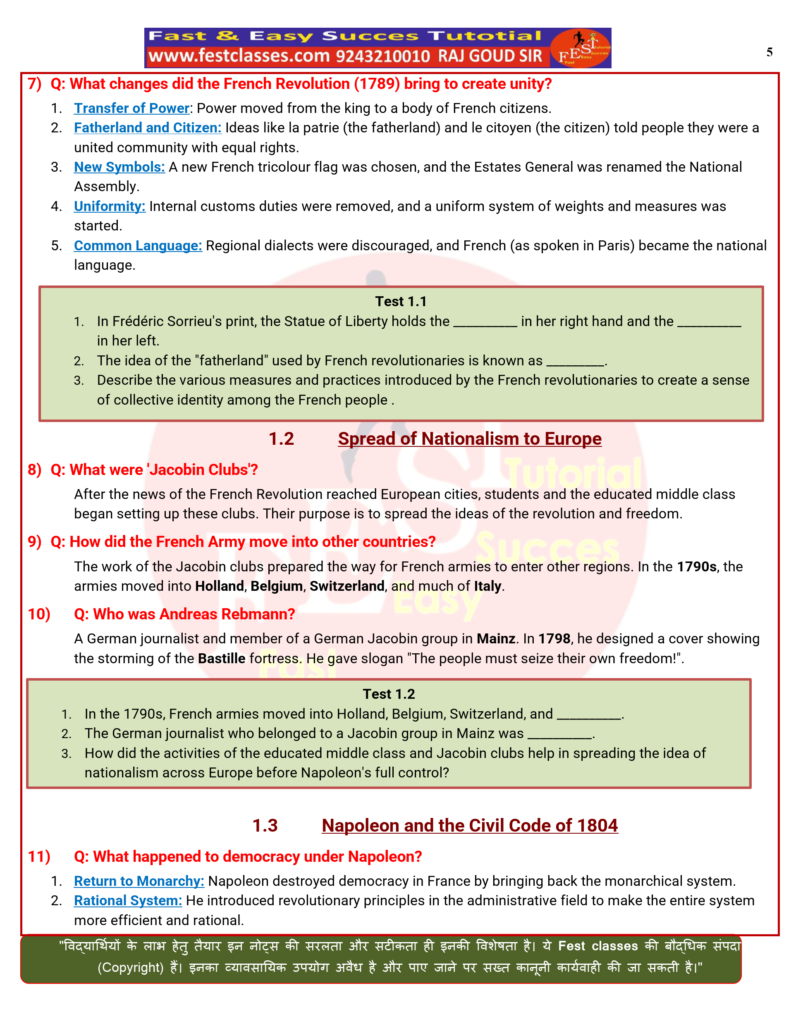
Q: What changes did the French Revolution (1789) bring to create unity?
Transfer of Power: Power moved from the king to a body of French citizens.
Fatherland and Citizen: Ideas like la patrie (the fatherland) and le citoyen (the citizen) told people they were a united community with equal rights.
New Symbols: A new French tricolour flag was chosen, and the Estates General was renamed the National Assembly.
Uniformity: Internal customs duties were removed, and a uniform system of weights and measures was started.
Test 1.1
In Frédéric Sorrieu’s print, the Statue of Liberty holds the __________ in her right hand and the __________ in her left.
The idea of the “fatherland” used by French revolutionaries is known as _________.
Describe the various measures and practices introduced by the French revolutionaries to create a sense of collective identity among the French people .
Common Language: Regional dialects were discouraged, and French (as spoken in Paris) became the national language.
Spread of Nationalism to Europe
Q: What were ‘Jacobin Clubs’?
After the news of the French Revolution reached European cities, students and the educated middle class began setting up these clubs. Their purpose is to spread the ideas of the revolution and freedom.
Q: How did the French Army move into other countries?
The work of the Jacobin clubs prepared the way for French armies to enter other regions. In the 1790s, the armies moved into Holland, Belgium, Switzerland, and much of Italy.
Q: Who was Andreas Rebmann?
Test 1.2
In the 1790s, French armies moved into Holland, Belgium, Switzerland, and __________.
The German journalist who belonged to a Jacobin group in Mainz was __________.
How did the activities of the educated middle class and Jacobin clubs help in spreading the idea of nationalism across Europe before Napoleon’s full control?
A German journalist and member of a German Jacobin group in Mainz. In 1798, he designed a cover showing the storming of the Bastille fortress. He gave slogan “The people must seize their own freedom!”.
Napoleon and the Civil Code of 1804
Q: What happened to democracy under Napoleon?
Return to Monarchy: Napoleon destroyed democracy in France by bringing back the monarchical system.
Rational System: He introduced revolutionary principles in the administrative field to make the entire system more efficient and rational.
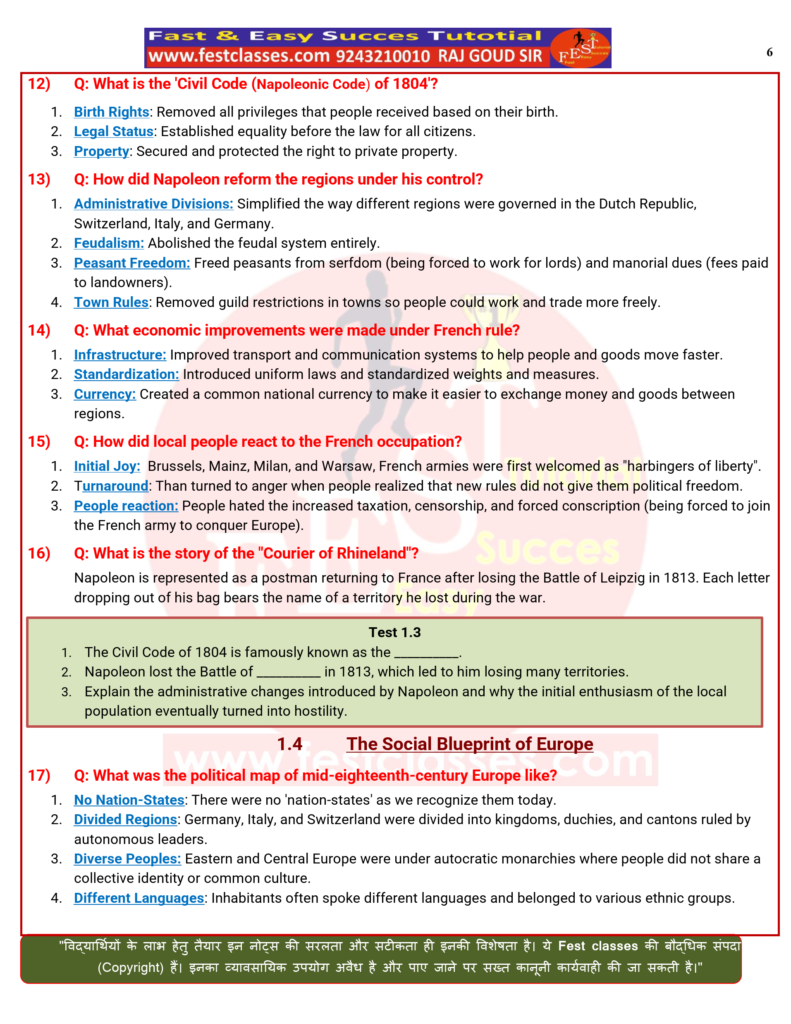
Q: What is the ‘Civil Code (Napoleonic Code) of 1804’?
Birth Rights: Removed all privileges that people received based on their birth.
Legal Status: Established equality before the law for all citizens.
Property: Secured and protected the right to private property.
Q: How did Napoleon reform the regions under his control?
Administrative Divisions: Simplified the way different regions were governed in the Dutch Republic, Switzerland, Italy, and Germany.
Feudalism: Abolished the feudal system entirely.
Peasant Freedom: Freed peasants from serfdom (being forced to work for lords) and manorial dues (fees paid to landowners).
Town Rules: Removed guild restrictions in towns so people could work and trade more freely.
Q: What economic improvements were made under French rule?
Infrastructure: Improved transport and communication systems to help people and goods move faster.
Standardization: Introduced uniform laws and standardized weights and measures.
Currency: Created a common national currency to make it easier to exchange money and goods between regions.
Q: How did local people react to the French occupation?
Initial Joy: Brussels, Mainz, Milan, and Warsaw, French armies were first welcomed as “harbingers of liberty”.
Turnaround: Than turned to anger when people realized that new rules did not give them political freedom.
People reaction: People hated the increased taxation, censorship, and forced conscription (being forced to join the French army to conquer Europe).
Q: What is the story of the “Courier of Rhineland”?
Test 1.3
The Civil Code of 1804 is famously known as the __________.
Napoleon lost the Battle of __________ in 1813, which led to him losing many territories.
Explain the administrative changes introduced by Napoleon and why the initial enthusiasm of the local population eventually turned into hostility.
Napoleon is represented as a postman returning to France after losing the Battle of Leipzig in 1813. Each letter dropping out of his bag bears the name of a territory he lost during the war.
The Social Blueprint of Europe
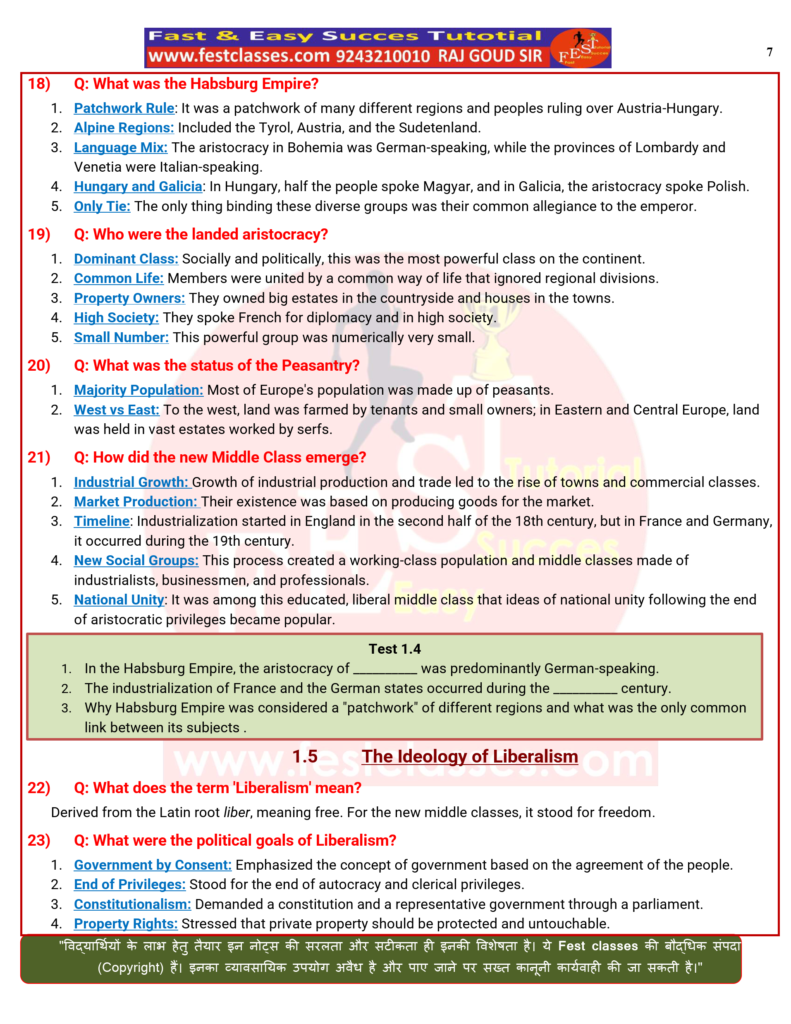
Q: What was the political map of mid-eighteenth-century Europe like?
No Nation-States: There were no ‘nation-states’ as we recognize them today.
Divided Regions: Germany, Italy, and Switzerland were divided into kingdoms, duchies, and cantons ruled by autonomous leaders.
Diverse Peoples: Eastern and Central Europe were under autocratic monarchies where people did not share a collective identity or common culture.
Different Languages: Inhabitants often spoke different languages and belonged to various ethnic groups.
Q: What was the Habsburg Empire?
Patchwork Rule: It was a patchwork of many different regions and peoples ruling over Austria-Hungary.
Alpine Regions: Included the Tyrol, Austria, and the Sudetenland.
Language Mix: The aristocracy in Bohemia was German-speaking, while the provinces of Lombardy and Venetia were Italian-speaking.
Hungary and Galicia: In Hungary, half the people spoke Magyar, and in Galicia, the aristocracy spoke Polish.
Only Tie: The only thing binding these diverse groups was their common allegiance to the emperor.
Q: Who were the landed aristocracy?
Dominant Class: Socially and politically, this was the most powerful class on the continent.
Common Life: Members were united by a common way of life that ignored regional divisions.
Property Owners: They owned big estates in the countryside and houses in the towns.
High Society: They spoke French for diplomacy and in high society.
Small Number: This powerful group was numerically very small.
Q: What was the status of the Peasantry?
Majority Population: Most of Europe’s population was made up of peasants.
West vs East: To the west, land was farmed by tenants and small owners; in Eastern and Central Europe, land was held in vast estates worked by serfs.
Q: How did the new Middle Class emerge?
Industrial Growth: Growth of industrial production and trade led to the rise of towns and commercial classes.
Market Production: Their existence was based on producing goods for the market.
Timeline: Industrialization started in England in the second half of the 18th century, but in France and Germany, it occurred during the 19th century.
New Social Groups: This process created a working-class population and middle classes made of industrialists, businessmen, and professionals.
Test 1.4
In the Habsburg Empire, the aristocracy of __________ was predominantly German-speaking.
The industrialization of France and the German states occurred during the __________ century.
Why Habsburg Empire was considered a “patchwork” of different regions and what was the only common link between its subjects .
National Unity: It was among this educated, liberal middle class that ideas of national unity following the end of aristocratic privileges became popular.
The Ideology of Liberalism
Q: What does the term ‘Liberalism’ mean?
Derived from the Latin root liber, meaning free. For the new middle classes, it stood for freedom.
Q: What were the political goals of Liberalism?
Government by Consent: Emphasized the concept of government based on the agreement of the people.
End of Privileges: Stood for the end of autocracy and clerical privileges.
Constitutionalism: Demanded a constitution and a representative government through a parliament.
Property Rights: Stressed that private property should be protected and untouchable.
Q: What was the status of ‘Suffrage’ (the right to vote)?
under the Jacobins did all adult males enjoy the right to vote. Napoleonic Code Went back to limited suffrage and reduced women to the status of a minor, subject to the authority of fathers and husbands.
Q: What did Liberalism mean in the Economic Sphere?
Demanded the abolition of state-imposed restrictions on the movement of goods and capital.
Q: What was the ‘Zollverein’?
Trade problem: In 1833, a merchant traveling from Hamburg to Nuremberg had to pass through 11 customs barriers and pay a 5% duty at each.
Measurement Problems: Every region had its own weights and measures; for example, the elle (cloth measure) varied from 53.5 cm to 65.6 cm depending on the city.
Test 1.5
The customs union formed in 1834 at the initiative of Prussia was called the __________.
Under the Napoleonic Code, women were reduced to the status of a __________, subject to the authority of fathers and husbands.
Explain the economic obstacles faced by merchants in German-speaking regions in the early 19th century and how the Zollverein helped overcome them.
Zollverein: In 1834, a customs union or Zollverein was formed at the initiative of Prussia. It abolished tariff barriers and reduced the number of currencies from over thirty to just two. The union aimed to bind the Germans economically into a nation and strengthen national sentiment.
The Conservative Reaction (1815)
Q: What was the spirit of ‘Conservatism’ after 1815?
Napoleon’s Defeat: After Napoleon in 1815, European governments were driven by a spirit of conservatism.
Conservatives believed: That established institutions of state and society—like the monarchy, the Church, and the family—should be preserved.
Modernization: Most realized that a return to the pre-revolutionary society was not possible;
Effective Power: A modern army and a dynamic economy were seen as tools to make state power
Q: What was the ‘Congress of Vienna’?
European powers: Britain, Russia, Prussia, and Austria—who defeated Napoleon met at Vienna in 1815. The Congress was hosted by the Austrian Chancellor Duke Metternich.The Treaty: They drew up the Treaty of Vienna of 1815 with the goal of undoing most changes from the Napoleonic wars.
Q: What were the key decisions of the Treaty of Vienna?
Bourbon Restoration: The Bourbon dynasty, deposed during the revolution, was restored to power in France.
France’s Borders: France lost the territories and states were set up boundaries to prevent future expansion.
Territorial Gains: The kingdom of the Netherlands (including Belgium) was set up in the north, and Genoa was added to Piedmont in the south.
Prussia and Austria: Prussia was on its western frontiers, while Austria was given control of northern Italy.
The German Confederation: The confederation of 39 states set up by Napoleon was left untouched.
Eastern Changes: Russia was given part of Poland, and Prussia was given a portion of Saxony.
Q: How did Conservative Regimes rule after 1815?
Autocratic Rule: Meaning they did not tolerate criticism or dissent.
Censorship: Imposed laws to control what was said in newspapers, books, plays, and songs.
Test 1.6
Who hosted the Congress of Vienna in 1815?
A) Giuseppe Mazzini B) Napoleon Bonaparte C) Duke Metternich D) Friedrich List
What was the main intention of the Treaty of Vienna of 1815?
A) To start new revolutions across Europe B) To restore monarchies and create a new conservative order
C) To give all European citizens the right to vote D) To abolish the German confederation of 39 states
Describe the territorial changes made to the map of Europe by the Treaty of Vienna and explain why these specific boundaries were created around France.
Repressing Liberty: They curb activities against autocratic governments or reflected ideas of freedom.
The Secret Revolutionaries
Q: Why did revolutionaries go underground after 1815?
Fear of Repression: During the years after 1815, the fear of being punished by conservative governments.
Spreading Ideas: Secret societies were formed in many European states to train revolutionaries.
Q: Who was Giuseppe Mazzini?
An Italian revolutionary born in Genoa in 1805. He became a member of the secret society of the Carbonari. He was sent into exile in 1831 at the age of 26 for attempting a revolution in Liguria.
Q: What societies did Mazzini found?
Young Italy: Founded first as an underground society in Marseilles.
Young Europe: Founded later in Berne.
Membership: These groups included like-minded young men from Poland, France, Italy, and the German states.
Q: What was Mazzini’s vision for Italy?
Natural Units: He believed that God intended nations to be the natural units of mankind.
Unified Republic: Italy could not remain a patchwork of small states and convert into a single unified republic.
Basis of Liberty: This unification was seen as the only basis for Italian liberty.
Q: How did conservatives react to Mazzini?
His vision of democratic republics and opposition to monarchy frightened the conservatives.
Test 1.7
In which city was Giuseppe Mazzini born in 1805?
A) Rome B) Genoa C) Marseilles D) Berne
Which secret society was founded by Giuseppe Mazzini in Berne?
A) The Carbonari B) Young Italy C) Young Europe D) Jacobin Club
Explain why Giuseppe Mazzini believed that the unification of Italy into a single republic was necessary for the liberty of its people
Duke Metternich described him as ‘the most dangerous enemy of our social order’.
The Age of Revolutions (1830–1848)
Q: What happened in France during the July Revolution of 1830?
The first upheaval took place in France in July 1830.The Bourbon kings, who had been restored to power in 1815, were overthrown by liberal revolutionaries.A constitutional monarchy was installed with Louis Philippe at its head.
The Ripple Effect: Metternich once remarked, “When France sneezes, the rest of Europe catches cold.”
Q: How did the July Revolution affect Belgium?
The July Revolution sparked an uprising in Brussels.This led to Belgium breaking away from the United Kingdom of the Netherlands.
Q: What was the Greek War of Independence?
Greece had been part of the Ottoman Empire since the 15th century.the struggle for Greece independence began in 1821.Nationalists in Greece got support from Greeks living in exile and from West Europeans who admired ancient Greek culture.
End Result: The Treaty of Constantinople of 1832 finally recognized Greece as an independent nation.
Q: What was the ‘Romantic Imagination’ in nationalism?
Not Just War: Nationalism did not only come about territorial expansion and war; culture played a vital role.
Art and Emotion: Romanticism was a cultural movement that sought to develop a particular form of nationalist sentiment through emotions, intuition, and mystical feelings.
Critique of Science: Romantic artists criticized the glorification of reason and science.
Common Heritage: They focused on a shared collective heritage and a common cultural past
Q: Who was Johann Gottfried Herder?
This German philosopher claimed that true German culture was to be discovered among the common people—the das volk. and: the true spirit of the nation (Volksgeist) was popularized through folk songs, folk poetry, and folk dances.
Q: How did language play a role in Polish nationalism?
After the partition of Poland by Russia, Prussia, and Austria, the Polish language was forced out of schools and replaced by Russian.
Many clergy in Poland began to use language as a weapon of national resistance.
Test 1.8
Which treaty recognized Greece as an independent nation in 1832?
A) Treaty of Vienna B) Treaty of Versailles C) Treaty of Constantinople D) Treaty of Paris
Who famously said, “When France sneezes, the rest of Europe catches cold”?
A) Giuseppe Mazzini B) Duke Metternich C) Louis Philippe D) Johann Gottfried Herder
Explain the role of ‘Romanticism’ and cultural movements in the growth of nationalism in Europe.
Using Polish for Church gatherings led to many priests being jailed or sent to Siberia by the Russian authorities.
Hunger, Hardship, and Popular Revolt
Q: Why were the 1830s called years of “great economic hardship” in Europe?
Population Explosion: There was an enormous increase in population all over Europe.
Unemployment: There were more seekers of jobs than there were jobs available.
Migration: People from rural areas migrated to cities, living in overcrowded slums.
Cheap Imports: Small producers in towns faced stiff competition from cheap, machine-made goods imported from England (especially in textile production).
Aristocratic Burden: Peasants struggled under the burden of feudal dues and obligations.
Food Prices: A bad harvest and rising food prices led to widespread pauperism (poverty) in towns and villages.
Q: What happened in Paris in 1848?
Food shortages and widespread unemployment brought the people of Paris out onto the streets.and the monarch, Louis Philippe, was forced to flee.
Proclamation of Republic: A National Assembly proclaimed a Republic and granted suffrage (the right to vote) to all adult males above 21. The government guaranteed the right to work and set up national workshops to provide employment.
Q: What was the Silesian Weavers’ Revolt of 1845?
Test 1.9
In 1848, the National Assembly of France granted the right to vote to all adult males above the age of: …….
…………… event took place in 1845 in response to contractors reducing payments to workers?
“The 1830s were years of great economic hardship in Europe.” Explain
Weavers in Silesia led a revolt against contractors who supplied them with raw materials but drastically reduced their payments. On June 4, a crowd of weavers marched to the houses of their contractors demanding higher wages. When treated with scorn and threats, they broke into houses, smashed windowpanes, and looted storehouses of cloth. The army was called in, and in the clash that followed, eleven weavers were shot.
1848: The Revolution of the Liberals
Q: What was the ‘Revolution of the Liberals’ in 1848?
The educated middle classes led a revolution for constitutionalism and national unification. They demanded the creation of a nation-state based on a constitution, freedom of the press, and freedom of association.
Q: What was the Frankfurt Parliament?
On May 18, 1848, 831 elected representatives marched to the Church of St. Paul to take their seats.They drafted a constitution for a German nation to be headed by a monarchy subject to a parliament.
Rejection: When the crown was offered to Friedrich Wilhelm IV, King of Prussia, he rejected it and joined other monarchs to oppose the elected assembly.
Failure: The parliament was dominated by the middle classes who ignored the demands of workers and artisans; as a result, it lost their support and was eventually forced to disband by the military.
Q: What was the role of women in these movements?
Active Participation: large numbers of women had participated actively in the liberal movement.
Their Actions: They formed their own political associations, founded newspapers, and took part in political meetings and demonstrations.
Denial of Rights: They were denied suffrage rights (the right to vote) during the election of the Assembly.
Only observer: Women admitted only as observers to stand in the visitors’ gallery in the Frankfurt Parliament
Q: What were the consequences of the 1848 Revolutions?
End of Old Ways: Monarchs realized that revolution could only be ended by granting concessions to the liberals.
End of Serfdom: In Central and Eastern Europe, serfdom and bonded labor were abolished both in the Habsburg dominions and in Russia.
Autonomy: The Habsburg rulers granted more autonomy to the Hungarians in 1867.
Test 1.10
The Frankfurt Parliament was convened in the Church of St. Paul on May 18, 1848. (True/False)
King Friedrich Wilhelm IV of Prussia enthusiastically accepted the crown offered by the Frankfurt Parliament. (True/False)
Women were given equal voting rights during the election of the National Assembly in 1848. (True/False)
After the 1848 revolutions, serfdom and bonded labor were abolished in the Habsburg dominions. (True/False)
Discuss the role of the middle class in the Frankfurt Parliament. Why did the assembly eventually fail to achieve its goals?
The Making of Germany and Italy
Q: Did nationalism stay linked to democracy after 1848?
After the failure of 1848, nationalism in Europe moved from its democratic, revolutionary roots. Conservative leaders began using national feelings to strengthen state power and achieve dominance over Europe.
Q: How was Germany unified?
Prussian Leadership: After the middle-class attempt to unite Germany failed in 1848, Prussia took the lead in the movement for national unification.
Otto von Bismarck: The Chief Minister of Prussia, known as the architect of this process. He carried it out with the help of the Prussian army and bureaucracy.
Three Wars: Over seven years, Prussia fought and won three wars against Denmark, Austria, and France.
The Empire: In January 1871, the Prussian King, William I, was proclaimed German Emperor in a ceremony at the Palace of Versailles.
Q: What was the political state of Italy before unification?
During the mid-nineteenth century, Italy was divided into seven states.The north was under Austrian Habsburgs, the centre was ruled by the Pope, and the southern regions were under the Bourbon kings of Spain. Sardinia-Piedmont This was the only state ruled by an Italian princely house.
Q: Who were the leaders of Italian unification?
Giuseppe Mazzini: During the 1830s, he sought to form a unified Italian Republic and formed the secret society Young Italy.
Count Cavour: The Chief Minister of Sardinia-Piedmont. He was a brilliant diplomat who led the movement to unite the regions of Italy.
Giuseppe Garibaldi: A famous freedom fighter who led the “Expedition of the Thousand.” His volunteer army of Red Shirts helped drive out the Spanish rulers in the south.
Q: How was the Kingdom of Italy finally formed?
Defeating Austria: In 1859, Sardinia-Piedmont defeated the Austrian forces with help from France.
Winning the South: In 1860, Garibaldi and his volunteers marched into South Italy and the Kingdom of the Two Sicilies to win the support of local peasants.
The King: In 1861, Victor Emmanuel II was proclaimed the king of a united Italy.
Test 1.11
Otto von Bismarck is considered the architect of German unification. (True/False)
In 1871, the German Empire was proclaimed at a ceremony held in Berlin. (True/False)
Sardinia-Piedmont was the only Italian state ruled by an Italian princely house before unification. (True/False)
Giuseppe Garibaldi led the “Red Shirts” to help unify southern Italy. (True/False)
Briefly describe the roles of Count Cavour and Giuseppe Garibaldi in the unification of Italy.
The Strange Case of Britain
Q: Why was the formation of the British nation-state called “strange”?
Unlike France or Germany, the nation-state was not the result of a sudden upheaval or revolution. It was a slow political process that took place over a long period.
Q: What were the primary identities in the British Isles before the 18th century?
The people who inhabited the British Isles were primarily identified by their ethnicity—English, Welsh, Scot, or Irish.As the English nation steadily grew in wealth, importance, and power, it began to extend its influence over the other nations of the islands.
Q: How did the English Parliament gain control?
Power Shift: The English Parliament seized power from the monarchy in 1688 at the end of a long conflict.This Parliament became the tool through which a nation-state, with England at its center, was built.
Q: What was the ‘Act of Union’ (1707)?
The Agreement: An act between England and Scotland that resulted in the formation of the ‘United Kingdom of Great Britain‘.
English Dominance: In practice, it meant that England was able to impose its influence on Scotland.
Suppression of Culture: The Catholic clans of the Scottish Highlands were forbidden to speak their Gaelic language or wear their national dress, and many were forcibly driven out of their homeland.
Q: How was Ireland incorporated?
Ireland was deeply divided between Catholics and Protestants. The English helped the Protestants of Ireland to establish their dominance over a largely Catholic country.After a failed revolt led by Wolfe Tone and his United Irishmen in 1798, Ireland was forcibly incorporated into the United Kingdom in 1801.
Q: What were the symbols of the ‘New Britain’?
The Flag: The British flag (Union Jack).
The Anthem: The national anthem (God Save Our Noble King).
The Language: The English language was actively promoted, while the older cultures of the subordinate nations survived only as bit-players in this union.
Test 1.12
The unification of Britain was the result of a sudden, violent revolution. (True/False)
The Act of Union (1707) was signed between England and Ireland. (True/False)
Wolfe Tone led a failed revolt against British dominance in 1798. (True/False)
Scotland’s Catholic clans were allowed to keep their Gaelic language after the Act of Union. (True/False)
Why is the model of the nation or the nation-state in Britain considered to be different from the rest of Europe?
Visualising the Nation
Q: How did artists represent a nation in the 18th and 19th centuries?
Personification: Artists started representing a nation as if it were a person.
Female Figure: Nations were usually portrayed as female figures. This female figure did not represent any real woman in particular; instead, it was an allegory—a way to give an abstract idea (like liberty or justice).
Q: Who was ‘Marianne’?
In France, the nation was personified as Marianne, a popular Christian name. She was symbols of Liberty and the Republic—the red cap, the tricolour, and the cockade.Statues of Marianne were erected in public squares to remind the people of the national symbol of unity. Her image was also marked on coins and stamps.
Q: Who was ‘Germania’?
Germania became the allegory of the German nation, In visual representations, she wears a crown of oak leaves, because the German oak stands for heroism. She is often shown carrying a sword, symbolizing a readiness to fight.
Q: What do the various symbols represent?
Broken Chains: Being freed.
Breastplate with Eagle: Symbol of the German empire and strength.
Olive branch around the sword: Willingness to make peace.
Black, red, and gold tricolour: Flag of the liberal-nationalists in 1848, banned by the Dukes of the German states.
Rays of the rising sun: Beginning of a new era.
Test 1.13
1. Answer in One Word
What is the term for an abstract idea (like greed, envy, or liberty) expressed through a person or a thing?
Which specific plant’s leaves are used in Germania’s crown to represent heroism?
2. Theory Question: Why did artists use female allegories to represent the nation? Mention the specific allegories used for France and Germany.
Nationalism and Imperialism
Q: How did nationalism change by the end of the 19th century?
Loss of Idealism: Nationalism no longer retained its idealistic, liberal-democratic sentiment. It became a narrow creed with limited ends.
Intolerance: Nationalist groups became increasingly intolerant of each other and were ever ready to go to war.
Imperialist Tool: Major European powers began to manipulate the nationalist aspirations of subject peoples to further their own imperialist aims.
Q: What was the ‘Balkan’ region?
A region of geographical and ethnic variation comprising modern-day Romania, Bulgaria, Albania, Greece, Macedonia, Croatia, Bosnia-Herzegovina, Slovenia, Serbia, and Montenegro.
The People: The inhabitants of this region were broadly known as the Slavs.
Ottoman Rule: A large part of the Balkans was under the control of the Ottoman Empire.
Q: Why did the Balkans become a “powder keg”?
Ottoman Decline: The spread of romantic nationalism and the weakening of the Ottoman Empire made this region very explosive.
Internal Conflict: As different Slavic nationalities struggled to define their identity and independence, they became fiercely jealous of each other. Each hoped to gain more territory at the expense of the others.
Big Power Rivalry: European powers (Russia, Germany, Austria-Hungary, and Britain) were keen on countering each other’s hold over the Balkans to extend their own control.
The Disaster: Rivalry led to a series of wars in the region and finally culminated in the First World War.
Q: How did the world react to European Imperialism?
Anti-Colonial Movements: Many countries in the world which had been colonized by European powers began to oppose imperial domination.
Test 1.14
Answer in One Word
What was the broad term used for the inhabitants of the Balkan region?
Which empire’s disintegration primarily contributed to the instability in the Balkans?
2. Q:: “The Balkan states were fiercely jealous of each other and each hoped to gain more territory at the expense of the others.” Explain how this internal conflict, combined with Big Power rivalry, led to the First World War.
Specific Nationalism: People everywhere developed their own specific variety of nationalism, but the idea that societies should be organized into ‘nation-states’ came to be accepted as natural and universal.