


Chapter – 1.
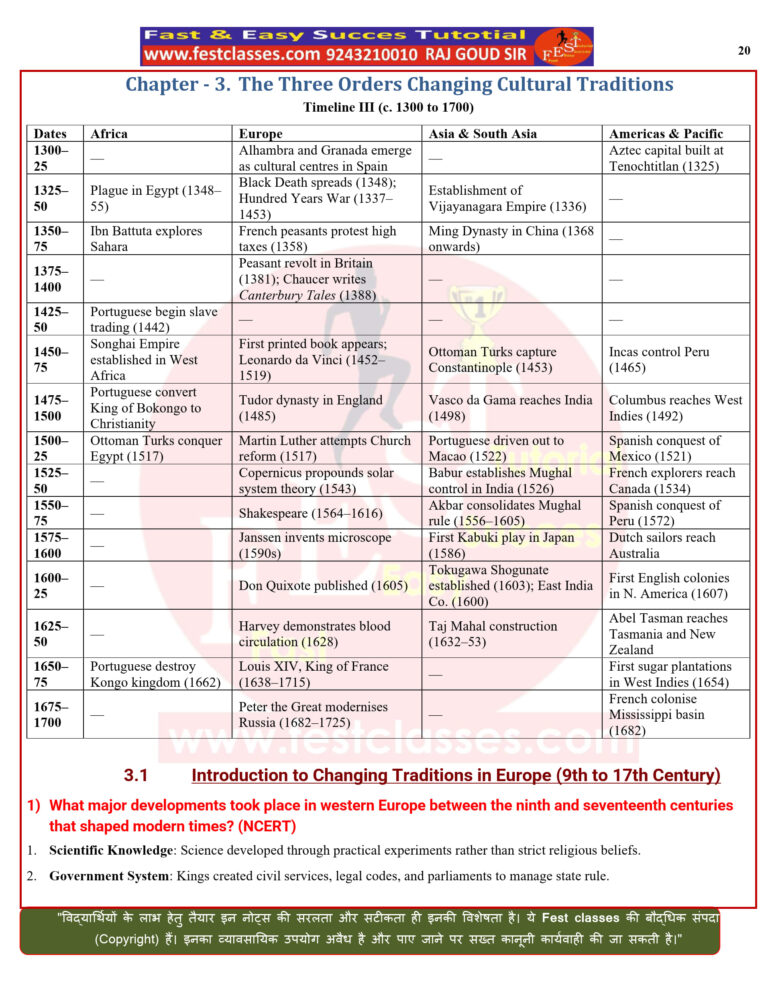
Timeline III (c.
1300 to 1700)
|
Dates |
Africa |
Europe |
Asia &
South Asia |
Americas
& Pacific |
|
1300–25 |
— |
Alhambra and
Granada emerge as cultural centres in Spain |
— |
Aztec capital
built at Tenochtitlan (1325) |
|
1325–50 |
Plague in
Egypt (1348–55) |
Black Death
spreads (1348); Hundred Years War (1337–1453) |
Establishment
of Vijayanagara Empire (1336) |
— |
|
1350–75 |
Ibn Battuta
explores Sahara |
French
peasants protest high taxes (1358) |
Ming Dynasty
in China (1368 onwards) |
— |
|
1375–1400 |
— |
Peasant
revolt in Britain (1381); Chaucer writes Canterbury Tales (1388) |
— |
— |
|
1425–50 |
Portuguese
begin slave trading (1442) |
— |
— |
— |
|
1450–75 |
Songhai
Empire established in West Africa |
First printed
book appears; Leonardo da Vinci (1452–1519) |
Ottoman Turks
capture Constantinople (1453) |
Incas control
Peru (1465) |
|
1475–1500 |
Portuguese
convert King of Bokongo to Christianity |
Tudor dynasty
in England (1485) |
Vasco da Gama
reaches India (1498) |
Columbus
reaches West Indies (1492) |
|
1500–25 |
Ottoman Turks
conquer Egypt (1517) |
Martin Luther
attempts Church reform (1517) |
Portuguese
driven out to Macao (1522) |
Spanish
conquest of Mexico (1521) |
|
1525–50 |
— |
Copernicus
propounds solar system theory (1543) |
Babur
establishes Mughal control in India (1526) |
French
explorers reach Canada (1534) |
|
1550–75 |
— |
Shakespeare
(1564–1616) |
Akbar
consolidates Mughal rule (1556–1605) |
Spanish
conquest of Peru (1572) |
|
1575–1600 |
— |
Janssen
invents microscope (1590s) |
First Kabuki
play in Japan (1586) |
Dutch sailors
reach Australia |
|
1600–25 |
— |
Don Quixote
published (1605) |
Tokugawa
Shogunate established (1603); East India Co. (1600) |
First English
colonies in N. America (1607) |
|
1625–50 |
— |
Harvey
demonstrates blood circulation (1628) |
Taj Mahal
construction (1632–53) |
Abel Tasman
reaches Tasmania and New Zealand |
|
1650–75 |
Portuguese
destroy Kongo kingdom (1662) |
Louis XIV,
King of France (1638–1715) |
— |
First sugar
plantations in West Indies (1654) |
|
1675–1700 |
— |
Peter the
Great modernises Russia (1682–1725) |
— |
French
colonise Mississippi basin (1682) |
1.1
Introduction to Changing
Traditions in Europe (9th to 17th Century)
1) What major developments took place in western Europe between the
ninth and seventeenth centuries that shaped modern times? (NCERT)
1.
Scientific Knowledge: Science developed
through practical experiments rather than strict religious beliefs.
2.
Government System: Kings created civil
services, legal codes, and parliaments to manage state rule.
3.
Technology: Better tools improved farm
output and factory work.
Example: Farmers started using iron-tipped plows instead of
wooden ones, which increased crop yields across European farms.
2) How did the collapse of the Roman Empire affect western Europe by
the ninth century?
1.
Tribal Rule: Local tribes took over Roman
areas and built small kingdoms using local custom rules.
2.
Rise of Feudalism: Kings and lords
controlled big estates (manors) worked by bound peasants (serfs).
3.
Role of Church: The Catholic Church owned
vast lands and guided public behavior for spiritual life.
Example: A peasant farmed a lord’s land in exchange for
physical protection against enemy tribal attacks.
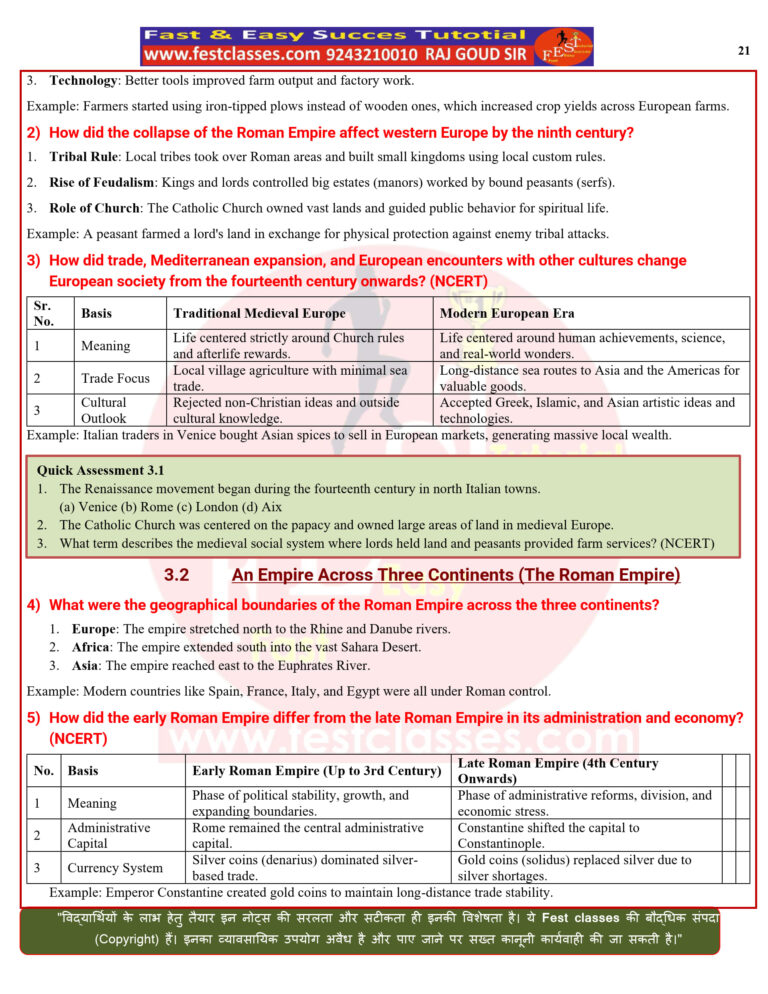
3) How did trade, Mediterranean expansion, and European encounters with
other cultures change European society from the fourteenth century onwards?
(NCERT)
|
Sr. No. |
Basis |
Traditional
Medieval Europe |
Modern
European Era |
|
1 |
Meaning |
Life centered
strictly around Church rules and afterlife rewards. |
Life centered
around human achievements, science, and real-world wonders. |
|
2 |
Trade Focus |
Local village
agriculture with minimal sea trade. |
Long-distance
sea routes to Asia and the Americas for valuable goods. |
|
3 |
Cultural
Outlook |
Rejected
non-Christian ideas and outside cultural knowledge. |
Accepted
Greek, Islamic, and Asian artistic ideas and technologies. |
|
Quick Assessment 3.1 1.
The Renaissance movement began during the
fourteenth century in north Italian towns. (a) Venice (b) Rome (c) London (d) Aix 2.
The Catholic Church was centered on the
papacy and owned large areas of land in medieval Europe. 3.
What term describes the medieval social
system where lords held land and peasants provided farm services? (NCERT) |
1.2
An Empire Across Three
Continents (The Roman Empire)
8)
What were the geographical
boundaries of the Roman Empire across the three continents?
1.
Europe: The empire stretched north to the
Rhine and Danube rivers.
2.
Africa: The empire extended south into
the vast Sahara Desert.
3.
Asia: The empire reached east to the
Euphrates River.
Example: Modern countries like Spain, France, Italy, and
Egypt were all under Roman control.
9) How did the early Roman Empire differ from the late Roman Empire in
its administration and economy? (NCERT)
|
No. |
Basis |
Early
Roman Empire (Up to 3rd Century) |
Late Roman
Empire (4th Century Onwards) |
|
|
|
1 |
Meaning |
Phase of
political stability, growth, and expanding boundaries. |
Phase of
administrative reforms, division, and economic stress. |
|
|
|
2 |
Administrative
Capital |
Rome remained
the central administrative capital. |
Constantine
shifted the capital to Constantinople. |
|
|
|
3 |
Currency
System |
Silver coins
(denarius) dominated silver-based trade. |
Gold coins
(solidus) replaced silver due to silver shortages. |
|
|
Example: Emperor Constantine
created gold coins to maintain long-distance trade stability.
16)
Describe the main social
classes, position of women, and gender relations in Roman society.
1.
Social Hierarchy: Senators and knights
formed the rich upper class, while slaves and manual workers formed the lower
class.
2.
Legal Rights of Women: Married women kept
property rights over their natal family property.
3.
Marital Control: Fathers kept legal power
over daughters, while husbands held financial control over household budgets.
|
Quick Assessment 3.2
|
1.3
The Three Orders
17)
What were the ‘Three Orders’ of
medieval European society, and what was the role of each order? (NCERT)
1.
First Order (Clergy): Catholic priests
and bishops who conducted church prayers and guided moral life.
2.
Second Order (Nobility): Kings and lords
who owned land, controlled armies, and maintained order.
3.
Third Order (Peasants): Cultivators and
workers who grew food and paid taxes to lords.
Example: A peasant worked on a
lord’s farmland for three days a week without wage payment.
18)
Explain the features of the
manorial estate and the life of serfs in medieval Europe.
1.
Manorial Estate: A large self-sufficient
landholding containing the lord’s castle, village, fields, and forests.
2.
Serf Status: Peasants legally bound to
the lord’s land who could not leave without permission.
3.
Labour Service: Serfs paid rent by
working on the lord’s private land (demesne).
Example: A serf needed the lord’s personal approval to marry
outside the estate.
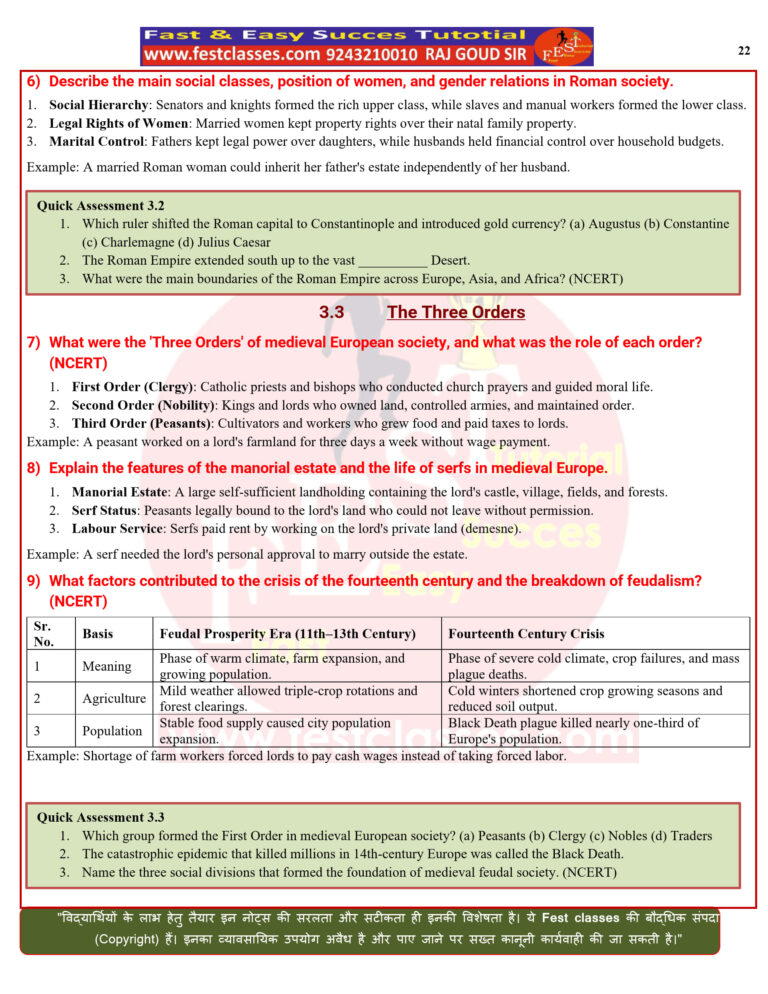
19)
What factors contributed to the
crisis of the fourteenth century and the breakdown of feudalism? (NCERT)
|
Sr. No. |
Basis |
Feudal
Prosperity Era (11th–13th Century) |
Fourteenth
Century Crisis |
|
1 |
Meaning |
Phase of warm
climate, farm expansion, and growing population. |
Phase of
severe cold climate, crop failures, and mass plague deaths. |
|
2 |
Agriculture |
Mild weather
allowed triple-crop rotations and forest clearings. |
Cold winters
shortened crop growing seasons and reduced soil output. |
|
3 |
Population |
Stable food
supply caused city population expansion. |
Black Death
plague killed nearly one-third of Europe’s population. |
Example: Shortage of farm workers forced lords to pay cash
wages instead of taking forced labor.
|
Quick Assessment 3.3
|
1.4
Displacing Indigenous Peoples
24)
How did European settlement in
North America and Australia lead to the displacement of native populations?
(NCERT)
1.
Land Seizure: European settlers forcibly
pushed native tribes off their ancestral lands for farming and mining.
2.
Forced Treaties: Settlers signed treaties
with native chiefs to take land, then broke the agreements when convenient.
3.
Disease Spread: European settlers brought
diseases like smallpox, which wiped out entire native populations.
Example: Native Americans were forced to move west onto dry,
poor land reserves called “Reservations.”
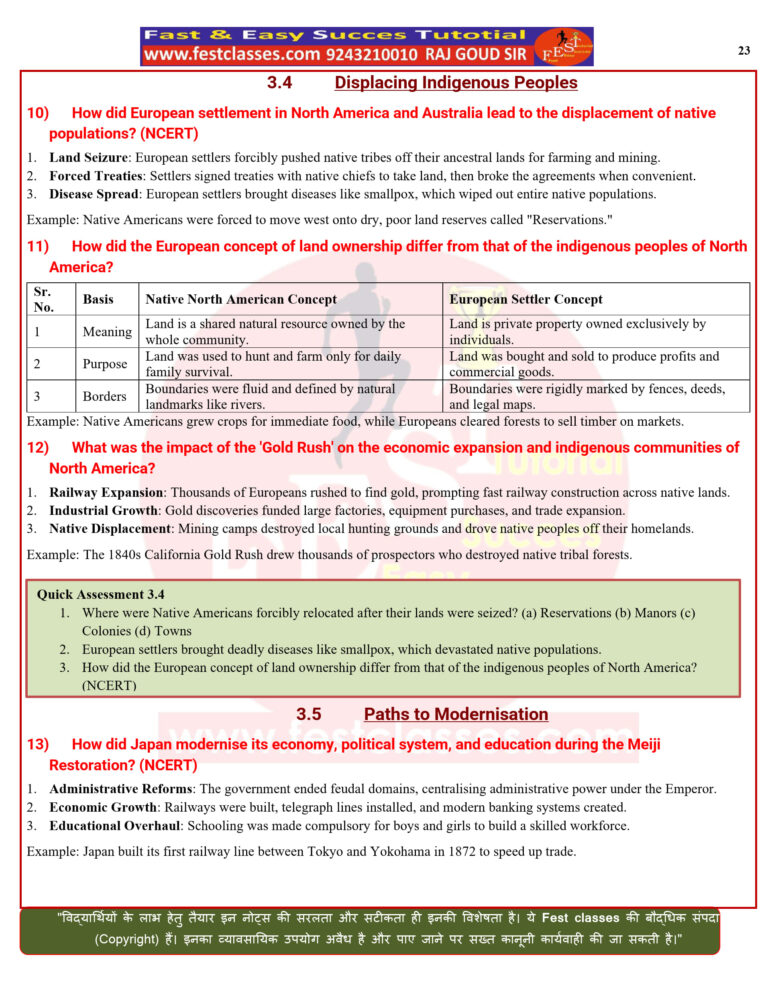
25)
How did the European concept of
land ownership differ from that of the indigenous peoples of North America?
|
Sr. No. |
Basis |
Native
North American Concept |
European
Settler Concept |
|
1 |
Meaning |
Land is a
shared natural resource owned by the whole community. |
Land is
private property owned exclusively by individuals. |
|
2 |
Purpose |
Land was used
to hunt and farm only for daily family survival. |
Land was
bought and sold to produce profits and commercial goods. |
|
3 |
Borders |
Boundaries
were fluid and defined by natural landmarks like rivers. |
Boundaries
were rigidly marked by fences, deeds, and legal maps. |
Example: Native Americans grew crops for immediate food,
while Europeans cleared forests to sell timber on markets.
30)
What was the impact of the
‘Gold Rush’ on the economic expansion and indigenous communities of North
America?
1.
Railway Expansion: Thousands of Europeans
rushed to find gold, prompting fast railway construction across native lands.
2.
Industrial Growth: Gold discoveries
funded large factories, equipment purchases, and trade expansion.
3.
Native Displacement: Mining camps
destroyed local hunting grounds and drove native peoples off their homelands.
|
Quick Assessment 3.4
|
1.5
Paths to Modernisation
31)
How did Japan modernise its
economy, political system, and education during the Meiji Restoration? (NCERT)
1.
Administrative Reforms: The government
ended feudal domains, centralising administrative power under the Emperor.
2.
Economic Growth: Railways were built,
telegraph lines installed, and modern banking systems created.
3.
Educational Overhaul: Schooling was made
compulsory for boys and girls to build a skilled workforce.
Example: Japan built its first railway line between Tokyo
and Yokohama in 1872 to speed up trade.
32)
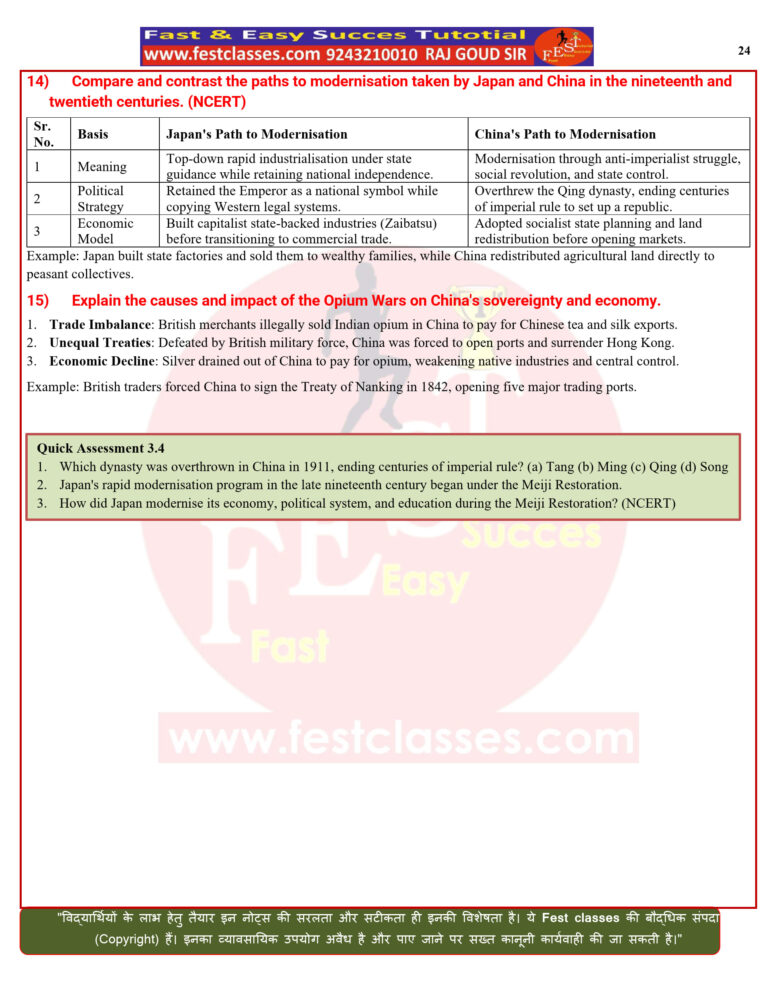
Compare and contrast the paths
to modernisation taken by Japan and China in the nineteenth and twentieth
centuries. (NCERT)
|
Sr. No. |
Basis |
Japan’s
Path to Modernisation |
China’s
Path to Modernisation |
|
1 |
Meaning |
Top-down
rapid industrialisation under state guidance while retaining national
independence. |
Modernisation
through anti-imperialist struggle, social revolution, and state control. |
|
2 |
Political
Strategy |
Retained the
Emperor as a national symbol while copying Western legal systems. |
Overthrew the
Qing dynasty, ending centuries of imperial rule to set up a republic. |
|
3 |
Economic
Model |
Built
capitalist state-backed industries (Zaibatsu) before transitioning to
commercial trade. |
Adopted
socialist state planning and land redistribution before opening markets. |
Example: Japan built state factories and sold them to
wealthy families, while China redistributed agricultural land directly to
peasant collectives.
37)
Explain the causes and impact
of the Opium Wars on China’s sovereignty and economy.
1.
Trade Imbalance: British merchants
illegally sold Indian opium in China to pay for Chinese tea and silk exports.
2.
Unequal Treaties: Defeated by British
military force, China was forced to open ports and surrender Hong Kong.
3.
Economic Decline: Silver drained out of
China to pay for opium, weakening native industries and central control.
Example: British traders forced China to sign the Treaty of
Nanking in 1842, opening five major trading ports.
|
Quick Assessment 3.4 1.
Which dynasty was overthrown in China in
1911, ending centuries of imperial rule? (a) Tang (b) Ming (c) Qing (d)
Song 2.
Japan’s rapid modernisation program in the
late nineteenth century began under the Meiji Restoration. 3.
How did Japan modernise its economy,
political system, and education during the Meiji Restoration? (NCERT) |